Bittensor’s Architecture at a Glance
Bittensor is an attempt to answer a difficult question: what if AI services did not have to come from a handful of centralized companies? Could independent developers, researchers, and infrastructure operators contribute machine-learning models, computing resources, data, or other digital services to a shared network—and receive rewards based on the usefulness of their work?
That is the idea behind Bittensor.
Rather than building one enormous AI model and asking everyone to use it, Bittensor organizes independent markets called subnets. Each subnet focuses on a particular kind of digital service. One might specialize in text generation, another in image generation, another in data collection, and another in machine-learning infrastructure. Participants compete to provide useful outputs, while validators assess their performance and submit evaluations to the blockchain.
The native cryptocurrency, TAO, coordinates incentives across the network. It is used for staking, delegation, subnet participation, and network-level economic activity. Bittensor also has its own blockchain, commonly referred to as Subtensor, so TAO is not simply an ERC-20 token deployed on Ethereum.
The project is associated with the Opentensor Foundation and its early contributors, including co-founders Jacob Steeves and Ala Shaabana. Its technical direction has evolved considerably since the network’s early days, especially after the introduction of Dynamic TAO (dTAO), which added subnet-specific tokens and market-based mechanisms for allocating emissions.
| Dimension | Bittensor specification |
|---|---|
| Project | Bittensor |
| Native asset | TAO |
| Blockchain | Subtensor, based on Substrate technology |
| Founding organization | Opentensor Foundation |
| Early co-founders | Jacob Steeves and Ala Shaabana |
| Main architecture | Specialized, competitive subnets |
| Main participant roles | Miners, validators, subnet owners, and delegators |
| Consensus for subnet rewards | Yuma Consensus |
| Subnet token model | Dynamic TAO (dTAO) and subnet-specific alpha tokens |
| Maximum TAO supply | 21 million |
| First halving | December 2025 |
| Current base emission | 0.5 TAO per block, approximately 3,600 TAO per day at a 12-second block interval |
| Primary use case | Incentivizing decentralized AI and other digital services |
A few details in this table deserve clarification. Bittensor’s maximum TAO supply is 21 million, but its subnet-specific alpha tokens have their own issuance and market mechanics. Also, the halving schedule is not simply a timer that cuts rewards after exactly 10.5 million blocks. The protocol calculates halving thresholds using total issuance. That distinction becomes important when you analyze the network’s monetary policy.
The official Bittensor emissions documentation is the best reference for the current issuance model. It records the first halving in December 2025, reducing the base emission from 1 TAO to 0.5 TAO per block.
How Bittensor Works?

The easiest way to understand Bittensor is to stop thinking of it as one AI platform. It is closer to a marketplace of specialized service networks, each with its own participants, performance criteria, and incentive structure.
Imagine you want an AI service that can generate high-quality text, retrieve information from the web, produce images, or provide access to distributed computing resources. In a traditional model, you would probably use a centralized provider. That company controls the infrastructure, decides which models are available, sets the prices, and determines how contributors are compensated.
Bittensor tries a different approach. It allows independent participants to compete to provide a particular service, while blockchain-based incentives reward those who deliver useful results according to the rules of the relevant subnet.
This is not the same as saying that Bittensor replaces every centralized AI company. Its real proposition is narrower and more interesting: it provides a common economic and technical framework in which independently operated services can compete.
Specialized AI Subnets: Dedicated Markets for Digital Intelligence
A subnet is an independent service market within the wider Bittensor network. Each subnet is designed around a particular task or digital commodity and has its own miners, validators, incentive mechanism, and subnet-specific token.
You can think of a subnet as a specialized competition. Instead of asking every participant to solve the same general problem, the subnet defines what useful work looks like and rewards participants who perform well against that definition.
Examples of possible subnet applications include:
- Text generation: Producing responses to prompts, completing writing tasks, or evaluating language-model performance.
- Image generation: Creating images based on user instructions and scoring them according to quality or relevance.
- Data collection: Gathering, organizing, or retrieving information from specified sources.
- Machine-learning infrastructure: Providing computing resources or model-serving capabilities.
- Prediction markets and forecasting: Generating predictions that can be evaluated against subsequent outcomes.
- Specialized digital services: Providing search, storage, analytics, or other services that can be measured through a subnet-specific incentive mechanism.
These examples describe categories of work, not a guarantee that every subnet in the directory currently offers a production-ready version of each service. Subnet availability, registration status, and actual functionality change over time. The Bittensor subnet directory and the official subnet documentation are useful starting points when checking what is active.
What makes the architecture interesting is that subnets can define different evaluation systems. A text-generation subnet might care about relevance, factual accuracy, and response quality. A data subnet might prioritize freshness, completeness, and successful retrieval. A computing subnet could measure availability, execution time, or resource delivery.
There is no reason to expect one universal scoring formula to work for all of these tasks. Bittensor’s subnet model allows each market to define its own approach to evaluating useful work, while the broader network provides shared blockchain infrastructure and economic incentives.
Why does this matter?
It gives developers room to experiment. A team does not need to build an entirely new blockchain just to launch a specialized AI marketplace. It can create a subnet, define the service it wants to reward, recruit miners and validators, and participate in the network’s emission system.
However, a subnet is not automatically successful just because it exists. It still needs customers or users, reliable infrastructure, useful output, capable validators, and an incentive model that does not reward meaningless activity. A subnet can attract speculative capital without building a service that people genuinely need.
That distinction is essential when evaluating Bittensor. The number of registered subnets tells you something about ecosystem activity, but it does not tell you how many are delivering valuable services.
Subnet Miners and Validators: Who Does What?
Bittensor’s incentive system depends on two primary participant roles: miners and validators. They have different responsibilities, and understanding the difference makes the entire network easier to follow.
Miners provide the service.
A miner operates a server, model, data pipeline, computing resource, or other service required by a subnet. When a request arrives, the miner attempts to produce an output that satisfies the subnet’s requirements.
For example, imagine a text-generation subnet. A client submits a prompt, and several miners may return responses. Each miner is effectively competing to produce an answer that the subnet’s evaluation system considers useful.
Miners are not necessarily running the same model. One may use a smaller, faster model; another may operate a larger model with more expensive hardware. Their performance depends on how well their outputs match the subnet’s scoring criteria.
Validators evaluate the service.
Validators assess miners’ outputs and determine which participants are providing better results. They may send test queries, compare responses, verify information, measure latency, or apply a task-specific scoring system.
After evaluating miners, validators submit weight assignments to the blockchain. These weights express their assessment of each miner’s relative utility.
The network then uses Yuma Consensus to process the validator assessments and calculate reward allocations.
The official validator guide explains that validation takes place within individual subnets. Each subnet defines its own incentive mechanism, and validators use that mechanism to evaluate miners before submitting weights to the blockchain.
| Participant | Main responsibility | What determines performance? |
|---|---|---|
| Miner | Provides the subnet’s service or digital output | Quality, relevance, reliability, speed, and task-specific utility |
| Validator | Tests and evaluates miners | Accuracy, consistency, independence, and agreement with reliable consensus |
| Subnet owner | Creates and manages the subnet’s incentive environment | Subnet design, participation, and ongoing development |
| Delegator | Stakes TAO or subnet assets with a validator, depending on the staking route | Validator performance, commission, network rewards, and token prices |
A useful analogy is a competition with independent contestants and judges. Miners are the contestants. Validators are the judges. Yuma Consensus is the mechanism that combines the judges’ assessments and determines how rewards should be distributed.
Of course, the analogy is not perfect. Validators are economic participants, not neutral observers. They have incentives of their own, which is precisely why Bittensor needs a mechanism to discourage dishonest scoring and reward manipulation.
How Bittensor Evaluates Useful Work?
Yuma Consensus is one of the most important parts of Bittensor’s design. It is the mechanism that turns validators’ evaluations into miner and validator reward allocations.
The problem it tries to solve is surprisingly difficult. In many decentralized networks, the quality of a service can be measured objectively. You can check whether a storage provider retained a file or whether a computing task completed successfully.
AI output is often more subjective. Two models can produce different answers to the same prompt, and deciding which answer is better may require judgment. A validator could also manipulate its rankings to favor a miner it controls or has a financial relationship with.
Bittensor needs a way to aggregate evaluations without assuming that every validator is honest.
How Yuma Consensus Processes Validator Scores
Each validator evaluates miners and submits a set of weights. A weight represents how much value the validator believes a particular miner provides to the subnet.
The network then combines these assessments using stake-weighted consensus rules.
In simplified terms, the process works like this:
- Validators evaluate miners according to the subnet’s incentive mechanism.
- They submit their rankings or weights to the blockchain.
- The consensus algorithm compares the submitted weights, taking validator stake into account.
- Excessive or unsupported rankings can be corrected through consensus-based clipping.
- The resulting miner incentive and validator reward calculations determine how the subnet’s emissions are distributed.
The crucial idea is that a validator should not be able to direct an excessive amount of rewards toward a miner simply by assigning that miner an unusually high score. Its assessment must have sufficient support from other validators’ stake-weighted evaluations.
The official Yuma Consensus documentation describes the algorithm as a subjective utility consensus mechanism. It explains how stake-weighted median scoring, consensus clipping, and validator bonds are used to reduce the benefits of selfish or manipulative weight assignments.
A simple example
Suppose a subnet has three miners: Miner A, Miner B, and Miner C. Several validators test their outputs and submit rankings.
| Miner | General validator assessment |
|---|---|
| Miner A | High-quality responses and reliable performance |
| Miner B | Good quality but inconsistent response times |
| Miner C | Low-quality responses and frequent errors |
If most of the validator stake agrees that Miner A provides the most useful service, its consensus weight should reflect that support. A single validator assigning Miner C an unusually high score should not be enough to redirect a large share of emissions toward it.
This is the basic intuition behind consensus clipping. The algorithm limits the influence of weights that exceed the level supported by sufficient validator stake.
Validator Bonds and Why Consistent Evaluation Matters
Yuma Consensus also uses a bonding mechanism to reward validators whose assessments consistently align with the eventual consensus.
A validator’s bond represents its accumulated relationship with particular miners based on its submitted weights and the network’s reward calculations. The system uses an exponential moving average, which means that the relationship develops over time rather than changing entirely in response to one evaluation.
This creates an incentive for validators to identify useful miners early and evaluate them accurately. A validator that consistently recognizes strong performance can benefit from its accumulated bonds as those miners receive emissions.
It also makes lazy evaluation less attractive. If a validator simply copies another validator’s rankings without independently evaluating miners, it risks failing to build the same useful, consistent relationships.
That does not mean the mechanism eliminates manipulation. Its security assumptions still matter, especially the distribution of stake and the behavior of validators. If a sufficiently large share of stake colludes, the quality of consensus can be compromised. Yuma Consensus is designed to make manipulation more difficult and economically costly, not to create an impossible-to-attack system.
The research behind the mechanism is available in the Bittensor consensus documentation and technical materials. If you are evaluating a subnet, it is worth understanding its validator incentives rather than assuming that the word decentralized automatically means every evaluation is independent.
Is Yuma Consensus Really Proof of Intelligence?
The term Proof of Intelligence is often used to describe Bittensor’s incentive model. It captures the project’s ambition: reward useful intelligence and digital services rather than relying solely on traditional mining computations.
However, it is important not to confuse Proof of Intelligence with a universal scientific test of intelligence.
Bittensor does not have one global benchmark that objectively measures how intelligent every model is. Different subnets evaluate different types of work, and their scoring systems can be very different.
A miner could perform extremely well on a data-retrieval subnet but have no particular advantage on a language-generation subnet. The network rewards performance within the relevant market, not an abstract score representing general intelligence.
For that reason, I find it more accurate to describe Bittensor as a decentralized incentive network for useful digital services, with AI as a major focus. Its value depends on whether subnet-specific evaluation systems can identify and reward work that users actually want.
Dynamic TAO (dTAO): Market-Based Subnet Incentives
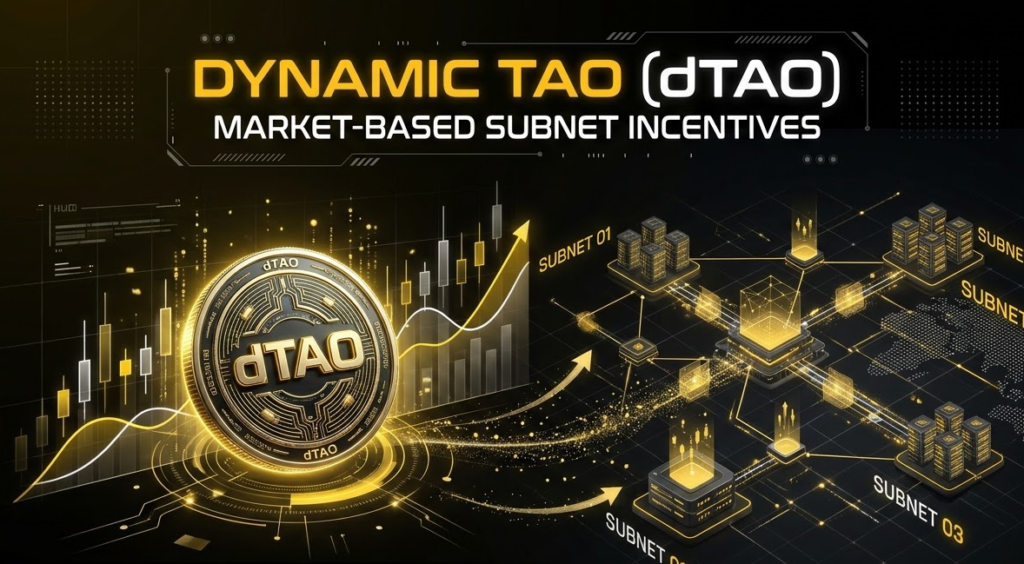
Dynamic TAO introduced a major change to Bittensor’s economic structure. Before dTAO, subnet emission allocation relied more directly on the network’s previous incentive arrangements. The dTAO upgrade introduced subnet-specific alpha tokens and automated market-maker pools that connect subnet participation with TAO.
This is important because it gives each subnet a market price rather than treating every subnet as an identical destination for network emissions.
What Are Alpha Tokens?
Each subnet has its own token, commonly called its alpha token. These tokens are not interchangeable with one another.
For example, alpha associated with one subnet is a different asset from alpha associated with another. Each has its own market, liquidity pool, supply, and price relative to TAO.
When a participant stakes TAO into a subnet’s pool, the transaction exchanges TAO for that subnet’s alpha token at the applicable pool price. When the participant unstake-exits, the process reverses, subject to fees, slippage, and available liquidity.
This gives subnet participants exposure to the market valuation of the specific service network they support.
The official Bittensor network documentation explains that TAO is the native network token, while each subnet has its own alpha asset traded against TAO through a subnet pool.
How dTAO Routes Emissions
The basic dTAO idea is that subnet markets help determine how network emissions are allocated. A subnet attracting greater market valuation can receive a larger share of TAO emissions, while a subnet losing market support may receive less.
The current emissions documentation describes a price-based model using an exponentially weighted moving average of subnet token prices. This means the allocation is not simply a snapshot of one trade or one moment of market activity.
The process can be understood in two stages:
Stage one: TAO enters subnet pools.
At the block level, the network allocates TAO emissions across eligible subnet pools according to the emission-share mechanism. Alpha is also injected into the pool to support the market structure.
Stage two: Subnet participants receive alpha emissions.
At the subnet’s epoch, accumulated alpha emissions are distributed among the subnet owner, miners, validators, and stakers according to the network’s allocation rules and Yuma Consensus.
The current emissions guide describes the distribution as an 18% allocation to the subnet owner, 41% to miners, and 41% to validators and their stakers. These are protocol-level distribution proportions described in the guide; the actual value received by an individual participant depends on performance, stake, validator take, and the subnet’s economics.
There is an important historical detail here. Bittensor’s subnet emission-share model changed during 2025 and 2026. The documentation describes a flow-based model used from November 2025 to June 2026, which relied on net TAO flows. That model has since been deprecated in favor of the current price-based approach. This is why older dTAO explanations may describe a different allocation formula.
Does dTAO Make the Best Subnets Automatically Win?
Not automatically. Market price is a signal of demand and expectations, but it is not a perfect measurement of real-world utility.
A subnet’s alpha price may rise because investors expect it to become important, because more TAO is entering its pool, or because speculative interest is increasing. That does not prove that its service is better than competitors’ services.
The model introduces market feedback, but market feedback can be noisy. A subnet with strong marketing and speculative momentum may attract capital before it demonstrates lasting usefulness. Another subnet may provide a valuable service but struggle to attract attention or liquidity.
When researching a subnet, I would examine several things together:
- Service quality: Does the subnet produce something that users actually need?
- Miner performance: Are miners consistently delivering useful outputs?
- Validator quality: Are evaluations credible and independently performed?
- Market depth: Is there enough liquidity to enter or exit a position without excessive slippage?
- Emission share: How much of the network’s available emissions does the subnet attract?
- Developer activity: Is the project being maintained and improved?
- User demand: Are there real customers or applications using the service?
dTAO is an economic coordination mechanism, not a guarantee that capital will always identify the most useful technology.
TAO Tokenomics
TAO is Bittensor’s native cryptocurrency and the main asset connecting its blockchain economy. Its monetary policy is deliberately reminiscent of Bitcoin: a maximum supply of 21 million tokens and an issuance schedule that decreases over time through halvings.
The comparison is useful, but TAO is not Bitcoin. Bitcoin primarily secures a peer-to-peer monetary network through Proof of Work. TAO participates in a network designed to incentivize decentralized digital services, including AI-related work.
The Bitcoin-Inspired Monetary Policy
Bittensor’s protocol defines a maximum TAO supply of 21 million. New tokens are issued through block emissions, and the amount issued per block decreases as the network passes its halving thresholds.
This creates a predictable long-term issuance framework. It also means that the network cannot simply increase TAO supply without changing the underlying protocol rules.
The project is often described as having a fair-launch background, without a conventional venture-capital token allocation or large premine reserved for investors. That history is part of the reason TAO is compared with Bitcoin. However, a fair-launch narrative should not be confused with a guarantee of equal ownership or equal influence. Early participants may accumulate substantial holdings, and stake concentration remains an important factor in a proof-of-stake network.
TAO’s supply policy is also distinct from the alpha token supply model. Each subnet’s alpha asset has its own issuance schedule and market dynamics. The existence of a 21 million TAO cap does not mean every subnet token has the same economic behavior as TAO.
The First Halving and Current Daily Emissions
Bittensor’s first halving occurred in December 2025. The base emission fell from 1 TAO per block to 0.5 TAO per block.
With an average block interval of approximately 12 seconds, the network produces around 7,200 blocks per day. At 0.5 TAO per block, that works out to approximately:
7,200 × 0.5 = 3,600 TAO per day
This is a useful estimate of base issuance before accounting for the protocol’s recycling and burning mechanisms.
The official emissions page confirms the first halving and the current base emission rate. It also explains that registration burns and transaction fees affect issuance accounting.
One detail is particularly important: Bittensor halvings are based on issuance thresholds, not a simple fixed count of 10.5 million blocks.
The first reduction happened when total issuance crossed 10.5 million TAO. The next threshold is 15.75 million TAO, followed by further thresholds that move progressively closer to the 21 million ceiling.
Because recycled TAO can be re-emitted, the timing of future halvings is not necessarily a fixed four-year countdown. Recycling can affect the issuance measure used by the protocol, which means the actual schedule depends on network activity and token accounting.
This is a more accurate description than saying TAO automatically halves every 10.5 million blocks.
Why Does TAO Halving Matter?
Halving reduces the rate at which new TAO enters the economy. If demand for TAO remains stable or increases while new issuance falls, the reduced supply flow may support a more favorable supply-demand balance.
But there is no automatic price increase built into a halving event.
The market price still depends on demand, liquidity, broader crypto conditions, and the perceived usefulness of the network. If demand weakens, a lower issuance rate does not prevent the price from falling.
There is another layer to consider: TAO emissions are connected to subnet incentives. A lower base emission means less new TAO is available to inject into subnet markets, which can affect the amount of alpha issued and the rewards available to miners, validators, and stakers.
In other words, halving is not just a scarcity event for investors. It also changes the economic resources available to the network’s service providers.
TAO vs Subnet Alpha
It is easy to confuse TAO and alpha tokens because both are part of the same economic system. But they play different roles.
| Feature | TAO | Subnet alpha |
|---|---|---|
| Network role | Native asset of Bittensor | Token specific to an individual subnet |
| Supply policy | Maximum 21 million | Each subnet alpha has its own issuance cap and schedule |
| Market | Network-wide asset | Separate TAO/alpha pool for each subnet |
| Main economic function | Staking, network participation, and subnet allocation | Subnet-specific staking, rewards, and market exposure |
| Price drivers | Overall Bittensor demand and network economics | Individual subnet demand, liquidity, and performance expectations |
| Interchangeability | Native network asset | One subnet’s alpha is not equivalent to another subnet’s alpha |
When you stake TAO into a subnet, you are not simply depositing TAO into a bank account. You are interacting with a market pool and receiving exposure to the subnet’s alpha token. The value of that position can change because of the alpha price, pool liquidity, and the amount of TAO you can recover when unstaking.
That introduces market risk on top of the usual validator and protocol risks.
Common Misconceptions About Bittensor (TAO)
Bittensor combines blockchain infrastructure, AI services, staking, market mechanisms, and decentralized governance. It is understandable that newcomers sometimes mix these concepts together. A few misconceptions are particularly worth correcting.
Misconception: Bittensor Trains AI Models Directly on the Blockchain
Bittensor does not run large neural-network training workloads directly inside blockchain blocks.
Training and inference require substantial computing resources. Running those workloads directly on a blockchain would be inefficient and prohibitively expensive.
Instead, miners perform the heavy computational work off-chain. They operate models, servers, data pipelines, or other services and return results to users or validators.
The blockchain handles the economic and coordination layer: registering participants, recording stake, receiving validator weights, calculating consensus, and distributing rewards.
This distinction is central to understanding the protocol. Bittensor is not a giant on-chain AI computer. It is a blockchain-coordinated marketplace in which the actual services generally run on external infrastructure.
Misconception: TAO Is an ERC-20 Token
TAO is not originally an Ethereum ERC-20 token. It is the native cryptocurrency of Bittensor’s own Subtensor blockchain, which is built using Substrate technology.
That means you should not assume that an ordinary Ethereum wallet address or ERC-20 token contract is the correct way to handle native TAO. Wallets and exchanges must support the Bittensor network or the relevant supported representation.
If you see a wrapped or bridged TAO asset on another blockchain, remember that it is not necessarily identical in operational terms to native TAO. You need to understand the bridge, custodian, or contract arrangement that backs the external representation.
For native network information, use the official Bittensor documentation and verify the destination network before making a transfer.
Misconception: Every Subnet Receives the Same TAO Rewards
Subnets do not receive identical allocations simply because they are registered on Bittensor.
The dTAO system uses market-based allocation mechanisms to distribute TAO emissions across eligible subnet pools. The current price-based model means that subnet price signals influence the share of emissions each subnet receives.
After that, Yuma Consensus helps determine how a subnet’s emissions are distributed among its participants.
A subnet with weak market support may receive a smaller share than one attracting more capital. Within each subnet, miners and validators also receive different allocations based on their performance and the relevant reward rules.
This means that being part of Bittensor does not guarantee a fixed amount of TAO income.
Misconception: Staking TAO Guarantees a Fixed Return
Delegating TAO to a validator is not equivalent to placing money in a fixed-interest savings account. Rewards depend on network emissions, validator performance, commission, stake conditions, and the broader economic design.
If you stake through a subnet’s dTAO pool, you also take exposure to the price of that subnet’s alpha token. You may receive more or less TAO when you unstake than you originally committed, depending on the market price and pool conditions.
The reward rate displayed by a dashboard should therefore be treated as a variable estimate, not a guaranteed annual percentage yield.
Misconception: Every AI Subnet Provides a Useful Commercial Product
A subnet can be technically active without having meaningful external demand. Some may be experimental, some may be focused on infrastructure, and others may be developing services that have not yet found a sustainable customer base.
It is important to distinguish between:
- A registered subnet.
- A subnet with active miners and validators.
- A subnet producing measurable service output.
- A subnet with genuine external users.
- A subnet generating sustainable economic demand.
These are different stages of development. A high token price or emission allocation does not prove that a subnet has reached the final stage.
Bittensor System Architecture
The following map summarizes the relationship between Bittensor’s blockchain, subnet participants, consensus system, and native token.
                         OPENTENSOR FOUNDATION
                         Early contributors:
                    Jacob Steeves & Ala Shaabana
                                  |
                                  v
                         BITTENSOR NETWORK
                                  |
             +--------------------+--------------------+
             |                    |                    |
             v                    v                    v
          SUBTENSOR            SUBNETS              TAO TOKEN
        Blockchain layer   Specialized markets    Native asset
             |                    |                    |
             |          +---------+---------+          |
             |          |                   |          |
             |          v                   v          |
             |        MINERS             VALIDATORS    |
             |      Provide work       Evaluate work   |
             |          |                   |          |
             |          +---------+---------+          |
             |                    |                    |
             |                    v                    |
             |             YUMA CONSENSUS               |
             |          Stake-weighted scoring          |
             |                    |                    |
             |                    v                    |
             |             EMISSION REWARDS             |
             |                    |                    |
             +--------------------+--------------------+
                                  |
                                  v
                           DYNAMIC TAO
                         TAO / ALPHA POOLS
                                  |
                                  v
                       SUBNET-SPECIFIC ECONOMY
The architecture has three connected layers:
- Service layer: Subnets, miners, and validators create and evaluate digital services.
- Consensus and incentive layer: Yuma Consensus processes validator weights and determines participant reward shares.
- Economic layer: TAO emissions and subnet alpha markets connect network participation with market incentives.
The important point is that none of these components works in isolation. A subnet needs useful miners, credible validators, and an incentive structure that attracts participation. dTAO provides a market mechanism for subnet-level capital allocation, while TAO supplies the shared native asset.
How to Stake TAO and Delegate to a Validator
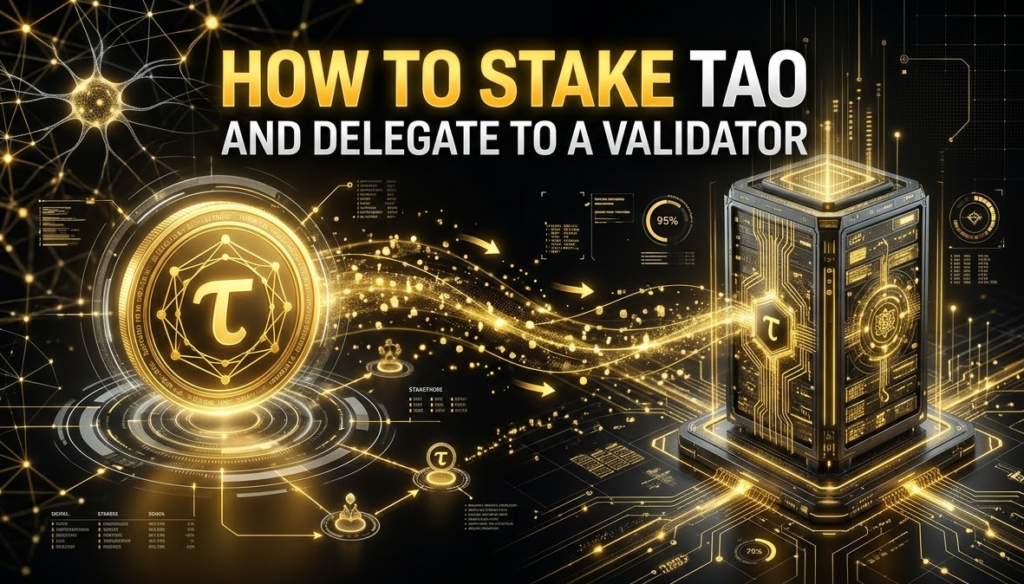
If you want to participate in Bittensor without running your own miner or validator infrastructure, delegating stake is one possible route.
The process is relatively straightforward, but there are several decisions you should make before committing funds. In particular, you need to distinguish between staking native TAO with a validator and staking through a subnet’s dTAO pool. They are not identical transactions and do not carry exactly the same risks.
Phase One: Acquire Native TAO
Choose a compatible wallet.
Start with a wallet that explicitly supports the Bittensor network. The official Bittensor wallet documentation is a good starting point for checking supported wallet options and setup instructions.
Create a wallet and store the recovery phrase securely. Never share your recovery phrase with anyone claiming to be a validator, support agent, or staking service.
Acquire native TAO.
You can obtain TAO through a cryptocurrency exchange that supports native Bittensor withdrawals or through another legitimate transfer route.
Before withdrawing, verify that the exchange supports native TAO rather than only a wrapped asset on another blockchain. Check the network shown on the withdrawal page and compare it with the receiving wallet.
For a first transfer, I recommend testing with a small amount. It is much easier to identify a network or address mistake before moving a larger balance.
Verify the incoming transaction.
After the transfer, check your wallet balance and confirm the transaction using a Bittensor-compatible explorer. TaoStats provides network information and staking-related data through its explorer and analytics platform.
Phase Two: Select a Validator
Understand what delegation does.
When you delegate stake to a validator, you assign your stake to support that validator’s participation in the network. You retain ownership of your tokens, but the stake is associated with the validator for reward and network accounting purposes.
A validator’s performance matters because your rewards may depend on the emissions it earns and the commission it charges.
Compare validators carefully.
Do not choose a validator only because it advertises the highest return. Look at a combination of factors:
| Evaluation factor | Why it matters |
|---|---|
| Uptime | Frequent downtime can affect validator performance |
| Take or commission | A validator’s commission reduces the rewards passed to delegators |
| Stake distribution | Very large validators may have different influence and reward characteristics |
| Performance history | Historical performance can help identify consistency, but does not guarantee future results |
| Operational transparency | Clear information about infrastructure and validator management is useful |
| Community reputation | Independent feedback can help identify operational or communication problems |
You can use TaoStats to inspect validator and staking information. Always verify the current values in the interface because validator performance, commission, and network conditions can change.
Phase Three: Delegate Your TAO
Open the staking interface.
Use the official wallet or a trusted Bittensor-compatible staking interface. Confirm that you are interacting with the correct network and validator.
Choose the validator.
Review the validator’s commission, performance, and other available information. Make sure you understand how the interface calculates expected rewards.
Enter the amount.
Specify how much TAO you want to delegate. Keep enough available for any transaction fees and future wallet operations.
Review and confirm.
Read the transaction details before signing. Confirm the destination validator, amount, and any relevant fee or staking conditions.
Monitor the position.
After delegation, check your stake and reward information periodically. You should also review the validator’s status and commission over time rather than assuming the initial selection remains suitable forever.
Native TAO Staking vs dTAO Subnet Staking
One important choice is whether you want exposure to the broader network through native TAO delegation or to a particular subnet through its alpha market.
| Feature | Native TAO delegation | dTAO subnet staking |
|---|---|---|
| Main asset involved | TAO | TAO exchanged for subnet alpha |
| Primary exposure | Validator and network staking economics | A specific subnet’s market and emissions |
| Reward relationship | Depends on validator and network rules | Depends on subnet emissions, staking position, and market conditions |
| Price exposure | TAO price | TAO and subnet alpha price dynamics |
| Main risks | Validator performance, protocol, and TAO market risk | Alpha volatility, pool liquidity, subnet performance, and protocol risk |
| Suitable for | Participants seeking network-level staking exposure | Participants who want exposure to a specific subnet economy |
Do not assume that all staking interfaces use the same process. Read the transaction preview carefully and understand whether you are delegating native TAO or exchanging TAO for alpha through a subnet pool.
Risks to Understand Before Staking
Staking is not risk-free. Some of the main risks include:
- Market volatility: TAO and subnet alpha prices can move sharply.
- Validator performance: Poor uptime or ineffective participation may reduce rewards.
- Commission changes: A validator may change its take rate according to the applicable rules.
- Liquidity and slippage: Unstaking through a dTAO pool can return a different amount of TAO because pool prices and liquidity change.
- Protocol risk: Software bugs or network-level problems can affect transactions and reward calculations.
- Operational risk: Wallet compromise, phishing, or signing a malicious transaction can result in permanent losses.
If you are new to Bittensor, start small and learn how the staking interface reports your position before committing a substantial amount.
FAQ
What is Bittensor (TAO), and how does it work?
Bittensor is an open-source decentralized network that uses blockchain incentives to coordinate independent digital-service providers, particularly AI and machine-learning services. Its specialized subnets allow miners to provide services and validators to evaluate their performance. Yuma Consensus processes validator assessments, while TAO and subnet-specific alpha tokens connect participation with economic rewards.
What are Bittensor subnets?
Subnets are specialized markets within the Bittensor network. Each focuses on a particular service or task, defines its own incentive mechanism, and has its own miners and validators. Examples include text generation, data services, image-related tasks, and computing infrastructure. Their performance and adoption vary, so the existence of a subnet does not automatically mean it has a successful commercial product.
What is Yuma Consensus?
Yuma Consensus is Bittensor’s mechanism for converting validator assessments into miner and validator reward allocations. Validators submit weights reflecting their evaluation of miners. The algorithm combines these assessments using stake-weighted consensus rules, helping reduce the influence of unsupported or manipulative rankings.
Why is TAO compared to Bitcoin?
TAO is compared to Bitcoin because it has a maximum supply of 21 million tokens and a halving-based issuance policy. Its first halving occurred in December 2025, reducing the base emission from 1 TAO to 0.5 TAO per block. However, TAO serves a different purpose: it helps coordinate incentives in a decentralized service network rather than functioning primarily as a peer-to-peer monetary asset.
What is the difference between a miner and a validator on Bittensor?
Miners provide the services or outputs required by a subnet, such as model responses, data, or computing resources. Validators test and evaluate those outputs, then submit weights to the blockchain. Yuma Consensus processes the weights to determine reward allocations. Miners focus on delivering useful work; validators focus on measuring its quality.
What is Dynamic TAO (dTAO)?
Dynamic TAO is Bittensor’s subnet-specific token and market mechanism. Each subnet has its own alpha token and TAO liquidity pool. Participants can stake TAO into a subnet pool in exchange for alpha, and the subnet’s market price influences its share of network emissions under the current price-based allocation model.
How many TAO will ever exist?
Bittensor’s maximum TAO supply is 21 million. The protocol issues TAO through block emissions, with the emission rate decreasing at defined issuance thresholds. The maximum supply is a protocol parameter, while actual circulating supply depends on issuance, staking, recycling, and other supply-accounting rules.
How often does TAO halve?
TAO’s first halving occurred in December 2025. The protocol’s halving mechanism is based on total-issuance thresholds rather than a simple fixed number of blocks. The first threshold was 10.5 million TAO issued, and the next is 15.75 million. Recycling can affect the timing, so describing every halving as exactly four years apart is an approximation rather than a guaranteed calendar schedule.
How much TAO is emitted each day?
Following the first halving, the base emission is 0.5 TAO per block. With an average block interval of approximately 12 seconds, that corresponds to about 3,600 TAO per day before accounting for recycling and other issuance adjustments. The actual supply-accounting figures should be checked against the current official emissions data.
Does Bittensor run AI models on its blockchain?
No. Heavy AI computation generally happens off-chain on infrastructure operated by miners. The blockchain handles coordination, staking, validator weights, consensus calculations, and reward distribution. This separation allows the network to coordinate computationally intensive services without trying to execute large neural networks directly inside blockchain blocks.
Is TAO an ERC-20 token?
No. Native TAO is the cryptocurrency of Bittensor’s own Subtensor blockchain, which is built using Substrate technology. A wrapped or bridged representation of TAO on another network may exist, but it should not be confused with native TAO. Always verify the network and asset type before transferring funds.
Can anyone create a Bittensor subnet?
Subnet registration is permissionless in the sense that participants can register a subnet by meeting the network’s registration requirements and paying the applicable registration cost. However, registration costs and subnet limits are dynamic. The Taostats subnet registration guide explains that registration costs respond to demand and that the network has rules governing subnet capacity and deregistration.
Does staking TAO guarantee passive income?
No. Rewards are variable and depend on network emissions, validator performance, commission, staking conditions, and the market value of TAO. If you stake through a subnet’s dTAO pool, you also take exposure to the subnet’s alpha token and its liquidity. Neither route guarantees a fixed return.
Is Bittensor a decentralized AI network?
Bittensor is designed to coordinate decentralized service providers through open subnet markets, blockchain-based incentives, and validator evaluation. However, decentralization should be evaluated in practice rather than assumed from the project’s architecture. Stake concentration, validator distribution, subnet ownership, infrastructure dependence, and governance influence all matter.
Final Thoughts
Bittensor is interesting because it approaches decentralized AI from an economic and coordination perspective. Instead of trying to build one model that competes directly with every centralized AI provider, it creates a framework where specialized networks can compete to deliver different kinds of digital services.
Subnets provide the specialization. Miners supply the work. Validators assess its quality. Yuma Consensus converts those assessments into reward allocations, while Dynamic TAO connects subnet participation with market-based incentives. TAO provides the shared monetary asset and long-term issuance framework.
That is a more sophisticated design than simply launching a cryptocurrency with an AI label. It also creates more questions that investors and developers need to investigate.
A subnet may attract capital without attracting customers. A high alpha price may reflect speculation rather than service quality. Validators can have incentives that do not always align perfectly with users. And a 21 million TAO supply cap does not guarantee that demand for the token will grow.
If I were researching Bittensor, I would focus on the actual services being delivered rather than relying only on token price or the number of registered subnets. I would look at miner performance, validator behavior, subnet liquidity, real user demand, and the sustainability of each subnet’s incentive mechanism.
The same principle applies to TAO itself. Its Bitcoin-inspired scarcity policy is an important part of its tokenomics, but the long-term case for the asset depends on whether Bittensor becomes useful infrastructure for decentralized digital services.
Ultimately, Bittensor’s biggest test is not whether it can create more subnets or distribute more tokens. It is whether those subnets can deliver services that people genuinely want—and whether the network can reward that work reliably, transparently, and sustainably.
Research and verification note: The most important current corrections incorporated into this guide are that TAO’s first halving occurred in December 2025, the base emission is now 0.5 TAO per block (about 3,600 per day), and the halving thresholds are issuance-based rather than a fixed 10.5-million-block interval. The current dTAO emission model is also price-based; older explanations based on net TAO flows may be outdated.