

What Is Stellar (XLM)?
If you are new to crypto, Stellar can look deceptively simple. You see XLM, a wallet address, a transaction, and a few seconds later the money has moved. Underneath that simple experience, though, Stellar is doing something quite specific: it is trying to make blockchain infrastructure useful for the movement of real-world money and financial assets.
That distinction matters.
Bitcoin started with the idea of peer-to-peer electronic cash. Ethereum expanded the concept into a programmable platform where developers could build applications. Stellar took a different route. From the beginning, the network was heavily focused on payments, asset issuance, financial access, and interoperability between different currencies.
The easiest way I would explain Stellar to someone seeing it for the first time is this:
Stellar is a public blockchain designed to make different forms of money and digital assets easier to move between people, businesses, and financial systems. XLM is the network’s native digital asset.
That sounds straightforward, but there is an important detail hiding inside it. Stellar does not require every person sending money internationally to buy and hold XLM.
Instead, Stellar can act as infrastructure underneath the transaction.
For example, imagine that you want to send a dollar-denominated asset to someone who ultimately wants euros. A Stellar path payment can potentially find a route through available markets and liquidity so that you send one asset while the recipient receives another. Stellar’s documentation describes path payments as transactions where the asset sent differs from the asset received, with conversions potentially passing through the network’s decentralized exchange and liquidity pools. (Stellar Docs)
That is where Stellar becomes much more interesting than simply “another cryptocurrency.”
Stellar’s origins and the non-profit mission
Stellar was launched in 2014 by Jed McCaleb and Joyce Kim, with the Stellar Development Foundation established as the non-profit organization supporting the network and its ecosystem. Early Stellar materials described the project as open-source and explicitly connected it with a non-profit foundation. (Stellar)
McCaleb is particularly important to Stellar’s history because he had previously been involved in Ripple. His departure and subsequent work on Stellar helped create two projects that are still frequently compared today: Stellar and Ripple’s XRP ecosystem.
The comparison is understandable, but it can also be misleading.
Both projects are associated with cross-border payments. Both have their own native digital assets. Both emerged from overlapping parts of the early cryptocurrency industry. But their organizational structures and historical missions are not identical.
The Stellar Development Foundation describes its mission around expanding access to the global financial system through Stellar technology. Denelle Dixon has served as the foundation’s CEO since 2019. (Stellar)
So when you hear “Stellar,” it helps to separate three things:
- Stellar network: the public blockchain itself.
- XLM: the network’s native asset, also called Lumens.
- Stellar Development Foundation: the non-profit organization supporting development and ecosystem growth.
They are related, but they are not interchangeable.
XLM at a glance
| Attribute | Stellar / XLM |
|---|---|
| Native asset | XLM (Lumens) |
| Network type | Public Layer-1 blockchain |
| Primary focus | Payments, tokenized assets, financial infrastructure |
| Consensus | Stellar Consensus Protocol (SCP) |
| Mining | No |
| Conventional staking | No |
| Typical ledger finality | Roughly 5 seconds |
| Base transaction fee | 0.00001 XLM per operation |
| Smart contracts | Yes, through Stellar’s Soroban platform |
| Native exchange functionality | Yes |
| Tokenized assets | Yes |
Stellar’s own documentation describes settlement as fast and deterministic, with ledgers written roughly every five seconds. (Stellar)
How Stellar Works: Bridging Fiat and Crypto

The most useful mental model for Stellar is not “a faster Bitcoin.”
Think of it more like a financial rail.
The network can carry XLM, stablecoins, tokenized currencies, and other issued assets. It can also connect those on-chain assets to traditional financial systems through entities known as Anchors.
What are Stellar Anchors?
This is one of the most important concepts to understand if you want to know what makes Stellar different.
An Anchor is essentially a bridge between the Stellar network and traditional financial infrastructure.
According to Stellar’s documentation, Anchors can accept deposits in fiat currencies through existing financial rails and provide corresponding digital assets on Stellar. They can also allow users to redeem those digital assets back into the underlying real-world asset. (Stellar Docs)
Imagine a company that accepts U.S. dollars through a bank transfer.
You deposit $100.
The Anchor can issue a blockchain-based dollar asset representing that value. You can then transfer that asset to another Stellar address without asking the traditional banking system to process another international wire at every step.
Later, the recipient can potentially redeem the digital asset through an appropriate Anchor.
The blockchain becomes the transfer layer.
The Anchor becomes the bridge to the traditional financial system.
That distinction is crucial because blockchain technology does not magically turn fiat money into crypto. There still has to be a real-world mechanism connecting the two systems.
Stellar’s built-in decentralized exchange
Another feature that often gets overlooked is that Stellar has exchange functionality built directly into the protocol.
The network’s decentralized exchange, commonly referred to as the SDEX, uses order books and native operations for buying and selling assets. Stellar’s documentation explains that the ledger stores both account balances and buy/sell orders, allowing assets to be exchanged directly on the network. (Stellar Docs)
This is quite different from the experience many people associate with decentralized exchanges today.
On Ethereum, for example, you may think immediately of smart-contract-based protocols. Stellar historically approached asset exchange much closer to the concept of a financial marketplace built into the ledger itself.
And then comes one of Stellar’s cleverest features: path payments.
Path payments and Stellar’s “route finding” advantage
Suppose you hold USD tokens and want to pay someone who wants EUR.
You do not necessarily need to manually perform:
USD → XLM → EUR
Instead, Stellar can search for an available conversion path.
That route could theoretically look like:
USD → XLM → EUR
or:
USD → USDC → EUR
or involve several other assets, depending on the available liquidity.
Stellar’s documentation gives examples of path payments that can travel through several assets before the recipient receives the destination asset. (Stellar Docs)
This is one of those features that sounds abstract until you imagine actually using it.
If I am sending money to you, I don’t necessarily care which intermediary asset the protocol uses. I care about three things:
- How much leaves my account.
- How much reaches you.
- How quickly the transaction settles.
Stellar is designed to make the complicated conversion process happen underneath the user experience.
That is a very payments-oriented design philosophy.
Stellar Consensus Protocol: How Does Stellar Reach Agreement?
Stellar does not use Bitcoin-style Proof-of-Work mining.
It also does not use the same type of Proof-of-Stake model that Ethereum uses.
Instead, Stellar uses the Stellar Consensus Protocol (SCP).
The system is based on a concept known as Federated Byzantine Agreement (FBA).
If that sounds intimidating, don’t worry. The basic idea is easier than the terminology suggests.
Beyond Proof-of-Work and Proof-of-Stake
On a Proof-of-Work blockchain, computers compete using computational work.
On a conventional Proof-of-Stake blockchain, validators typically participate by staking tokens and following the network’s consensus rules.
Stellar takes another route.
Nodes decide which other nodes they trust to participate in reaching agreement. The network then uses overlapping groups of trusted nodes to establish consensus.
Stellar describes SCP as a Proof-of-Agreement system in which nodes choose trusted groups and use those overlapping groups to agree on the ledger state. (Stellar)
There is no race to find a block through brute-force computation.
There is no requirement to lock up a large amount of XLM simply to participate in consensus.
And there is no mining reward mechanism comparable to Bitcoin’s.
Quorum sets and quorum slices
This is where the terminology becomes important.
A quorum set is the collection of nodes that a validator chooses to rely upon.
A quorum slice is a subset of that group that is sufficient to satisfy the validator’s threshold for agreement.
Stellar’s technical documentation provides a simple example: if a node trusts three other nodes but requires any two of them to agree, the combinations of two nodes form its quorum slices. (Stellar Docs)
You can think of it like this.
Imagine I have three colleagues whose judgment I trust:
- Alice
- Bob
- Carol
I decide that any two agreeing with each other is enough for me to accept a decision.
My quorum set is Alice, Bob, and Carol.
My quorum slices are:
- Alice + Bob
- Alice + Carol
- Bob + Carol
Now imagine those people have their own trusted groups.
Those groups overlap.
Agreement spreads through these overlapping relationships until the network reaches consensus.
That is the basic intuition behind Federated Byzantine Agreement.
Why Stellar can settle so quickly
Because Stellar is not solving a computational puzzle, it can reach agreement without spending enormous amounts of electricity on mining.
The Stellar network says transactions are generally finalized in about five seconds, with the resulting ledger state treated as final rather than requiring a long chain of additional confirmations. (Stellar)
That matters enormously for payments.
If you’re sending a small amount of money to a friend, waiting several minutes is annoying.
If you’re operating a financial service processing thousands or millions of transactions, settlement speed becomes infrastructure.
XLM: What Is the Real Purpose of Lumens?
It is easy to look at XLM’s market price and conclude that the token exists primarily as an investment asset.
That misses a large part of its actual network function.
XLM performs several practical jobs inside Stellar.
XLM as an anti-spam mechanism
Every transaction on Stellar requires a fee.
The base fee is extremely small – 0.00001 XLM per operation – but the existence of the fee itself is important. Stellar’s documentation explains that transactions require a fee to enter the ledger, while its broader protocol design uses fees to discourage network abuse and spam. (Stellar Docs)
Why not make transactions completely free?
Because a completely free ledger is an attractive target for abuse.
Imagine that someone writes software capable of submitting 10 million meaningless transactions.
If every transaction costs nothing, there is very little economic friction preventing that attack.
A tiny fee changes the equation.
It makes large-scale spam expensive without making legitimate payments meaningfully expensive.
There is another interesting part here: Stellar fees are not simply paid to validators as personal income. Stellar’s policy materials explain that transaction fees are used to curb abuse and are burned rather than distributed as validator rewards. (Stellar Resources)
XLM and account reserves
XLM also plays a role in the minimum balance required to maintain Stellar accounts and certain ledger entries.
This creates another layer of economic friction against creating enormous quantities of useless ledger objects.
So if you’re holding XLM, you’re not simply holding “the Stellar version of a gas token.”
XLM is part of the network’s economic architecture.
Stellar vs. Ripple: Why Are XLM and XRP So Often Compared?
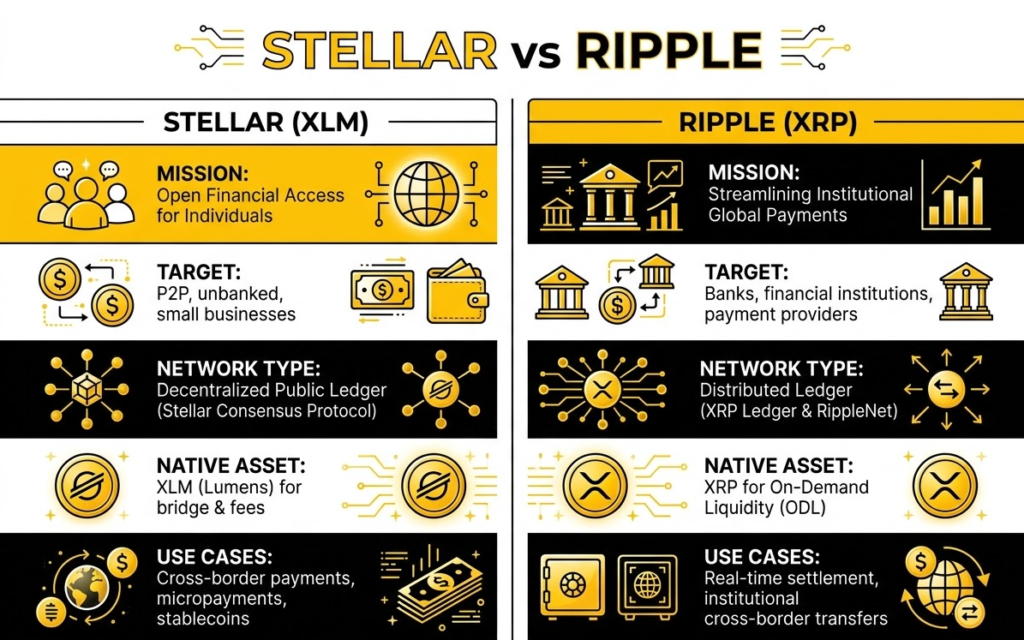
If you have spent any time researching XLM, you have probably encountered the question:
“Is Stellar basically the same thing as Ripple?”
No.
The comparison exists for historical reasons, but the projects have developed distinct identities.
Jed McCaleb’s involvement in both projects is the obvious connection. Stellar emerged after his time at Ripple, and the two ecosystems have continued to focus heavily on financial infrastructure.
But the organizations and network structures are different.
| Feature | Stellar | Ripple / XRP ecosystem |
|---|---|---|
| Native asset | XLM | XRP |
| Network | Stellar | XRP Ledger |
| Supporting organization | Stellar Development Foundation | Ripple is a separate private company |
| Broad historical focus | Financial access, payments, asset issuance | Institutional financial infrastructure and payments |
| Consensus | Stellar Consensus Protocol | XRP Ledger Consensus |
| Smart-contract platform | Soroban | XRPL has its own expanding programmability stack |
| Native exchange functionality | Yes | Yes |
One correction is worth making to the simplified descriptions you sometimes see online: it is too simplistic to say that Stellar is “for retail” while XRP is “for banks.”
Both ecosystems have institutional ambitions, and both have evolved considerably.
The more useful distinction is how each ecosystem approaches financial infrastructure.
Stellar has consistently emphasized open infrastructure, asset issuance, payment rails, and financial inclusion, while Ripple is a private company that builds products around the XRP Ledger and broader payments infrastructure.
In other words, don’t think of XLM and XRP as Coke and Pepsi.
Think of them as two blockchain ecosystems with overlapping origins and some overlapping use cases but different organizations, technical architectures, and strategic approaches.
Soroban: Stellar Is No Longer Just a Payments Blockchain
For years, one of the easiest criticisms of Stellar was:
“It’s good for payments, but what can developers actually build on it?”
That criticism is increasingly outdated.
Stellar now has Soroban, its smart-contract platform.
According to Stellar’s developer documentation, Soroban smart contracts are programs written in Rust and compiled into WebAssembly (Wasm) for deployment on the network. (Stellar Docs)
This changes the conversation considerably.
Instead of thinking about Stellar only as:
send money → receive money
you can now think about:
financial assets + payments + programmable logic
That combination is particularly interesting for financial applications.
Why Rust and WebAssembly?
Soroban uses Rust as its primary smart-contract programming language.
Rust has become popular in blockchain development because it offers strong performance and memory-safety characteristics while giving developers relatively low-level control.
The contracts are compiled to WebAssembly.
For you as an end user, the programming language is mostly invisible.
What matters is what developers can build with it.
That includes potential applications involving:
- Lending
- Trading
- Asset issuance
- Financial automation
- Tokenized real-world assets
- Stablecoins
- Payment applications
- Institutional financial workflows
Stellar itself positions Soroban around financial applications and DeFi, with developer tooling including an SDK, CLI, RPC infrastructure, and local development environments. (Stellar)
The important point is not that Soroban automatically makes Stellar a competitor to every Ethereum application.
It doesn’t.
The point is that Stellar now has a programmable execution environment that can sit alongside the network’s existing strengths in payments and tokenized assets.
Institutional Adoption: Where Stellar Gets Particularly Interesting
This is where I think Stellar becomes much more interesting than its reputation as simply “the cheap payments coin.”
The network has spent years building infrastructure around stablecoins, remittances, tokenized assets, and institutional finance.
Franklin Templeton and tokenized funds
One of the clearest examples is Franklin Templeton’s Franklin OnChain U.S. Government Money Fund, represented by the BENJI token.
Franklin Templeton and the Stellar Development Foundation marked five years of the fund’s operation in 2026. The company describes the fund as the first U.S.-registered mutual fund to use a public blockchain as its official system of record for processing transactions and recording share ownership. The fund launched on Stellar in 2021. (United States)
That is a very different use case from simply sending cryptocurrency between wallets.
You are talking about a regulated financial product whose ownership and transaction records are represented using blockchain infrastructure.
That is essentially the real-world asset (RWA) narrative in practical form.
MoneyGram and cash-to-crypto infrastructure
Stellar has also built a significant relationship with MoneyGram.
In 2022, MoneyGram and the Stellar Development Foundation announced a service connecting digital wallets with cash on/off-ramp infrastructure in several remittance markets, including Canada, Kenya, the Philippines, and the United States. (Stellar)
This is a fascinating combination because it connects two worlds that are often treated separately.
One person may be using a crypto wallet.
Another person may want physical cash.
The underlying infrastructure needs to accommodate both.
That is precisely where an on/off-ramp network becomes useful.
The relationship has continued to develop; Stellar announced in 2026 that MoneyGram would also participate as a Tier 1 validator, alongside Figure Markets and Range. (Stellar)
USDC on Stellar
Stablecoins are another major piece of the puzzle.
Circle announced Stellar as an official chain for USDC in 2020, bringing the dollar-denominated asset to Stellar’s network. (Circle)
Today, Circle continues to list Stellar among the networks supporting native USDC. Its current information also highlights use cases including cross-border payments, fiat on/off-ramping, and bulk payment disbursements. (Circle)
This matters because XLM doesn’t have to be the only asset moving through Stellar.
In fact, if Stellar succeeds as financial infrastructure, stablecoins and tokenized assets could become just as important – and potentially more important for some applications – than XLM itself.
XLM provides the network’s native utility.
The rest of the ecosystem can provide the actual financial instruments users want to transact with.
Why Stellar Is Particularly Well Suited to Cross-Border Payments
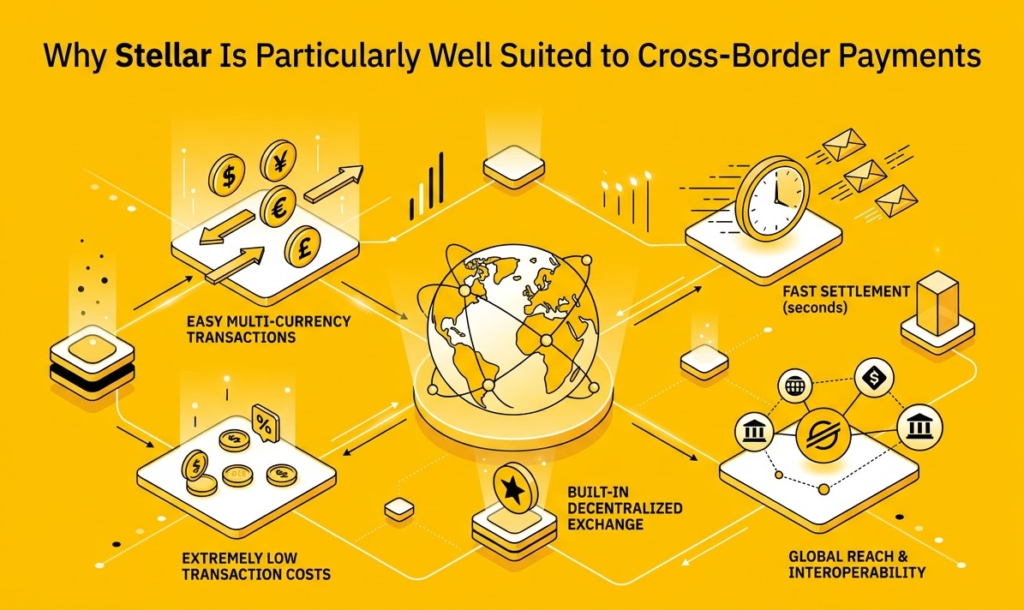
Cross-border payments are frustrating for a very simple reason: money does not move around the world as easily as information does.
You can send an email to another continent almost instantly.
Moving $100 can involve banks, correspondent relationships, compliance checks, currency conversion, settlement windows, and several different financial systems.
Stellar’s design tries to compress much of that process into a blockchain transaction.
The key components fit together neatly:
- Anchors connect blockchain assets with fiat systems.
- Tokenized assets represent currencies and other financial instruments on-chain.
- Path payments allow one asset to be sent while another reaches the recipient.
- The SDEX and liquidity pools provide mechanisms for asset conversion.
- SCP provides fast consensus and finality.
- XLM provides native network utility and transaction-fee functionality.
- Soroban adds programmable financial logic.
That’s a fairly coherent architecture.
And it explains why Stellar’s ecosystem has repeatedly focused on remittances, stablecoins, tokenization, and financial inclusion rather than treating payments as merely one application among thousands.
Stellar’s Native AMMs and Liquidity Infrastructure
There is another Stellar feature worth knowing if you are interested in how the network handles asset exchange.
Stellar introduced protocol-native automated market maker functionality through Protocol 18.
The Stellar Development Foundation announced in 2021 that validators had voted to upgrade the network with AMM functionality, allowing liquidity pools to exist directly within the protocol rather than requiring a separate smart-contract implementation. (Stellar)
This is important because liquidity is everything in financial infrastructure.
Imagine Stellar supports a token representing a local currency.
If nobody wants to trade it, the token is technically available but practically useless.
You need buyers.
You need sellers.
You need liquidity.
AMMs provide another mechanism for that liquidity to exist.
Even more interestingly, Stellar designed its liquidity infrastructure to work alongside path payments. Stellar’s technical material explains that path payments can route through order books and liquidity pools depending on the available conversion path. (Stellar)
So Stellar isn’t simply bolting a DEX onto an otherwise unrelated blockchain.
Asset exchange is deeply integrated into the network’s original payments architecture.
Stellar vs. Other Layer-1 Networks
If you are comparing Stellar with Ethereum or Solana, the biggest mistake is to compare only transaction speed.
Almost every blockchain advertises some version of “fast and cheap.”
The more interesting question is:
What was the network actually designed to do?
| Feature | Stellar | Ethereum | Solana |
|---|---|---|---|
| Primary historical focus | Payments and financial assets | General-purpose smart contracts | High-performance general-purpose applications |
| Native asset | XLM | ETH | SOL |
| Consensus family | Stellar Consensus Protocol | Proof-of-Stake | Proof-of-Stake-based architecture with Proof of History |
| Mining | No | No | No |
| Native asset exchange | Yes | Primarily via applications/protocols | Primarily via applications/protocols |
| Smart contracts | Soroban | Ethereum smart contracts | Solana programs |
| Smart-contract language | Rust / Wasm | Solidity and others | Rust and others |
| Typical Stellar ledger finality | About 5 seconds | Varies by protocol conditions | Very fast, with architecture optimized for high throughput |
| Major design emphasis | Payments, tokenization, interoperability | Programmable decentralized economy | Performance and scalable applications |
I would not read this table as saying one network is automatically “better.”
They solve somewhat different problems.
If you’re building a complex lending protocol, Ethereum’s enormous developer ecosystem may matter more to you.
If you’re building a high-performance consumer application, Solana’s architecture may be relevant.
If you’re building infrastructure around stablecoins, tokenized financial assets, cross-border transfers, and fiat connectivity, Stellar’s design choices become particularly relevant.
That’s the more useful way to think about the competition.
Frequently Asked Questions About Stellar
What is the main purpose of Stellar (XLM)?
Stellar is designed to provide open blockchain infrastructure for moving money and financial assets.
The network is particularly focused on cross-border payments, tokenized assets, financial access, and interoperability between traditional finance and blockchain-based assets.
XLM supports the network through transaction fees, account reserves, and other protocol-level functions.
The bigger picture is not simply “buy XLM and hope the price goes up.”
The underlying proposition is that a public blockchain can provide a common settlement layer for different forms of digital money.
Is Stellar the same as Ripple?
No.
Stellar and Ripple are separate ecosystems.
They do have an important historical connection because Jed McCaleb was involved in both, but the networks and organizations are different.
Stellar is supported by the Stellar Development Foundation, a non-profit organization, while Ripple is a private company that develops products and services around the XRP ecosystem.
The two also have overlapping but distinct strategic focuses.
Stellar has historically emphasized financial inclusion, open infrastructure, asset issuance, payments, and remittances. Ripple has focused heavily on institutional financial infrastructure and payment solutions.
Can Stellar run smart contracts?
Yes.
Stellar has a smart-contract platform called Soroban.
Soroban contracts are written in Rust and compiled to WebAssembly. Stellar’s official documentation describes Soroban as the smart-contract platform integrated into the Stellar network. (Stellar Docs)
That means developers can build applications that go beyond simple asset transfers.
The ecosystem can now combine:
payments + tokenized assets + liquidity + programmable contracts
That combination is one of the biggest changes in Stellar’s evolution.
Why does Stellar charge a transaction fee if transactions are almost free?
The tiny transaction fee exists partly to prevent abuse.
If transactions were completely free, attackers could potentially flood the network with enormous numbers of meaningless transactions.
The minimum fee creates an economic cost for that behavior.
Stellar’s current documentation and policy materials describe fees as a mechanism for preventing network abuse, while fees are burned rather than distributed as validator income. (Stellar Resources)
For ordinary users, the important point is that the fee is intentionally tiny.
The purpose isn’t to make Stellar a high-fee financial system.
It’s to make the ledger difficult to abuse.
How fast is a Stellar transaction?
Stellar’s ledgers generally close in approximately five seconds.
The network describes settlement as deterministic and final, meaning users do not need to wait for a long series of additional confirmations in the same way they might on a probabilistic blockchain. (Stellar)
That makes the network particularly attractive for payment use cases where waiting several minutes for settlement would be inconvenient.
Does Stellar use mining?
No.
Stellar does not use Proof-of-Work mining.
It uses the Stellar Consensus Protocol, where participating nodes reach agreement through federated voting and quorum structures rather than competing to solve computational puzzles. (Stellar Docs)
That also means there is no Bitcoin-style mining industry built around specialized ASIC hardware.
Is XLM a stablecoin?
No.
XLM is a volatile cryptocurrency.
It should not be confused with stablecoins such as USDC.
USDC on Stellar is a dollar-denominated digital asset issued by Circle, while XLM is Stellar’s native asset.
This distinction is especially important when using Stellar for payments.
A business may use Stellar’s network while choosing to transact primarily in stablecoins rather than taking XLM price exposure.
What are Stellar Anchors?
Anchors connect the Stellar network with traditional financial systems.
They can accept fiat deposits through banking or cash-based channels and issue corresponding digital assets on Stellar. They can also facilitate redemption back into the underlying asset. (Stellar Docs)
In simple terms:
Anchor = bridge between blockchain assets and traditional money.
Without that bridge, a blockchain can transfer tokens very efficiently but still struggle to connect those tokens with the financial systems people use every day.
Final Thoughts: Where Does Stellar Fit in the Blockchain Landscape?
Stellar is easy to misunderstand if you judge it only by the price chart of XLM.
The more interesting story is the infrastructure underneath it.
From the beginning, Stellar has been built around a fairly focused idea: make financial assets easier to issue, exchange, and move across borders.
The network’s architecture reflects that goal.
You have the Stellar Consensus Protocol instead of mining.
You have Anchors connecting blockchain assets with traditional financial rails.
You have a native decentralized exchange.
You have path payments that can convert assets while moving them between accounts.
You have XLM providing native network utility.
And now you have Soroban, which gives developers a programmable smart-contract environment built around Rust and WebAssembly. (Stellar Docs)
What I find most interesting about Stellar is that the network doesn’t necessarily require XLM to be the asset everyone ultimately wants to hold.
That’s actually part of the point.
A person might want dollars.
Another person might want euros.
A third might want a tokenized money-market fund.
A remittance company might want a stablecoin.
A financial institution might want to issue a tokenized asset.
Stellar’s job is to provide infrastructure that lets those assets interact.
And that helps explain why developments such as Franklin Templeton’s tokenized fund, USDC on Stellar, MoneyGram’s cash-to-crypto infrastructure, and Soroban matter. They represent different pieces of the same broader thesis: blockchain does not necessarily have to replace financial assets; it can provide a better way for those assets to move, settle, and interact. (United States)
If you are researching XLM purely as an investment, there are obviously other questions you need to ask about adoption, token economics, competition, regulation, and market demand.
But if you’re asking “What is Stellar?”, the clearest answer is simpler:
Stellar is a public blockchain designed around the movement of money and digital assets, with XLM serving as its native asset and a growing stack of payment, liquidity, tokenization, and smart-contract infrastructure built around it.
That is ultimately what makes Stellar worth paying attention to.