This guide examines Aave’s architecture, lending mechanics, token economics, GHO, Flash Loans, and risk-management framework as of 2026. One important distinction throughout the article: AAVE, aTokens, and GHO are three different assets with different purposes, and holding one does not automatically provide the benefits associated with the others.
Key Specifications & Architectural Overview of Aave
Aave is best understood as an on-chain money market rather than a conventional cryptocurrency exchange or lending company. Instead of matching individual lenders with individual borrowers, the protocol brings deposited assets together in shared liquidity pools and uses smart contracts to manage deposits, borrowing, repayments, collateral, and interest.
The project started as ETHLend in 2017, founded by Stani Kulechov, before moving toward a pooled lending architecture and adopting the Aave name. The Aave protocol made its debut in 2020, marking a significant change from its original peer-to-peer lending concept. The name “Aave” comes from the Finnish word for ghost, a rather unusual choice for a project focused on building financial infrastructure. You can explore its development history through the official Aave background and history and its ETHLend development history.
Aave at a glance
| Metric | Technical specification |
|---|---|
| Founding project | ETHLend, launched in 2017 |
| Founder | Stani Kulechov |
| Aave protocol launch | 2020 |
| Protocol classification | Non-custodial, decentralized liquidity and money market protocol |
| Core architecture | Peer-to-pool lending |
| Governance token | AAVE |
| Maximum AAVE supply | 16,000,000 tokens |
| Deposit receipt assets | aTokens, including aUSDC and aWETH |
| Native stablecoin | GHO |
| Advanced borrowing feature | Flash Loans |
| Capital-efficiency feature | Efficiency Mode (eMode) |
| Risk-management framework | Umbrella and the legacy Safety Module |
| Governance structure | Aave DAO |
Aave’s original development history and the distinction between its 2017 origins and 2020 protocol launch are documented in Aave’s official history and the Ethereum Foundation’s interview with Stani Kulechov.
Understanding the three most important Aave assets
One of the easiest ways to misunderstand Aave is to treat every token associated with the ecosystem as if it served the same purpose. In practice, AAVE, aTokens, and GHO operate in different parts of the financial system.
| Asset | Primary function | How users interact with it |
|---|---|---|
| AAVE | Governance and ecosystem utility | Hold, delegate voting power, and participate in eligible staking mechanisms |
| aTokens | Represent supplied assets and accrued lending interest | Receive when supplying supported assets and redeem against the underlying reserve |
| GHO | Aave’s decentralized, overcollateralized stablecoin | Mint against eligible collateral, transfer, repay, or use in supported DeFi applications |
For example, imagine you deposit 1,000 USDC into an Aave market. You receive a corresponding aUSDC position representing your supplied funds. As interest accrues, the underlying value of that position increases. You do not need to purchase AAVE to earn this ordinary lending yield.
GHO works differently. Rather than representing a deposit, it is a stablecoin that users can mint by borrowing against eligible collateral. Meanwhile, AAVE is primarily associated with governance and the broader protocol economy.
The AAVE token documentation, aToken and protocol documentation, and GHO technical documentation explain these distinctions.
How Aave Works?
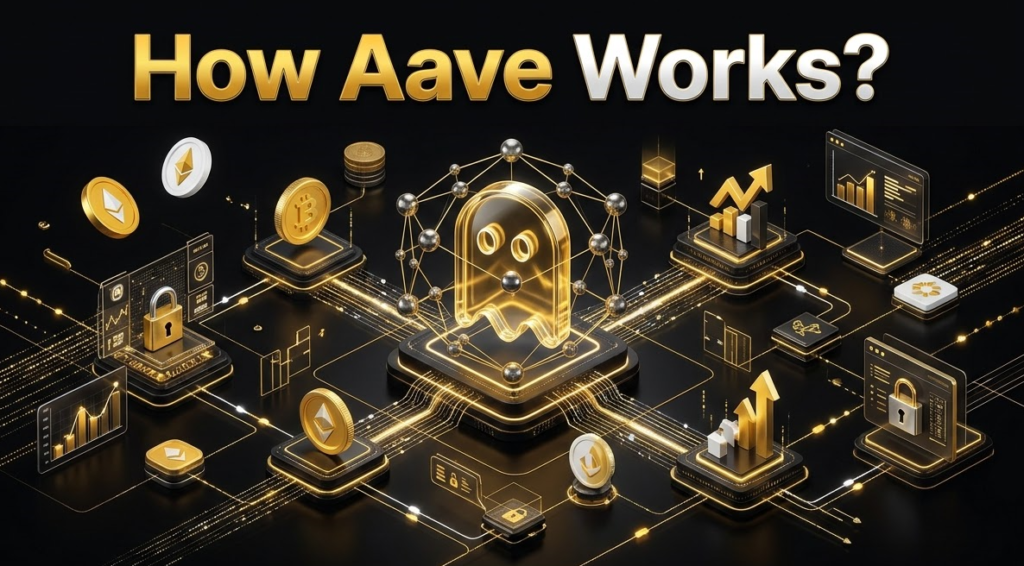
To understand why Aave became one of the most recognizable names in decentralized finance, you need to look beyond its token price. Its real innovation is the way it organizes liquidity.
Traditional financial institutions typically operate through a combination of deposit accounts, lending departments, credit assessments, and internal liquidity management. Aave takes a different approach: users interact with publicly accessible smart contracts, while the protocol handles the accounting and execution.
You can supply crypto assets, earn interest, borrow against eligible collateral, or use more advanced features without negotiating a loan with another individual.
The Peer-to-Pool Model vs Traditional Lending
Aave operates through a peer-to-pool model, meaning lenders contribute assets to shared liquidity reserves rather than negotiating directly with borrowers. Borrowers then draw liquidity from those reserves under predetermined collateral and risk conditions.
This is an important distinction because the original ETHLend concept was based on peer-to-peer lending. In that model, individual lenders and borrowers needed to find compatible counterparties, agree on loan conditions, and arrange the transaction.
That sounds straightforward, but it creates practical problems.
Imagine you want to borrow 5,000 USDC for a short-term trading opportunity. In a conventional peer-to-peer system, you would need someone willing to lend that exact amount under terms you find acceptable. If no suitable lender is available, the transaction cannot proceed.
Aave removes much of this matching friction by aggregating liquidity.
Here’s how the system works in practice:
For suppliers:
-
You connect a compatible self-custody wallet.
-
You select an asset supported by the relevant Aave market.
-
You deposit that asset into its liquidity reserve.
-
The protocol issues the corresponding aToken.
-
Your supplied position accrues interest according to the applicable market conditions.
For borrowers:
-
You deposit an eligible asset as collateral.
-
You enable the collateral option where applicable.
-
You select an available asset to borrow.
-
The protocol checks your borrowing capacity and risk parameters.
-
You receive the borrowed asset and begin accruing borrowing interest.
The important thing to understand is that Aave does not guarantee that every deposited asset can always be withdrawn immediately. A supplier’s ability to withdraw depends on available liquidity, market conditions, reserve configuration, and applicable protocol restrictions.
This is why checking the available liquidity of a market matters just as much as looking at its advertised supply APY.
How Aave determines lending and borrowing interest rates
Aave uses utilization-based interest-rate models. Rather than having a bank employee decide what interest rate a borrower should pay, smart contracts calculate rates using the relationship between supplied liquidity and outstanding borrowing.
The basic utilization formula is:
Consider a simplified example:
| Metric | Amount |
|---|---|
| Total supplied liquidity | 10,000,000 USDC |
| Total borrowed | 7,000,000 USDC |
| Available liquidity | 3,000,000 USDC |
| Utilization rate | 70% |
When utilization increases, a larger share of the available reserve is being used by borrowers. The protocol generally responds by increasing borrowing rates, making new borrowing more expensive and encouraging repayments or additional deposits.
When utilization is relatively low, borrowing rates are generally more attractive, while suppliers may receive lower yields.
Most Aave interest-rate strategies use a variable-rate curve with a utilization threshold, commonly called the optimal utilization rate or kink. Below this point, interest rates increase more gradually. Above it, borrowing rates rise much more sharply to discourage excessive reserve utilization.
This design helps maintain liquidity rather than allowing borrowers to consume nearly every available unit of a reserve without an economic incentive to repay. (Source: governance.aave.com)
However, there is an important detail that beginners often overlook: the APY displayed on Aave is not a guaranteed long-term return.
Suppose you deposit USDC when its displayed supply APY is 5%. That figure may change as borrowing demand rises or falls. If borrowers repay their loans and utilization declines, your supply yield can decrease. If demand for USDC borrowing increases, the yield may rise.
In other words, Aave lending returns are market-driven, not fixed bank-deposit interest.
You should also distinguish between:
-
Supply APY: The annualized return suppliers may earn on deposited assets.
-
Variable borrow APY: The interest borrowers pay, which changes with utilization and protocol parameters.
-
Protocol fees: Charges collected for particular operations, which may be distributed between liquidity providers and protocol-controlled revenue mechanisms according to the relevant configuration.
For live market parameters, the Aave protocol documentation and official market data are more useful than relying on an old APY screenshot or a third-party article.
Yield-Accruing aTokens: Earning Passive Crypto Interest
Now let’s look at one of Aave’s most important technical innovations: aTokens.
aTokens are interest-bearing receipt tokens issued when users supply assets to Aave. They represent a claim on the underlying supplied asset, with accrued interest reflected in the token balance.
For example:
-
Deposit USDC and receive aUSDC.
-
Deposit WETH and receive aWETH.
-
Deposit another supported asset and receive its corresponding aToken.
The basic issuance relationship is one-to-one at the time of deposit, although the value represented by your aToken position subsequently grows as interest accrues. (Source: generalist.com)
Let’s walk through a practical example.
Suppose you supply 2,000 USDC to an Aave market. The protocol issues approximately 2,000 aUSDC to represent your deposit.
Assume, purely for illustration, that your average supply rate remains 4% APY for an entire year. Ignoring changes in market conditions and other complications, the position would grow to approximately:
Your original deposit remains denominated in USDC, but the aToken position represents the accumulated value.
A technical detail worth understanding is that Aave uses an interest index and scaled balances to account for interest accrual. The displayed aToken balance can therefore increase over time without requiring a separate transaction every time interest is earned.
This is different from reward systems where users must manually claim newly distributed tokens.
Why aTokens matter beyond passive income
aTokens are not simply digital receipts that sit in your wallet. They can also participate in other DeFi strategies, depending on network support and the applications integrating them.
For example, users may be able to:
-
Transfer aTokens to another compatible wallet.
-
Use supported aTokens in other DeFi applications.
-
Deposit eligible aTokens into Aave’s Umbrella staking system.
-
Redeem aTokens for the underlying assets, subject to available liquidity and protocol conditions.
However, composability creates additional risk. Using an aToken in another protocol introduces exposure to that external protocol’s smart contracts, liquidity conditions, and collateral rules.
I would not treat aUSDC as identical to holding USDC directly in a self-custody wallet. Although it represents a claim on supplied USDC, it also depends on Aave’s contracts and the relevant market’s ability to honor withdrawals.
For the underlying mechanics, see the Aave V3 technical documentation.
Advanced DeFi Innovations
Aave’s lending pools are already useful for ordinary crypto investors, but the protocol becomes considerably more interesting when you look at its advanced financial instruments.
Three features deserve particular attention: Flash Loans, Efficiency Mode, and GHO. Each addresses a different problem in DeFi, from accessing temporary liquidity without collateral to improving borrowing efficiency and creating decentralized dollar-denominated liquidity.
Flash Loans: Uncollateralized Single-Block Execution Loans
Aave Flash Loans allow users to borrow crypto assets without providing upfront collateral, provided the borrowed amount and applicable fee are repaid within the same blockchain transaction, unless the transaction uses an explicitly supported debt-opening option.
This is probably one of the most unusual financial products in decentralized finance.
Think about how borrowing normally works. If you approach a bank for a $1 million loan, the lender will want to evaluate your creditworthiness, collateral, income, or other guarantees. Even in crypto lending, borrowers generally need to deposit assets worth more than the amount they intend to borrow.
Flash Loans take a completely different approach.
Instead of relying on collateral, they rely on atomic transaction execution.
An atomic transaction is an operation that either completes successfully in its entirety or reverts. If the Flash Loan receiver cannot satisfy the repayment requirements, the transaction fails, and the blockchain does not retain the intermediate state changes.
This is the mechanism that makes uncollateralized borrowing possible.
How a Flash Loan works
Imagine that a developer notices a temporary price difference between two decentralized exchanges:
-
Exchange A offers 1 ETH for 3,000 USDC.
-
Exchange B allows the developer to sell 1 ETH for 3,050 USDC.
-
The apparent price difference creates a potential arbitrage opportunity.
The developer does not necessarily need to own thousands of dollars in USDC to execute the strategy. Instead, they can build a smart contract that requests a Flash Loan from Aave.
The transaction might follow this sequence:
Flash Loan execution flow
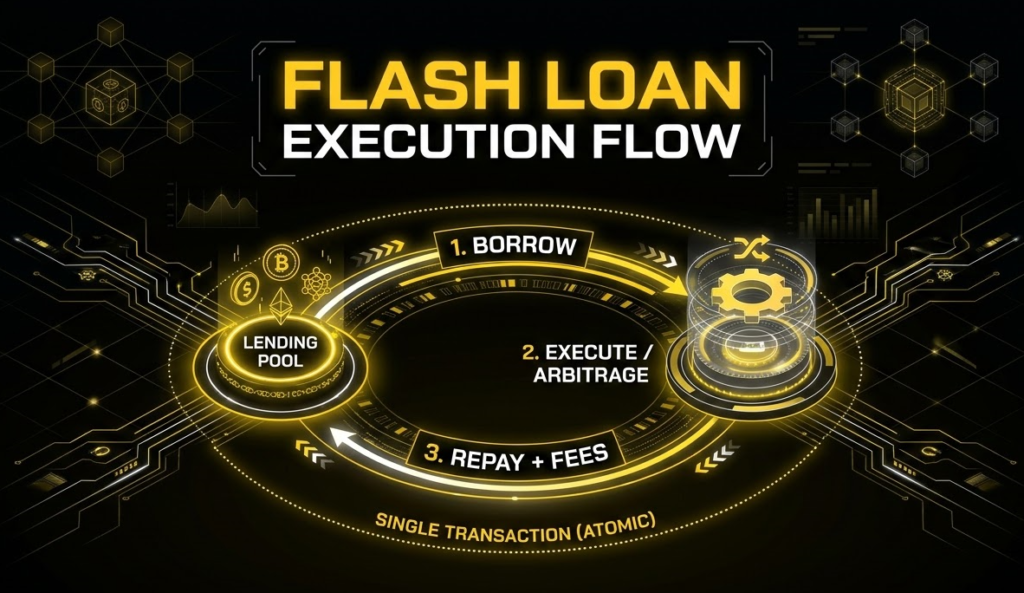
-
Request liquidity
The smart contract requests a specified amount of USDC from an Aave liquidity pool.
-
Receive borrowed assets
Aave transfers the requested funds to the designated receiver contract without requiring conventional deposit collateral.
-
Execute the strategy
The receiver contract performs the intended arbitrage, refinancing, liquidation, or other supported operation.
-
Repay the loan
The contract must have sufficient funds to cover the original principal and applicable Flash Loan premium.
-
Complete or revert
If repayment succeeds, the transaction completes. If the required repayment cannot be collected, the transaction reverts.
The entire sequence takes place within one transaction. The borrower cannot simply take the money, disappear, and promise to repay it next week.
What are Aave Flash Loans used for?
Flash Loans are particularly useful for developers building sophisticated DeFi applications.
| Use case | How Flash Loans help |
|---|---|
| Arbitrage | Exploit temporary price differences between decentralized exchanges |
| Collateral swaps | Replace one collateral asset with another without manually funding the entire operation |
| Debt refinancing | Move borrowing positions between markets or assets |
| Liquidations | Repay an unhealthy borrower’s debt and acquire discounted collateral |
| Liquidity optimization | Execute complex transactions without permanently committing substantial capital |
For example, a liquidator may identify an Aave borrower whose collateral position has become unhealthy. Rather than holding the entire amount of the outstanding debt, the liquidator can use a Flash Loan to obtain the necessary repayment funds, execute the liquidation, sell or exchange the acquired collateral, and repay the loan.
If the operation is profitable after fees and execution costs, the liquidator retains the remaining value.
This creates opportunities for developers and automated liquidation systems while helping Aave maintain the health of its lending markets.
Aave Flash Loan fees and technical requirements
Flash Loans are not necessarily free.
Aave’s developer documentation describes a 0.05% initial Flash Loan premium for V3 deployments, although governance can change the actual premium. You should always check the relevant market’s live configuration before calculating the cost of an operation.
For example, if a hypothetical Flash Loan has a 0.05% fee:
The borrower must therefore arrange repayment of 1,000,500 USDC, assuming the premium remains 0.05% and no other costs apply.
Developers also need to understand the difference between Aave’s two primary Flash Loan functions:
-
flashLoan(): Supports borrowing multiple assets in one transaction and can support opening a variable-rate debt position under specific conditions instead of immediately repaying an asset. -
flashLoanSimple(): Provides a simpler single-asset Flash Loan flow that requires repayment within the transaction.
These are not interchangeable in every situation, and their fee treatment can differ.
The official Aave V3 Flash Loan developer guide explains the receiver contract requirements, repayment process, and implementation details.
One more thing: Flash Loans do not eliminate financial risk. They eliminate the need for conventional collateral in the transaction, but they do not guarantee that an arbitrage or liquidation strategy will be profitable. Gas costs, slippage, unfavorable execution, and smart contract vulnerabilities can still make an operation fail or lose money.
Efficiency Mode (eMode) and Isolation Mode Risk Parameters
Another important Aave feature is Efficiency Mode, commonly known as eMode.
eMode allows borrowers to obtain greater borrowing power when using assets that belong to the same approved category of correlated assets.
The idea is straightforward: not all collateral assets carry the same relative risk.
For example, borrowing USDC against USDT presents a different price-risk profile from borrowing USDC against a highly volatile small-cap cryptocurrency.
USDC and USDT are both designed to track the US dollar. Their prices are therefore expected to remain relatively close under normal market conditions, although neither is guaranteed to maintain its peg.
Aave can use this relationship to configure more efficient borrowing parameters for eligible assets.
How eMode improves capital efficiency
Consider a simplified example in which you supply $10,000 worth of an eligible stablecoin.
Under a hypothetical standard collateral configuration with an LTV of 80%, your maximum initial borrowing capacity would be $8,000.
Now imagine that an eligible stablecoin eMode category offers a 97% LTV.
Your theoretical borrowing capacity becomes:
That means you could potentially borrow $9,700 rather than $8,000 against the same collateral.
The difference is substantial, particularly for traders and DeFi users who want to optimize capital utilization.
However, the 97% figure is an illustrative example based on an actual documented stablecoin eMode configuration, not a universal borrowing limit. The maximum LTV depends on the selected category, eligible assets, market deployment, and current governance parameters.
Aave’s advanced market documentation provides an example of a stablecoin category configured with a 97% maximum LTV and a 97.5% liquidation threshold.
Understanding the difference between LTV and liquidation threshold
These two terms are closely related, but they do not mean the same thing.
-
Loan-to-Value (LTV): Determines the maximum borrowing capacity relative to eligible collateral value.
-
Liquidation Threshold (LT): Determines when a borrow position becomes eligible for liquidation based on the collateral’s liquidation-weighted value.
You should not borrow right up to the maximum LTV simply because the interface allows you to do so. A small market movement, interest accumulation, or stablecoin depeg can rapidly reduce your safety margin.
What happened to Isolation Mode in Aave V3?
The original Aave V3 design introduced Isolation Mode to control the risks associated with newer or more volatile collateral assets.
When an asset was classified as isolated collateral, borrowers faced restrictions on which assets they could borrow against it. These restrictions helped contain potential losses if the collateral experienced a sharp price decline.
However, there is an important 2026 technical update that should not be overlooked: the original Isolation Mode framework was removed in Aave V3.7 and replaced by isolated eMode categories for the relevant risk-management use case.
Some older Aave V3 deployments still use earlier versions, so the configuration can differ across markets.
This is why describing Isolation Mode as a universal feature of every current Aave V3 deployment would be misleading.
The updated Aave V3 overview and Isolation Mode documentation explain how the architecture and supported configurations differ.
GHO: Aave’s Native Overcollateralized Stablecoin
GHO is one of the most important developments in the Aave ecosystem because it extends the protocol beyond ordinary lending and borrowing.
GHO is a decentralized, overcollateralized stablecoin native to Aave, designed to maintain a value pegged to the US dollar.
In simple terms, one GHO is intended to represent approximately one US dollar.
Unlike a typical stablecoin that relies primarily on a centralized issuer holding traditional financial reserves, GHO is created through an on-chain system of approved facilitators, collateral requirements, and governance-defined parameters.
How GHO minting works
Let’s say you have deposited ETH into the Aave Ethereum market and want to obtain dollar-denominated liquidity without selling your ETH.
Instead of exchanging your ETH for USDC on a decentralized exchange, you may be able to use it as collateral to mint GHO.
The process looks like this:
-
Supply eligible collateral to the Aave market.
-
Enable the asset as collateral where necessary.
-
Check your available borrowing capacity.
-
Borrow GHO through the Aave V3 Ethereum market.
-
Hold, transfer, or use the GHO in supported applications.
-
Repay the GHO debt and accrued interest when you want to reduce or close the position.
The important distinction is that GHO is minted rather than borrowed from an ordinary pool of existing GHO deposits.
Aave’s GHO facilitator creates new GHO within the limits authorized by governance. Each facilitator operates with a predefined minting capacity, often referred to as a bucket capacity.
This provides a mechanism for controlling the amount of GHO that different approved components of the ecosystem can create.
According to the official GHO documentation, the Aave V3 Ethereum market is one of the primary facilitators, allowing users to mint GHO against eligible supplied collateral.
Why overcollateralization matters
Imagine that you supply $10,000 worth of eligible ETH and mint $5,000 GHO.
Your position is backed by collateral worth twice the value of the GHO debt at the time of borrowing.
If ETH falls in price, the collateral value declines while your GHO debt remains denominated in dollars.
That can push your health factor toward the liquidation threshold.
For this reason, borrowers need to monitor their positions instead of assuming that overcollateralization automatically eliminates liquidation risk.
GHO’s peg also depends on market mechanisms, collateral quality, liquidity, governance, and the operation of its approved facilitators. A dollar peg is a design objective, not an unconditional guarantee that GHO will trade at exactly $1 in every market.
How GHO generates revenue for the Aave DAO
One of the interesting differences between GHO and ordinary supplied assets is the destination of borrowing interest.
When users borrow ordinary assets from Aave’s liquidity pools, interest generally flows to the suppliers of those assets, with applicable protocol fees handled according to the market configuration.
GHO follows a different economic model.
Interest paid by GHO borrowers is directed toward the Aave DAO treasury rather than being distributed to ordinary GHO liquidity suppliers in the same way as a conventional reserve asset.
This gives the DAO another potential source of revenue to fund protocol development, security, ecosystem growth, and governance-approved initiatives.
The Aave FAQ explains how GHO borrowing interest contributes to the DAO treasury.
GHO yield: Is it possible to earn interest on GHO?
Yes, but you need to distinguish between borrowing GHO and using GHO in a yield-generating product.
Holding GHO in a regular wallet does not automatically generate lending interest.
Aave has also introduced sGHO, an on-chain savings product that allows users to deposit GHO into a vault and receive sGHO.
The savings mechanism uses an on-chain yield index, with the savings rate determined through Aave governance. Unlike the legacy Safety Module staking arrangement, the sGHO savings product does not impose the same slashing exposure or cooldown requirements.
This distinction is particularly important if you are comparing ways to earn returns on stablecoins.
| GHO-related activity | Potential benefit | Main consideration |
|---|---|---|
| Holding GHO | Dollar-denominated liquidity | No automatic yield |
| Borrowing GHO | Access to liquidity against collateral | Borrowing interest and liquidation risk |
| Using GHO in DeFi | Additional utility and potential yield | External smart contract and liquidity risk |
| Depositing into sGHO | Access to the governance-set savings rate | Rate can change; smart contract risk |
| Staking GHO in Umbrella | Security rewards | Possible slashing and withdrawal restrictions |
For current product details, see the GHO stablecoin guide and Aave’s official FAQ.
AAVE Tokenomics, Supply Cap & Safety Module Staking
Understanding the technology is only one part of evaluating Aave. You also need to understand how its native token fits into the ecosystem and how the protocol manages its financial incentives.
AAVE is an ERC-20 token deployed on Ethereum. Its primary purpose is governance, although it also has a role in the protocol’s historical security framework and broader economic model.
It is important not to confuse the economic value of the AAVE token with the financial activity occurring inside Aave’s lending pools.
The 16 Million Fixed Supply Hard Cap and Revenue Buybacks
AAVE has a maximum supply of 16,000,000 tokens, established during the project’s transition from ETHLend to Aave.
This fixed supply is an important part of its token economics.
To understand where the 16 million figure came from, it helps to revisit the project’s token migration.
ETHLend originally issued LEND tokens in connection with its 2017 token sale. During the transition to Aave in 2020, LEND holders could convert their tokens into AAVE at a ratio of 100 LEND for one AAVE.
The migration resulted in:
-
13 million AAVE allocated through the LEND conversion.
-
An additional 3 million AAVE allocated to the Ecosystem Reserve.
-
A total initial AAVE supply of 16 million tokens.
This historical supply structure is documented in the SEC-filed AAVE disclosure.
Why does the 16 million supply cap matter?
Unlike cryptocurrencies that continually issue new tokens through mining or other ongoing issuance mechanisms, AAVE’s token model is built around a defined maximum supply.
That does not mean the token price must increase over time.
Its market value still depends on several factors:
-
Demand for AAVE among investors and governance participants.
-
The growth of Aave’s lending and borrowing activity.
-
The protocol’s revenue and treasury position.
-
Competition from other DeFi lending protocols.
-
Changes in token utility and governance decisions.
-
Broader cryptocurrency market conditions.
A fixed supply can create a scarcity narrative, but scarcity alone does not establish investment value.
AAVE buybacks and protocol revenue
One of the major developments in Aave’s token economics has been the introduction of revenue-funded buybacks.
Rather than relying exclusively on token emissions to support the ecosystem, the Aave DAO has pursued a strategy of using protocol revenue to purchase AAVE on the open market.
The original buyback program was approved as part of the Aavenomics initiative in August 2024 and began execution in April 2025.
The program initially operated with a reported annual budget of $50 million, with purchases adjusted according to liquidity, market conditions, and token volatility. The AAVE token documentation provides an overview of the buyback mechanism.
There was also an important subsequent development in 2026: a March 4 governance publication proposed reducing the annual buyback budget from approximately $50 million to $30 million in response to changing protocol revenue and operational funding requirements. This was a proposal, not something that should automatically be described as an already-executed budget change. You can follow the discussion in the Aave DAO buyback budget adjustment proposal.
This is worth highlighting because tokenomics can change through governance even when the maximum token supply remains unchanged.
Buybacks may create additional market demand, but they do not guarantee higher token prices, and the amount of tokens purchased depends on the actual execution of governance-approved programs.
The Safety Module (Umbrella Staking) and Slashing Backstop
Aave needs more than collateral requirements and liquidation mechanisms to manage risk. It also needs a framework for dealing with bad debt when something goes wrong.
This is where the Safety Module and its successor, Umbrella, become important.
Umbrella is Aave’s upgraded on-chain protection system, allowing users to stake eligible aTokens and GHO to help cover protocol deficits in exchange for rewards and acceptance of slashing risk.
There is an important distinction between the original Safety Module and the newer Umbrella architecture.
The original Safety Module allowed users to stake AAVE and other eligible assets, with staked funds potentially subject to slashing during protocol shortfall events.
Umbrella introduces a more granular approach, using asset-specific staking positions and automated deficit coverage.
How Umbrella staking works
Imagine that you supply USDC to an Aave market and receive aUSDC.
You can potentially deposit eligible aUSDC into the corresponding Umbrella staking contract.
In return, you receive a staking position that participates in the protocol’s protection framework.
The basic process is:
-
Supply an eligible asset to Aave.
-
Receive the corresponding aToken.
-
Select an available Umbrella staking pool.
-
Approve the staking contract to interact with your asset.
-
Deposit the eligible aToken or GHO.
-
Receive a staking position and become eligible for configured rewards.
The reward structure depends on governance-defined parameters and available incentives.
What happens when Aave experiences bad debt?
Let’s say a lending market experiences a deficit in USDC.
If the deficit exceeds the applicable offset protection, Umbrella can automatically reduce the value of the corresponding staked USDC-backed position to cover the shortfall.
This process is called slashing.
The important feature is that risk is isolated by asset and network.
For example, staking aUSDC in an Ethereum Umbrella pool does not automatically expose that position to every deficit across every Aave deployment. It is designed to cover the corresponding asset and network combination.
The system also incorporates deficit offsets, which provide a first layer of protection before staker funds are affected.
According to the official Umbrella documentation, the system supports staking eligible aTokens and GHO, with rewards and slashing conditions configured through governance.
Umbrella vs. the legacy Safety Module
| Feature | Legacy Safety Module | Umbrella |
|---|---|---|
| Primary role | Protocol deficit backstop | Automated protocol deficit coverage |
| Eligible staking assets | AAVE, ABPT and legacy GHO arrangements | Eligible aTokens and GHO |
| Slashing mechanism | Governance-driven legacy framework | Automated smart contract mechanism |
| Risk allocation | Legacy staking pool structure | Asset- and network-specific exposure |
| Rewards | Governance-configured incentives | Governance-configured rewards |
| Withdrawal | Cooldown requirements | 20-day cooldown and 2-day withdrawal window under the documented configuration |
A particularly important detail is that the legacy AAVE staking framework and Umbrella are not identical products.
Users who still hold legacy stkAAVE positions should not assume that they can simply transfer those positions into the newer Umbrella system. The available migration paths depend on the staking asset and current governance configuration.
Umbrella also does not mean that staking is risk-free. Stakers accept the possibility that their deposited assets can lose value if a qualifying deficit occurs.
The Aave Umbrella guide and official staking instructions provide more detailed information about supported assets, rewards, cooldowns, and slashing.
Common Pitfalls & Misconceptions About Aave
Aave is relatively straightforward once you understand its basic lending mechanics, but some of its features can be confusing, especially if you are new to DeFi.
The problem is that people often use the words Aave, AAVE, aTokens, lending, and staking interchangeably. They are connected, but they do not describe the same thing.
Let’s clear up three common misconceptions.
Misconception: Holding AAVE Automatically Earns Lending Interest
This is probably the most common misunderstanding among people discovering Aave through cryptocurrency exchanges.
Holding AAVE does not automatically generate the ordinary lending interest paid to Aave suppliers.
If you purchase 100 AAVE tokens and leave them in your wallet, you own 100 AAVE tokens. Your balance does not automatically increase because borrowers are paying interest on USDC, ETH, or other assets deposited into Aave.
The distinction is simple:
-
AAVE is the protocol’s governance token.
-
aTokens represent supplied assets and their accrued lending yield.
-
GHO is the protocol’s native stablecoin.
If your objective is to earn lending interest, you generally need to supply an eligible asset and receive the corresponding aToken.
For example, depositing USDC into an eligible Aave market gives you aUSDC exposure. The interest generated by that lending position is reflected in your aToken balance.
If your objective is to participate in protocol governance, AAVE is the relevant asset.
If you want to participate in Aave’s security framework, you need to investigate the eligible staking products, including the legacy Safety Module and newer Umbrella arrangements.
These activities have different economic incentives and risks.
It is also worth remembering that AAVE’s buyback program does not mean every tokenholder automatically receives additional tokens or a guaranteed dividend. Buybacks involve the DAO purchasing tokens on the open market, not automatically distributing an equivalent amount to every wallet.
Misconception: Flash Loans Require Deposit Collateral
This misunderstanding usually comes from treating Flash Loans as ordinary crypto loans.
Traditional Aave borrowing requires collateral, but Flash Loans work differently.
Flash Loans do not require upfront deposit collateral when the borrower follows the atomic repayment model.
The smart contract must complete the requested operation and satisfy the repayment conditions within the same transaction.
Why does this work?
Because the blockchain’s transaction execution rules prevent the protocol from accepting an incomplete operation that leaves the borrowed principal unpaid.
Imagine that a developer requests a $500,000 Flash Loan but cannot generate enough funds to repay the principal and fee.
The transaction reverts.
The developer does not get to keep the $500,000, and the protocol does not complete the loan as a successful transaction.
There are, however, technical exceptions within the flashLoan() function, which can allow eligible borrowers to open variable-rate debt instead of immediately repaying particular borrowed assets, provided the required collateral or credit delegation conditions are satisfied.
This is different from the simpler flashLoanSimple() flow, which requires repayment within the transaction.
The Aave Flash Loan documentation explains these two execution paths.
Misconception: Aave Is a Peer-to-Peer Lending Order Book
Aave is not a traditional peer-to-peer lending marketplace where individual lenders negotiate with individual borrowers.
It is a peer-to-pool protocol.
When you deposit USDC, you contribute to a shared liquidity reserve. When another user borrows USDC, they draw from that reserve according to the market’s rules and available liquidity.
This architecture has several important consequences:
-
You do not select an individual borrower.
-
Your interest rate is determined by the market’s utilization-based interest-rate model.
-
Borrowing capacity depends on eligible collateral and risk parameters.
-
Withdrawals depend on available liquidity and applicable restrictions.
-
Smart contracts execute the lending and borrowing operations.
This is also why checking the available liquidity of a reserve matters.
You may see a positive balance in your aToken wallet, but if the underlying reserve has insufficient immediately available liquidity, you may not be able to withdraw your entire position at that moment.
Understanding the peer-to-pool model helps explain both Aave’s efficiency and its limitations.
System Architecture & Entity Relationship Visual
Aave is easier to understand when you look at the relationships between its main components rather than examining every token independently.
The protocol has several interconnected layers: governance, liquidity management, yield generation, stablecoin issuance, and security.
The following knowledge graph summarizes how these components fit together.
Aave Protocol Ecosystem
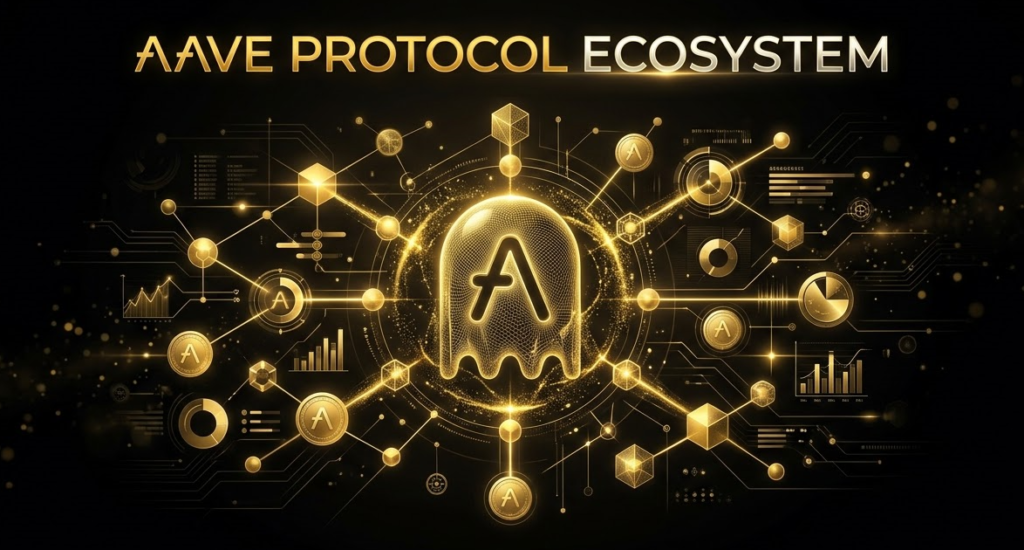
Decentralized liquidity and money market infrastructure
Peer-to-pool markets
Shared liquidity, lending and borrowing
AAVE token
Governance and ecosystem utility
aTokens
Deposit receipts and accrued yield
GHO stablecoin
Overcollateralized dollar-denominated asset
Flash Loans
Atomic, uncollateralized liquidity
eMode
Optimized borrowing for correlated assets
Aave DAO and risk management
Governance, risk parameters, Umbrella staking, and treasury management
The main entities have the following relationships:
| Entity | Relationship to Aave | Primary function |
|---|---|---|
| Stani Kulechov | Founder | Established the original ETHLend project |
| Aave Protocol | Core infrastructure | Manages decentralized liquidity markets |
| AAVE | Native governance token | Supports protocol governance |
| aTokens | Deposit-related assets | Represent supplied assets and accrued interest |
| GHO | Native stablecoin | Provides decentralized dollar-denominated liquidity |
| Flash Loans | Lending feature | Provides temporary liquidity without conventional collateral |
| eMode | Risk configuration | Improves borrowing efficiency for eligible correlated assets |
| Umbrella | Security framework | Helps cover qualifying protocol deficits |
The important point is that these components work together but remain economically distinct. AAVE does not represent a deposit in the lending pool, aTokens are not governance shares, and GHO is not simply another name for USDC.
How to Supply, Borrow, and Stake on Aave
Understanding how Aave works conceptually is useful, but actually using the protocol is where the details become important.
The good news is that you do not need to be a Solidity developer to supply assets or borrow against collateral. Ordinary users can interact with supported markets through the official Aave interface and a compatible self-custody wallet.
However, you should understand what each transaction does before approving it.
Phase 1: Depositing Assets to Earn Yield via aTokens
The first way to interact with Aave is by supplying cryptocurrency to a liquidity pool.
Step 1: Connect your Web3 wallet
Visit the official Aave application and connect a compatible wallet.
Depending on the network you want to use, you may need a wallet that supports Ethereum or another supported blockchain.
Before connecting, make sure that:
-
You are using the official application URL.
-
Your wallet is connected to the intended blockchain.
-
You have enough native network tokens to cover transaction fees.
-
You understand which wallet address is being used.
Never enter your seed phrase or private key into a website claiming to be an Aave support page.
Step 2: Select an asset to supply
Once connected, navigate to the relevant market and examine the supported assets.
For example, you might see:
-
USDC
-
USDT
-
WETH
-
Other eligible cryptocurrencies
The available assets and their supply conditions differ between networks and markets.
I would pay particular attention to the displayed supply APY, available liquidity, supply cap, and collateral eligibility before making a deposit.
A high APY might look attractive, but it does not automatically mean that an asset is a good choice. You should also consider the underlying token’s risk, liquidity, and market configuration.
Step 3: Enter the deposit amount
Choose how much you want to supply.
For example, suppose you decide to deposit 1,000 USDC.
The interface will display the transaction details, including the amount and the estimated aToken position.
Some tokens require an approval transaction before the actual deposit. This allows the Aave smart contract to transfer the specified asset from your wallet.
Always review the approval amount and destination contract before signing.
Step 4: Confirm the supply transaction
After approving the token transfer, confirm the supply transaction in your wallet.
Once the transaction is successfully executed, you should receive the corresponding aToken position.
For a 1,000 USDC deposit, this would ordinarily mean approximately 1,000 aUSDC at the time of supply.
Your aUSDC balance will then reflect the interest earned by the position as the protocol’s interest index changes.
Step 5: Monitor your position
Supplying assets is not necessarily a set-and-forget strategy.
You should periodically review:
-
Current supply APY.
-
Available liquidity.
-
Market supply caps.
-
Whether your asset remains eligible as collateral.
-
Any changes to the market’s risk parameters.
If you are using Aave purely for lending yield, remember that your returns are variable and your underlying assets remain exposed to protocol and token-specific risks.
Phase 2: Borrowing Against Collateral and Utilizing Flash Loans
Borrowing is a little more complicated because it introduces liquidation risk.
When you borrow from Aave, you are effectively creating a collateralized debt position.
Step 1: Supply eligible collateral
First, deposit an asset that the selected market allows you to use as collateral.
For example, you could supply ETH or another supported asset.
Not every supplied asset automatically qualifies as collateral. Some assets may have an LTV of zero or may have restrictions based on the market’s configuration.
Step 2: Enable the collateral option
If the asset is eligible, make sure it is enabled as collateral.
This allows Aave to include its liquidation-adjusted value when calculating your borrowing capacity.
Step 3: Check your health factor
Before borrowing, pay close attention to the health factor.
The basic formula is:
A health factor above 1 indicates that the position is currently above the liquidation boundary. A value below 1 makes the position eligible for liquidation.
Consider this simplified example:
| Metric | Value |
|---|---|
| Collateral value | $10,000 |
| Weighted liquidation threshold | 80% |
| Borrowed amount | $6,000 |
| Liquidation-adjusted collateral | $8,000 |
| Health factor | 1.33 |
The position has a health factor of approximately 1.33.
If the collateral value falls while the debt remains unchanged, the health factor decreases.
For example, if the collateral falls to $8,000:
The position is now much closer to liquidation.
You can learn more about the calculation through Aave’s official Health Factor documentation.
Step 4: Select the asset you want to borrow
Aave allows borrowers to select from eligible assets with available borrowing liquidity.
You may choose a stablecoin such as USDC or GHO, depending on the market and borrowing configuration.
The interface displays the applicable borrowing rate and available borrowing capacity.
Do not assume that the highest displayed borrowing limit is the safest amount to take. Maintaining a comfortable health factor is generally more important than maximizing leverage.
Step 5: Confirm the borrowing transaction
Review the transaction, borrowing rate, collateral position, and health factor before signing.
Once the transaction succeeds, the borrowed asset is transferred to your wallet, while your debt position begins accruing interest.
You can repay the loan later using the appropriate asset and the protocol’s repayment function.
Step 6: Manage your debt position
This is the part that separates responsible DeFi borrowing from unnecessarily risky speculation.
Monitor your health factor, especially during volatile market conditions.
If your collateral price declines, you can generally improve your position by:
-
Supplying additional collateral.
-
Repaying part of your outstanding debt.
-
Reducing exposure to volatile collateral assets.
-
Avoiding additional borrowing when the health factor is already low.
What about Flash Loans?
Flash Loans are not an ordinary borrowing option that you simply activate from your personal wallet dashboard.
They generally require a compatible smart contract that requests the liquidity, executes the intended operation, and satisfies the repayment requirements within the same transaction.
If you are a beginner, I would focus on understanding ordinary supply and borrow operations before attempting to develop a Flash Loan strategy.
A mistake in a complex smart contract can be expensive, even when the transaction ultimately reverts, because execution may still involve network fees.
Important risks to understand before using Aave
Aave is an established DeFi protocol, but that does not make it risk-free.
Some of the most important risks include:
| Risk category | What can happen | What you should consider |
|---|---|---|
| Smart contract risk | A vulnerability may cause financial losses | Review audits and use official contracts |
| Liquidation risk | Collateral value falls below the required threshold | Maintain a healthy collateral buffer |
| Oracle risk | Incorrect price data affects collateral valuation | Understand the market’s oracle dependencies |
| Liquidity risk | Insufficient available liquidity delays withdrawals | Check reserve liquidity before supplying |
| Stablecoin risk | A stablecoin loses its intended peg | Avoid assuming every stablecoin is risk-free |
| Governance risk | Parameters and incentives change | Monitor relevant DAO proposals |
| Network risk | Congestion or infrastructure problems affect transactions | Account for gas fees and network conditions |
| External protocol risk | Integrated applications experience exploits or failures | Assess additional exposure from composability |
Aave publishes information about its security reviews, audits, risk controls, and bug bounty programs on its official security page.
The protocol also relies on governance and risk-management frameworks to adjust parameters such as collateral factors, supply caps, and borrowing limits. Its risk documentation provides a useful starting point.
My general recommendation is to start with a small supply position, understand how the interface works, and avoid borrowing aggressively until you are comfortable with collateral management and liquidation mechanics.
Frequently Asked Questions About Aave
What is Aave (AAVE) and how does it work?
Aave is a decentralized, non-custodial liquidity protocol that allows users to supply cryptocurrency, earn interest, and borrow digital assets without relying on traditional financial intermediaries.
The protocol operates through shared liquidity pools managed by smart contracts. Suppliers deposit supported assets and receive interest-bearing aTokens, while borrowers use eligible collateral to access liquidity.
Aave also supports advanced features such as uncollateralized Flash Loans, Efficiency Mode, and GHO, its native overcollateralized stablecoin.
What is the difference between AAVE, aTokens, and GHO?
Although all three assets belong to the Aave ecosystem, they have different functions.
| Asset | Explanation | Main purpose |
|---|---|---|
| AAVE | Native ERC-20 governance token | Governance and ecosystem utility |
| aTokens | Interest-bearing deposit receipt tokens | Represent supplied assets and accumulated lending interest |
| GHO | Decentralized, overcollateralized stablecoin | Dollar-denominated liquidity and DeFi utility |
For example, if you deposit USDC into Aave, you receive aUSDC. If you purchase AAVE, you receive the governance token instead. If you borrow GHO against eligible collateral, you create a GHO debt position.
The three assets should not be treated as interchangeable.
What are Aave Flash Loans?
Aave Flash Loans are uncollateralized loans that allow developers to access liquidity without providing conventional upfront collateral.
The borrowed amount and applicable fee must be repaid within the same transaction under the standard Flash Loan repayment model. If the required repayment cannot be collected, the transaction reverts.
Flash Loans are commonly used for:
-
Arbitrage between decentralized exchanges.
-
Collateral swaps.
-
Debt refinancing.
-
Liquidation strategies.
-
Advanced DeFi liquidity operations.
They are particularly useful for developers who want to execute complex financial operations without maintaining large amounts of idle capital.
How does staking in the Aave Safety Module work?
Aave originally introduced the Safety Module to provide a financial backstop against certain protocol shortfalls.
The legacy system allowed users to stake AAVE and other eligible assets in exchange for incentives, while accepting potential slashing risk.
The newer Umbrella system upgrades this approach by allowing users to stake eligible aTokens and GHO in asset-specific protection pools.
If a qualifying deficit occurs, the corresponding staked assets can be reduced automatically to cover the shortfall.
In exchange, participants may receive rewards determined by protocol governance.
It is important to distinguish between legacy stkAAVE staking and the newer Umbrella staking framework because their eligible assets, mechanisms, and risk exposures differ.
What is the total supply of the AAVE token?
AAVE has a fixed maximum supply of 16,000,000 tokens (16 million).
The supply originated from the 2020 migration from ETHLend’s LEND token, with 13 million AAVE resulting from the conversion and another 3 million allocated to the Ecosystem Reserve.
Aave has also introduced revenue-funded buybacks to support its token economic model.
However, a fixed maximum supply does not guarantee price appreciation. The market value of AAVE continues to depend on demand, protocol adoption, governance decisions, and broader cryptocurrency market conditions.
You can verify the token’s supply history through the SEC-filed AAVE disclosure.
Is Aave safe to use?
Aave has several security measures, including external smart contract audits, governance-controlled upgrades, risk parameters, and bug bounty programs.
Nevertheless, no DeFi protocol is completely risk-free.
Users remain exposed to smart contract vulnerabilities, oracle failures, collateral volatility, liquidity constraints, and potential liquidation losses.
You should review the relevant market configuration and security documentation before depositing substantial funds.
Can you earn passive income with Aave?
Yes. The most direct way is to supply supported cryptocurrency assets to Aave liquidity pools.
For example, supplying USDC gives you aUSDC, which accrues interest according to the market’s utilization-based interest-rate model.
You may also explore eligible staking products, such as Umbrella, or GHO savings through sGHO.
However, these strategies involve different risks, and their returns are not guaranteed. Supply APYs and governance-set reward rates can change over time.
Does Aave work on multiple blockchains?
Yes. Aave has expanded beyond Ethereum and operates across multiple blockchain networks.
However, supported assets, borrowing conditions, interest rates, liquidity, and risk parameters can differ between deployments.
You should always check the specific market you intend to use rather than assuming that an asset has identical conditions across every network.
The official Aave market interface provides access to supported markets and their configurations.
Final Thoughts: Is Aave Still Relevant to DeFi in 2027?
Aave represents an important part of the evolution of decentralized finance. What started as ETHLend, an attempt to create peer-to-peer lending on Ethereum, developed into a sophisticated liquidity protocol built around shared lending pools, automated interest rates, collateral management, and permissionless financial infrastructure.
Its importance goes beyond allowing people to deposit USDC and earn interest.
Flash Loans have introduced new ways to access temporary liquidity and execute complex financial operations. Efficiency Mode has made borrowing more capital-efficient for correlated assets. GHO has extended the ecosystem into decentralized stablecoin issuance, while Umbrella has introduced a more granular approach to protocol protection.
The token economy is also evolving. AAVE remains central to governance, while revenue-funded buybacks represent an attempt to connect protocol activity with token economics.
But I would separate two questions when evaluating Aave.
First, is Aave useful as financial infrastructure? Its peer-to-pool architecture, interest-bearing aTokens, collateralized borrowing, and advanced DeFi features provide a compelling answer. It offers financial functionality that would traditionally require several separate intermediaries.
Second, does that automatically make AAVE a good investment? Not necessarily. Protocol adoption, revenue generation, governance, token demand, and market valuation are different things. A successful lending protocol does not guarantee that its governance token will appreciate.
If you are exploring DeFi for the first time, I would start by understanding how supplying assets and receiving aTokens works. Once you understand utilization rates, collateral requirements, and liquidation thresholds, you will have a much stronger foundation for exploring borrowing, GHO, and more advanced features.
Ultimately, Aave’s biggest contribution is not simply another cryptocurrency token. It is the idea that lending, borrowing, and liquidity management can operate through transparent, programmable financial infrastructure without requiring a traditional bank to sit between every participant.