Key Specifications and Architectural Overview of Hedera
If you have spent time researching public blockchains, you have probably noticed that most projects use familiar architectural language: blocks, validators, miners, smart contracts, and transaction fees. Hedera takes a slightly different route. It is a public distributed ledger that uses the Hashgraph consensus algorithm, which organizes information through a Directed Acyclic Graph (DAG) rather than a traditional sequence of blocks.
Its native cryptocurrency is HBAR. You use HBAR to pay for network services, interact with applications, and participate in the network’s Proof-of-Stake security model. Hedera also offers three important services: the Hedera Consensus Service (HCS), Hedera Token Service (HTS), and Hedera Smart Contract Service (HSCS).
The project was founded by Dr. Leemon Baird and Mance Harmon, with the Hashgraph consensus algorithm developed by Baird. Its governance model is another major differentiator: the Hedera Governing Council brings together organizations from different industries and regions to oversee the network’s strategic direction and participate in governance.
Here is a quick overview of the network.
| Metric | Technical specification |
|---|---|
| Network | Hedera public distributed ledger |
| Native cryptocurrency | HBAR |
| Founding figures | Dr. Leemon Baird and Mance Harmon |
| Original technology company | Swirlds |
| Consensus architecture | Hashgraph |
| Data structure | Directed Acyclic Graph (DAG) |
| Consensus security | Asynchronous Byzantine Fault Tolerance (aBFT) |
| Core communication method | Gossip-about-gossip |
| Consensus mechanism | Virtual voting |
| Governance | Hedera Governing Council |
| Council membership capacity | Up to 39 organizations |
| Token supply | 50 billion HBAR maximum |
| Consensus model | Proof-of-Stake |
| Native services | HCS, HTS, and Smart Contract Service |
| Smart contract compatibility | Ethereum Virtual Machine (EVM) compatible |
| Fee denomination | USD-based fee schedule, paid in HBAR |
One detail I want to clarify from the beginning: Hedera is not simply a conventional blockchain with a different marketing name. It uses a different data structure and consensus process. However, calling it a distributed ledger rather than a blockchain does not automatically make it faster, more decentralized, or safer in every situation. Those questions require looking at actual network performance, node participation, governance, and economic incentives.
The official Hedera overview provides a useful introduction to the network’s architecture and its native HBAR cryptocurrency.
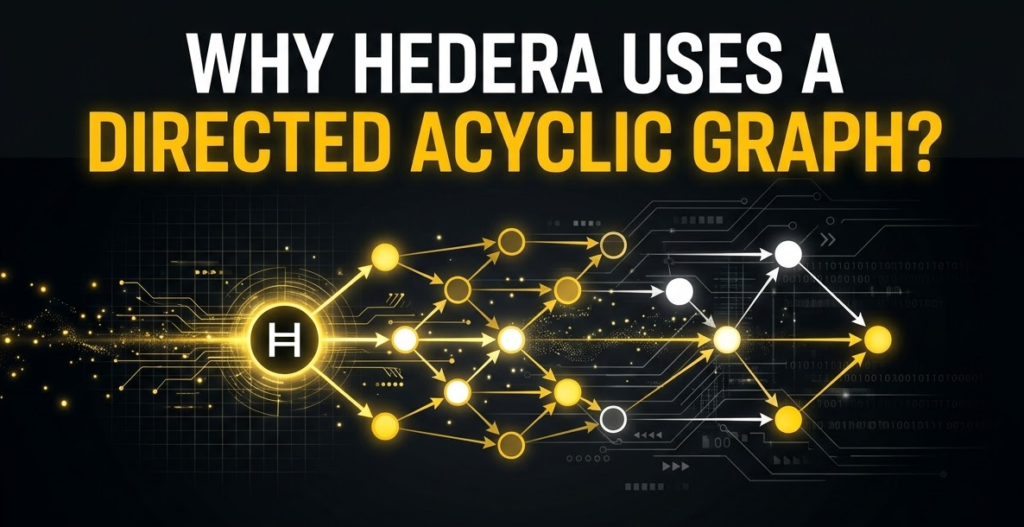
Why Hedera Uses a Directed Acyclic Graph?
To understand what makes Hedera different, start with the way a distributed ledger records information.
A traditional blockchain organizes transactions into blocks. Those blocks are linked in chronological order, creating a chain that nodes agree upon through a consensus mechanism. Hashgraph takes another approach. Instead of organizing the ledger around a single sequence of blocks, it records communication events between network participants in a continuously expanding graph.
This difference affects how information spreads, how nodes establish transaction order, and how the network reaches consensus.
Why Hedera Is Not a Traditional Blockchain
In a conventional blockchain, transactions are collected and organized into blocks. Depending on the network, miners or validators propose blocks, and the consensus mechanism determines which proposed history becomes part of the accepted ledger.
Bitcoin, for example, uses Proof-of-Work to select the block-producing participant. Ethereum uses Proof-of-Stake, with validators proposing and attesting to blocks.
Hedera’s Hashgraph architecture does not depend on this same sequential block-production model.
Instead, nodes exchange information with one another and create events that record both transactions and the history of their communication. Each event contains cryptographic references to earlier events, allowing the network to reconstruct how information spread.
Those relationships form a Directed Acyclic Graph.
A DAG is a structure made up of connected elements, or vertices, linked through directed edges. The connections point in a particular direction and do not create cycles. In Hashgraph, the graph records the history of communication between nodes.
Think about it this way: a conventional blockchain resembles a chronological list of accepted chapters, where each new block follows the previous one. Hashgraph resembles a shared communication history in which many participants contribute events and preserve the relationships between them.
| Feature | Traditional blockchain | Hedera Hashgraph |
|---|---|---|
| Data organization | Sequential blocks | Directed acyclic graph of events |
| Information propagation | Depends on the blockchain protocol | Gossip-based communication |
| Consensus process | Varies by blockchain | Hashgraph consensus and virtual voting |
| Transaction ordering | Established through block consensus | Calculated from shared event history |
| Block competition | Present in some blockchain designs | No traditional competitive mining |
| Native asset | Depends on the network | HBAR |
| Consensus security | Depends on the consensus mechanism | aBFT Hashgraph consensus with stake-weighted participation |
There is an important nuance here. Saying that Hedera does not use traditional sequential blockchain blocks does not mean it lacks a ledger, transaction history, or consensus rules. It still maintains a shared state that participants can verify. The difference lies in how the network reaches agreement and represents the history used to establish that agreement.
You may also see Hedera described as a DAG-based distributed ledger technology. That is a useful technical description, although the Hashgraph algorithm is more specific than the general DAG category. Not every DAG-based cryptocurrency uses Hashgraph consensus.
Gossip-about-Gossip: How Event Data Spreads Across the Network
The first major building block of Hashgraph consensus is the gossip protocol.
Gossip is a communication method in which participants periodically share information with other participants. Rather than requiring every node to communicate directly with every other node for each update, a node selects another node and shares what it knows. The receiving node then repeats the process with other participants.
This approach allows information to spread rapidly through a network.
Imagine that Alice receives a transaction. She shares the relevant information with Bob. Bob already knows about several other transactions, so he passes that information along when he communicates with Carol. Carol then shares what she has learned with another participant.
As this process continues, information spreads through the network without requiring one central server to distribute every update.
Hashgraph takes this idea further through something called gossip-about-gossip.
The nodes do not only share transaction information. They also share information about the history of their previous communication.
That history is recorded through events.
Each event contains information such as:
- Transactions known to the node at the time.
- A timestamp associated with the event.
- A cryptographic hash referencing the node’s previous event.
- A cryptographic hash referencing the other participant’s previous event.
- The creator’s digital signature.
The two parent hashes are especially important. One represents the node’s own previous event, while the other references the event associated with the participant it communicated with.
By repeatedly creating and sharing these events, nodes build a graph that captures the history of information exchange.
This is where the term gossip-about-gossip comes from: the network is effectively sharing not only what it knows, but also how it learned that information.
The official Hedera explanation of gossip-about-gossip walks through this communication model. The original Hashgraph consensus whitepaper provides a more technical explanation of the event structure and consensus algorithm.
Why does this matter?
Because the communication history gives nodes enough information to reason about what other nodes have already received. They do not need to send a separate message for every vote in the consensus process.
That leads directly to the second major component: virtual voting.
Virtual Voting: Reaching Consensus Without Broadcasting Traditional Votes
In many distributed systems, participants exchange explicit voting messages to agree on the order of transactions or the validity of proposed blocks.
Hashgraph uses a different method.
Because nodes maintain the shared history of gossip events, they can calculate how other nodes would have voted based on the information available to those nodes at a particular point in time.
In other words, a node can reconstruct another participant’s hypothetical vote from the graph’s history.
That is the basic idea behind virtual voting.
Suppose Alice, Bob, and Carol have all received information about a transaction. The event graph records how that information moved through the network. Each node can inspect the history and determine which participants would have known about the transaction at specific points.
From that shared history, nodes calculate consensus results without sending a separate vote message for every decision.
This reduces the communication overhead associated with traditional voting approaches.
It is important not to interpret “virtual” as meaning that the network does not communicate. Nodes still exchange events, transactions, and signatures. The distinction is that the voting process is calculated from the existing shared event history rather than requiring an additional stream of explicit voting messages.
Hashgraph’s consensus algorithm is designed to provide Asynchronous Byzantine Fault Tolerance.
That is a significant security property.
A Byzantine fault-tolerant system is designed to continue reaching agreement even when some participants behave maliciously or send inconsistent information. Asynchronous fault tolerance means the system does not need to assume a strict upper limit on how long messages may take to arrive.
In practical terms, the algorithm is designed to maintain agreement despite certain malicious participants and unpredictable network delays, provided its security assumptions are satisfied.
For Hedera, this is combined with stake-weighted consensus participation.
The result is a system designed to establish transaction ordering and timestamps while preserving the security properties of the Hashgraph protocol.
What Does aBFT Mean for HBAR Users?
Asynchronous Byzantine Fault Tolerance is not something you directly interact with when sending HBAR. You do not need to understand the algorithm to transfer tokens or use a decentralized application.
However, it matters when evaluating the network.
aBFT is a formal security property, not a promise that a network can never experience outages, software defects, operational problems, or attacks outside the model’s assumptions.
When researching Hedera, I would separate three questions:
- Does the consensus algorithm provide strong theoretical fault-tolerance properties?
- How is the network’s validator and node infrastructure distributed in practice?
- How effectively does the ecosystem manage software upgrades, operational failures, and governance decisions?
The first question concerns the algorithm. The other two concern how the network is actually operated.
Enterprise Governance
Hedera’s governance structure is one of the most recognizable parts of its identity.
Many cryptocurrency networks use token-based governance, informal developer coordination, or validator voting. Hedera instead has a formal Governing Council made up of organizations from different industries and regions.
The idea is to combine public-network access with a structured governance process that enterprises can understand.
This approach has advantages, but it also creates a different decentralization profile from networks where anyone can immediately operate a permissionless consensus validator.
Structure and Voting Power of the Governing Council
The Hedera Governing Council is designed to include up to 39 organizations.
Members are selected from different industries and geographic regions. The aim is to avoid having one company or one narrow industry dominate the governance process.
Organizations associated with the council have included major technology, telecommunications, manufacturing, financial, and academic institutions.
Examples include:
- Google.
- IBM.
- Boeing.
- Dell Technologies.
- Deutsche Telekom.
- FedEx.
These organizations bring different forms of expertise. A telecommunications company may understand large-scale infrastructure and network operations, while a technology company may contribute experience in cloud systems, software engineering, or enterprise integration.
Council members participate in governance activities, including decisions related to network development and strategic direction. They also operate consensus nodes under the network’s current governance model.
The Hedera Council membership page explains the council’s structure and the role of its members.
How Does Council Voting Work?
Council members have equal voting rights in the Governing Council’s governance process, subject to the applicable governing documents and decision rules.
This should not be confused with HBAR-weighted consensus.
There are two different mechanisms:
| Mechanism | What it determines |
|---|---|
| Council governance voting | Organizational decisions and network governance |
| Stake-weighted consensus | The influence of consensus nodes in the Hashgraph process |
The distinction is important because an organization does not receive a fixed percentage of all network consensus weight simply because it has a council seat.
The outline’s example of approximately 2.56% per member comes from dividing one vote by 39 seats. That is only a mathematical illustration of equal voting rights if all 39 seats are occupied. It should not be interpreted as a universal percentage of network stake or consensus power.
Why Would Enterprises Participate in Blockchain Governance?
For large organizations, governance predictability matters.
A company evaluating distributed-ledger technology may want to understand who can approve software changes, how operational responsibilities are distributed, and how the network handles disagreements.
A formal council provides a visible governance structure. It can make decision-making easier to document and communicate to enterprise stakeholders.
However, a structured council also means that governance is not identical to a fully open system in which anonymous token holders can independently make protocol decisions.
There is a trade-off between institutional accountability and open participation.
I would not automatically call that trade-off good or bad. It depends on what you expect from a public network.
If you prioritize a clear institutional governance framework, Hedera’s model may appeal to you. If your priority is permissionless participation at every level, you should examine its node decentralization roadmap more closely.
The Roadmap Toward Greater Node Decentralization
Hedera has described a phased approach to expanding the number and types of participants operating network nodes.
The broad objective is to move beyond a system where consensus infrastructure is concentrated among Governing Council organizations.
The network’s decentralization plans have included:
- Council-operated consensus nodes.
- Additional permissioned community nodes.
- A longer-term goal of permissionless consensus participation.
The Hedera decentralization overview describes the planned progression toward permissionless nodes.
It is important to distinguish the roadmap from the network’s actual current state.
A public network can allow anyone to read transaction records, submit transactions, and operate mirror-node infrastructure while still restricting who can run consensus nodes.
These are separate forms of participation.
Consensus Nodes vs. Mirror Nodes
A consensus node participates in the process that establishes transaction consensus.
A mirror node provides access to network data, such as transaction history and account information, without performing the same consensus role.
| Feature | Consensus node | Mirror node |
|---|---|---|
| Participates in consensus | Yes | No |
| Helps establish transaction order | Yes | No |
| Maintains network data | Yes | Stores and serves network information |
| Public data access | Not its primary role | Yes |
| Permissionless operation | Depends on current network rules | More open participation |
| Main purpose | Consensus and network operations | Data access, indexing, and application support |
As of the network model described in Hedera’s official documentation, mainnet consensus participation has been more restricted than mirror-node operation. That means you should not describe the mainnet as fully permissionless simply because it is a public network.
The Hedera roadmap is a useful place to check the current development direction and the status of decentralization-related initiatives.
Native Network Services
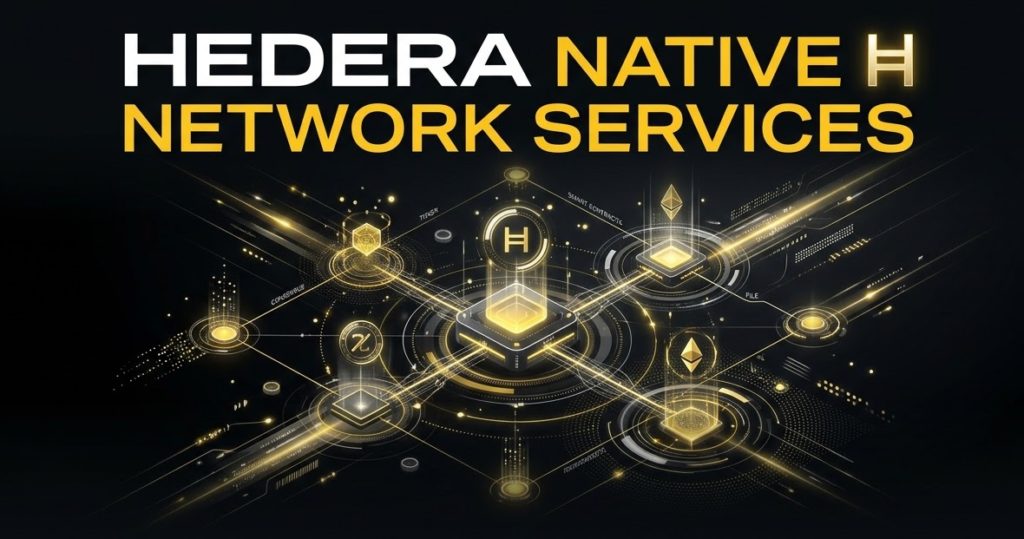
Hedera’s architecture is not only about consensus. The network also provides services designed to make common distributed-ledger operations easier for developers and businesses.
Three services deserve particular attention:
- Hedera Consensus Service.
- Hedera Token Service.
- Hedera Smart Contract Service.
Each one solves a different problem.
Hedera Consensus Service: A Decentralized Timestamping Engine
The Hedera Consensus Service, or HCS, allows applications to submit messages to the network and obtain a consensus order and timestamp.
This is useful when an application needs to establish that a particular event was recorded in a specific order.
Consider a supply-chain business tracking a shipment.
Different parties may record events such as:
- A product leaving a manufacturing facility.
- A shipment entering a distribution center.
- A package passing a customs checkpoint.
- A delivery being completed.
If each company maintains its own private database, it can become difficult to establish a consistent timeline when records disagree.
HCS provides a way to submit messages to a shared public consensus layer. The network establishes their ordering and assigns consensus timestamps.
The application can then use those records as evidence when reconstructing the sequence of events.
How HCS Works
At a high level, the process looks like this:
- An application creates a message.
- The message is submitted to a Hedera topic.
- The network reaches consensus on the message’s ordering.
- A consensus timestamp is assigned.
- Applications can retrieve the resulting message history through appropriate network infrastructure.
The topic is an important concept. It acts as a shared channel for messages associated with a particular application or workflow.
The service does not require every business to deploy a separate blockchain.
Instead, organizations can use the public consensus layer to establish a common event history while maintaining their own application logic and databases.
This is particularly useful for audit trails, supply-chain tracking, and multi-party workflows.
Why Consensus Timestamps Matter
Imagine two organizations disagree about which event happened first.
One database says a shipment was inspected before it left a warehouse. Another says the inspection happened afterward.
If the organizations use a shared consensus service, they can refer to the ordering established by the network rather than relying exclusively on their individual database timestamps.
That does not automatically prove that the real-world event was accurately reported. A blockchain can establish when information was submitted and the order in which it was recorded, but it cannot independently verify whether the original information was truthful.
This is an important distinction for enterprise applications.
HCS can improve the integrity of an audit trail, but businesses still need reliable data collection, identity controls, and operational procedures.
You can explore the Hedera Consensus Service documentation to understand how topics, messages, and consensus timestamps work.
Hedera Token Service: Creating Tokens Without Deploying Custom Smart Contracts
The Hedera Token Service, or HTS, allows developers to create and manage fungible tokens and non-fungible tokens through native network functionality.
This is a useful alternative to building every token operation through a custom smart contract.
On some smart-contract platforms, a developer must deploy a token contract and implement functions for transfers, balances, minting, burning, and administrative permissions.
HTS provides native token operations as part of the Hedera network.
That means developers can create tokens without having to write a completely custom contract for every basic asset-management function.
What Can You Create With HTS?
HTS supports several common token functions:
| Function | Purpose |
|---|---|
| Token creation | Establish a new fungible or non-fungible token |
| Minting | Increase the token supply when permitted |
| Burning | Reduce the token supply |
| Transfers | Move tokens between accounts |
| Freeze and unfreeze | Control whether an account can transact with a token |
| KYC management | Grant or revoke KYC status where configured |
| Wipe | Remove tokens from an account when the required permissions exist |
| Supply management | Control token issuance and supply-related operations |
These features are particularly relevant for businesses issuing loyalty points, digital credentials, stablecoins, supply-chain assets, and tokenized financial products.
How HTS Token Permissions Work
HTS tokens can have different administrative keys.
For example, a token may have:
- An admin key.
- A supply key.
- A freeze key.
- A wipe key.
- A KYC key.
- A pause key.
- A fee schedule key.
Not every token needs every key. The configuration depends on the asset’s intended use.
A loyalty-point token may require an admin and supply key so the issuer can manage issuance. A regulated asset may also need KYC and freeze functionality.
This flexibility is useful, but it creates responsibilities.
If you are issuing a token, you need to decide who controls its administrative permissions and what happens if those keys are lost, compromised, or transferred.
A token may be technically transferable while still being subject to administrative restrictions.
What Does HTS Cost?
HTS fees are based on the network’s published fee schedule and are paid in HBAR.
A commonly cited historical example is a typical token-creation fee of approximately $1, while a simple token transfer has often been quoted around $0.001. These are reference examples, not universal guarantees. The actual fee can change with the applicable schedule and the details of the transaction.
For instance, a token creation request with several administrative keys may cost more than a simpler configuration. Additional signatures and operations can also affect the total fee.
Hedera’s HTS fee explanation provides examples of typical costs and explains why transaction details matter.
If you are planning a production application, use the current fee schedule or fee estimator rather than hardcoding a historical fee into your business model.
Hedera Smart Contract Service: EVM Compatibility
The Hedera Smart Contract Service provides an environment for deploying and executing smart contracts.
It supports Ethereum Virtual Machine compatibility, allowing developers to use familiar Solidity-based development tools and workflows.
This matters because Ethereum has a large developer ecosystem. Many developers already understand Solidity, EVM execution, and tools such as Hardhat and other Ethereum-compatible frameworks.
Hedera’s EVM compatibility reduces the learning curve for developers who want to build applications on the network.
What Can Developers Build?
The Smart Contract Service can support applications such as:
- Decentralized exchanges.
- Lending and borrowing protocols.
- NFT marketplaces.
- Tokenized asset platforms.
- On-chain governance applications.
- Payment and settlement systems.
Developers can use Solidity and familiar EVM tooling while taking advantage of Hedera’s network infrastructure.
However, EVM compatibility does not mean every Ethereum application can be transferred without modification.
Differences in network configuration, transaction handling, precompiles, gas accounting, supported features, and external dependencies may require testing and adaptation.
A contract that works on Ethereum should not be assumed to work identically on Hedera without a proper deployment and security review.
HTS vs. Smart Contracts: Which Should You Use?
The two services can complement one another.
If you want to create a basic fungible token with standard administrative functions, HTS may be a straightforward option.
If you need complex application logic, custom financial rules, or interactions between multiple contracts, the Smart Contract Service may be more suitable.
| Requirement | Likely suitable service |
|---|---|
| Create a basic fungible token | HTS |
| Create an NFT | HTS |
| Manage standard token permissions | HTS |
| Execute custom Solidity logic | Smart Contract Service |
| Build a decentralized exchange | Smart Contract Service, often with HTS integration |
| Record ordered application events | HCS |
| Combine tokens with custom business rules | HTS and Smart Contract Service |
The best architecture depends on what you are building. Developers should avoid deploying custom contracts for functions already supported natively unless there is a clear reason to do so.
HBAR Tokenomics

HBAR is the economic foundation of the Hedera network.
It serves two main purposes: paying for network services and contributing to network security through Proof-of-Stake.
Its tokenomics are relatively straightforward at the headline level. HBAR has a fixed maximum supply of 50 billion coins. Network fees are denominated in USD but paid in HBAR, and holders can proxy stake their balances to consensus nodes.
However, each of these features deserves a closer look.
The 50 Billion Fixed Token Supply Ceiling
HBAR has a maximum supply of 50 billion tokens.
Unlike cryptocurrencies that issue new coins indefinitely through mining or staking rewards, Hedera’s total HBAR supply was created at network launch.
The coins were initially placed into treasury accounts and distributed over time according to the network’s allocation and release arrangements.
The fixed cap means the protocol is not designed to create additional HBAR beyond the 50 billion maximum.
The Hedera Treasury Management report explains how the network tracks total supply, released supply, allocated supply, and unreleased treasury balances.
Total Supply vs Circulating Supply
These terms are often confused, especially when people compare market capitalization across cryptocurrency projects.
Total supply refers to the number of HBAR that exist under the network’s supply rules.
Circulating supply represents the amount considered available in the market according to the methodology used by a particular data provider.
Unreleased tokens may remain in treasury accounts or be allocated for future purposes without being freely available to ordinary market participants.
This distinction matters because market capitalization is generally calculated using circulating supply, while fully diluted valuation uses the maximum supply.
For example, imagine HBAR trades at $0.10.
If the circulating supply is 40 billion HBAR, the implied circulating market capitalization is:
40 billion × $0.10 = $4 billion
Using the full 50 billion supply, the fully diluted valuation would be:
50 billion × $0.10 = $5 billion
These calculations are illustrative, not current market valuations.
How Is the 50 Billion HBAR Supply Distributed?
The original allocation and subsequent treasury releases have been managed through Hedera’s governance and treasury processes.
The network has used HBAR to support several categories, including:
- Ecosystem development.
- Network operations.
- Early investors and contributors.
- Employee and advisor compensation.
- Grants and developer incentives.
- Other approved ecosystem and treasury purposes.
You should be careful when quoting allocation percentages from older articles. Treasury releases, grants, and transfers can change the amount of HBAR held in different accounts.
For current supply and distribution information, the official treasury report is more useful than an outdated token-allocation infographic.
Are Staking Rewards Inflationary?
Not in the same way as a cryptocurrency that continuously mints new tokens beyond its original supply.
Hedera’s staking reward system operates within the existing 50 billion HBAR supply. Rewards can be distributed from designated network funds and treasury allocations.
That means staking rewards do not automatically increase the maximum supply.
However, a fixed maximum supply does not mean that every HBAR is already circulating. The timing and method of treasury releases remain important factors when evaluating potential supply changes in the market.
USD-Pegged Transaction Fees: Predictable Costs for Enterprises
One of Hedera’s major selling points is its fee model.
Instead of allowing the USD value of a transaction fee to fluctuate directly with the market price of HBAR, Hedera sets fees using USD-denominated rates.
Users still pay in HBAR.
The network calculates the HBAR amount using the applicable exchange-rate information at the time of the transaction.
This creates a useful distinction:
- The underlying fee schedule is denominated in USD.
- The amount of HBAR required can change with the HBAR/USD exchange rate.
Suppose a particular transaction has a network fee of $0.001.
If HBAR is worth $0.10, the equivalent payment is:
$0.001 ÷ $0.10 = 0.01 HBAR
If HBAR rises to $0.20, the same USD-denominated fee would require:
$0.001 ÷ $0.20 = 0.005 HBAR
The USD cost remains the same under the same fee schedule, but the number of HBAR paid changes.
This is useful for businesses that need to estimate operating costs.
Imagine a company processing millions of token transfers. If transaction costs changed dramatically with network congestion or token price movements, forecasting application expenses could become difficult.
A USD-based fee schedule gives developers a more predictable basis for estimating costs.
Does Every HBAR Transfer Cost $0.0001?
No. You should not treat $0.0001 as a universal fee for every HBAR transfer.
The actual fee depends on the transaction type, the number of signatures, the operation being performed, and the current fee schedule.
Historical Hedera materials have quoted different typical fees for simple transfers and native token operations. More recent disclosures have also used average transaction-cost figures that differ from older examples.
The Hedera fee documentation should be your reference for current transaction categories and pricing.
For example, an ordinary HBAR transfer, an HTS token creation, a contract call, and a transaction requiring several signatures are not equivalent operations.
They consume different network resources and can carry different fees.
Why This Model Appeals to Enterprises
Businesses generally care about more than whether a transaction is cheap.
They also want to know whether the cost can be forecast, whether the payment process is consistent, and whether the infrastructure can support the application’s expected workload.
USD-denominated fees help with financial planning because developers can estimate the cost of an operation in a familiar currency.
That does not eliminate all uncertainty. Exchange rates, fee schedule changes, and transaction complexity still matter.
But it provides a more predictable cost structure than a model where fees are directly auctioned through a continuously changing market.
Native Proxy Staking: How HBAR Holders Participate in Security
HBAR holders can participate in network security through native staking.
The system allows an account to proxy its stake to a consensus node. The node’s consensus weight reflects the HBAR staked to it, subject to the network’s rules and limits.
This provides a way for ordinary holders to contribute to the network without operating validator infrastructure themselves.
How Proxy Staking Works
The process is relatively simple:
- You hold HBAR in a supported account.
- You select an eligible consensus node.
- You submit a staking transaction that assigns your stake to that node.
- Your HBAR contributes to the node’s stake weight.
- If the node and your account meet the reward conditions, you may receive staking rewards.
You do not need to send your HBAR to the node operator.
This is an important security distinction. Native proxy staking does not require you to transfer custody of your coins to the validator.
Your HBAR remains in your account, subject to the normal account and network rules.
Does Hedera Staking Lock Your HBAR?
Hedera’s native proxy staking model does not require the same type of bonding or lockup commonly associated with other Proof-of-Stake networks.
The HBAR remains liquid, and the network’s native staking model does not impose slashing penalties on the staked balance.
That does not mean every staking product using HBAR has the same risk profile.
A third-party platform may offer a separate staking or lending arrangement that requires you to deposit assets into a contract or transfer them to a custodian. Those products can introduce risks that do not exist in native proxy staking.
Always distinguish native staking from third-party yield products.
The official Hedera staking FAQ explains how proxy staking differs from delegated Proof-of-Stake systems.
How Much Can You Earn?
Staking rewards are variable.
They depend on network parameters, reward funding, node eligibility, and the amount of stake participating in the system.
Hedera’s public information has described reward rates that can change over time. A quoted annual percentage should therefore be treated as an estimate or current parameter, not a permanent guarantee.
The Hedera explanation of staking describes how stake weight influences consensus and how rewards are distributed.
If you are staking HBAR, check the current reward information in your wallet or through official network resources before making assumptions about expected income.
Common Pitfalls and Misconceptions About Hedera (HBAR)
Hedera has several technical features that are easy to misunderstand if you approach it with assumptions taken from Bitcoin or Ethereum.
Here are three common mistakes worth avoiding.
Misconception #1: Hedera Is a Standard Blockchain
Hedera is a distributed ledger, but it does not use the conventional sequential block structure associated with traditional blockchains.
Its consensus algorithm uses a Hashgraph data structure, built from events connected through cryptographic hashes.
That is why it is more precise to describe Hedera as a Hashgraph-based distributed ledger rather than simply calling it a standard blockchain.
This distinction does not mean Hedera lacks familiar blockchain functionality. It still supports transactions, tokens, smart contracts, public account data, and consensus-based recordkeeping.
The difference is architectural.
Misconception #2: HBAR Fees Fluctuate Unpredictably With Crypto Volatility
HBAR’s market price can move significantly, but Hedera’s network fees are denominated in USD.
The network converts the applicable USD fee into HBAR when the transaction is processed.
This means that the number of HBAR required for a transaction can change as the market price changes, while the underlying USD-denominated fee remains tied to the published schedule.
You should still check the actual transaction fee. Different operations have different costs, and the schedule can be updated.
The mistake is assuming that Hedera uses exactly the same fee-auction model as every other smart-contract blockchain.
Misconception #3: Anyone Can Operate a Mainnet Consensus Node Today
A public network is not automatically a permissionless consensus network.
Hedera’s mainnet consensus infrastructure has operated under a more restricted model involving Governing Council organizations, while mirror-node participation is more open.
This is an important distinction when evaluating decentralization.
You can interact with the public network without being a council member. You can build applications, hold HBAR, submit transactions, and access network data.
But that does not necessarily mean you can independently start a mainnet consensus node under the same conditions as an existing council operator.
Hedera has described a roadmap toward broader node participation, and you should check the official roadmap for the latest status rather than assuming a future phase has already been completed.
System Architecture
Hedera’s architecture becomes easier to understand when you separate the consensus layer, governance structure, network services, and native cryptocurrency.
The following diagram summarizes those relationships.
                    HEDERA PUBLIC NETWORK
                            |
                Hashgraph Consensus Algorithm
                            |
             +--------------+--------------+
             |                             |
       Gossip-about-Gossip             Virtual Voting
             |                             |
             +--------------+--------------+
                            |
                aBFT Consensus and Ordering
                            |
              Hedera Governing Council
                            |
              Consensus Node Infrastructure
                            |
       +--------------------+--------------------+
       |                    |                    |
      HCS                  HTS                  HSCS
       |                    |                    |
  Event ordering       Native tokens       EVM smart contracts
  Timestamps           NFTs and assets      Solidity applications
       |                    |                    |
       +--------------------+--------------------+
                            |
                           HBAR
                            |
            +---------------+---------------+
            |               |               |
         Network fees    Proxy staking   Native payments
            |
       50 Billion Maximum Supply
The diagram is conceptual. Governance, consensus, and application services are connected, but they are not the same component.
For example, the Governing Council oversees governance decisions, while Hashgraph consensus establishes transaction ordering. HCS, HTS, and HSCS provide different application-level services, and HBAR is the native cryptocurrency used throughout the network.
How to Stake HBAR and Create Tokens Through HTS
If you want to explore Hedera beyond simply holding HBAR, two useful starting points are native proxy staking and token creation through HTS.
You do not need to become a protocol engineer to understand the basic process, but you should know what each transaction authorizes.
Phase One: Native Proxy Staking HBAR
Step 1: Choose a Compatible Wallet
Start with a wallet that supports Hedera accounts and native staking functionality.
Examples of wallets used in the Hedera ecosystem include HashPack and Blade Wallet. Before downloading any wallet, verify its official website and application distribution channel.
A wallet is the interface you use to manage your account and authorize transactions. It does not change the underlying staking rules.
Step 2: Check Your HBAR Balance
Make sure your account has enough HBAR to cover the staking transaction and any other network fees.
Do not stake funds that you may need immediately for another purpose without first understanding how the wallet and network handle account operations.
Native proxy staking does not require you to send your HBAR to a validator, but you still need to understand the account’s available balance and staking configuration.
Step 3: Select an Eligible Consensus Node
Open the staking section of your wallet and review the available node options.
Consider factors such as:
- Node eligibility.
- Reward conditions.
- Stake weight.
- Operational reliability.
- Available information about the node operator.
Do not select a node based only on a headline reward percentage. Reward eligibility and network parameters can change.
Step 4: Confirm the Staking Transaction
Choose the node and review the staking details before signing.
The transaction assigns your account’s stake to the selected node. It does not transfer your private keys or automatically send your HBAR to the node operator.
Once the transaction is confirmed, check your account information to make sure the selected staking configuration is reflected correctly.
Step 5: Monitor Your Rewards
Staking rewards depend on current network conditions and eligibility rules.
Check your wallet or official Hedera resources periodically. If you change your staking node or update your account configuration, review how that affects reward eligibility.
Phase Two: Creating a Token With Hedera Token Service
HTS allows developers to create fungible and non-fungible tokens through native network transactions.
You can use a developer interface, an SDK, or a suitable application that supports HTS.
Step 1: Define Your Token Parameters
Before creating a token, decide what you are issuing.
Typical parameters include:
| Parameter | Purpose |
|---|---|
| Token name | Human-readable asset name |
| Symbol | Short identifier |
| Initial supply | Number of units created initially |
| Decimals | Precision for fungible tokens |
| Treasury account | Account receiving the initial supply |
| Admin key | Administrative control, if configured |
| Supply key | Permission to mint or burn |
| KYC key | Permission to manage KYC status |
| Freeze key | Permission to freeze or unfreeze accounts |
| Wipe key | Permission to remove tokens from accounts |
| Pause key | Permission to pause token operations, if configured |
You do not need every administrative key. In fact, adding unnecessary permissions can increase operational risk.
Think carefully about which controls your token actually needs.
Step 2: Choose Your Creation Method
Developers can create HTS tokens using Hedera SDKs and supported transaction interfaces.
A token creation request defines the asset’s properties and the relevant administrative permissions.
The network processes the request and assigns a native token identifier.
Step 3: Pay the Applicable Fee in HBAR
HTS operations require network fees, which are paid in HBAR.
A commonly referenced typical fee for basic token creation has been around $1, but the exact amount depends on the current fee schedule and the complexity of the request.
Do not assume that every token creation request costs exactly the same amount.
Check the current Hedera network fee documentation before deploying a production asset.
Step 4: Receive the Token ID
Once the transaction succeeds, the network returns a token identifier.
This identifier is important because it distinguishes your asset from other tokens with similar names or symbols.
Keep the identifier and relevant transaction records somewhere secure.
Step 5: Test Token Operations
Before distributing the asset to users, test the operations your application needs.
For example:
- Transfer tokens between accounts.
- Mint additional units if a supply key exists.
- Burn tokens where permitted.
- Associate accounts with the token.
- Check administrative permissions.
- Verify any freeze or KYC restrictions.
A token that can be created successfully is not necessarily ready for a production application. You should test its full lifecycle and confirm that its permission model matches your intended use.
Frequently Asked Questions About Hedera (HBAR)
What Is Hedera, and How Does It Work?
Hedera is a public distributed ledger that uses the Hashgraph consensus algorithm. Its architecture relies on a Directed Acyclic Graph of events, gossip-about-gossip communication, and virtual voting to establish transaction order.
HBAR is its native cryptocurrency. It is used to pay network fees and participate in the network’s Proof-of-Stake security model.
Is Hedera Hashgraph a Blockchain?
Hedera is not a traditional sequential blockchain. It uses Hashgraph, a DAG-based distributed consensus architecture.
The network still provides familiar distributed-ledger functionality, including transactions, tokens, smart contracts, and public records. The main difference is how it represents event history and reaches consensus.
How Does Gossip-about-Gossip Work?
Gossip-about-gossip is a communication method in which nodes share transaction information along with cryptographic references to their previous communication events.
These references allow participants to reconstruct how information spread through the network. The resulting event graph provides the history used by the virtual voting algorithm to calculate consensus.
What Is Virtual Voting?
Virtual voting is a method through which nodes calculate how other participants would have voted based on the shared Hashgraph event history.
Instead of broadcasting a separate voting message for every consensus decision, nodes use the information already contained in the graph to calculate the expected votes locally.
This reduces additional communication overhead.
What Is Asynchronous Byzantine Fault Tolerance?
Asynchronous Byzantine Fault Tolerance, or aBFT, is a security property designed to allow a distributed system to reach agreement even when some participants behave maliciously and message delays are unpredictable.
Hedera’s Hashgraph algorithm is designed to provide this property under its protocol assumptions.
It does not mean that the network is immune to every possible software defect, operational failure, or attack.
What Is the Hedera Governing Council?
The Hedera Governing Council is a group of organizations responsible for overseeing network governance and strategic direction.
It has capacity for up to 39 members, with organizations from different industries and geographic regions. Members participate in governance activities and operate consensus nodes under the network’s current operating model.
Who Created Hedera?
Hedera was founded by Dr. Leemon Baird and Mance Harmon.
Baird invented the Hashgraph consensus algorithm, while the project was originally developed through Swirlds, the technology company associated with the founders.
What Is the Maximum Supply of HBAR?
HBAR has a maximum supply of 50 billion tokens.
The total supply was created at network launch and distributed over time through treasury and ecosystem arrangements. The network’s staking rewards operate within this existing supply rather than creating additional tokens beyond the maximum cap.
How Much Does a Hedera Transaction Cost?
Hedera uses a USD-denominated fee schedule, with users paying the corresponding amount in HBAR.
The fee depends on the transaction type and the applicable network schedule. A simple transfer, a token creation request, and a smart contract operation can have different costs.
For an accurate estimate, check the current official fee schedule.
Are Hedera Fees Fixed in USD?
Hedera fees are set using USD-denominated prices, but users pay in HBAR.
The number of HBAR required can change as the token’s market exchange rate changes. The underlying USD fee is designed to provide greater cost predictability for applications and businesses.
Does Hedera Support Smart Contracts?
Yes. Hedera offers the Smart Contract Service, which supports EVM-compatible smart contracts and Solidity-based development.
Developers can use familiar Ethereum tooling, although they should test applications for differences in network behavior and supported features before deployment.
What Is the Difference Between HCS and HTS?
HCS is the Hedera Consensus Service. It allows applications to submit messages and obtain a consensus order and timestamp.
HTS is the Hedera Token Service. It allows developers to create and manage fungible tokens and NFTs through native network functionality.
HCS focuses on event ordering and timestamping, while HTS focuses on digital assets.
Can Anyone Run a Hedera Mainnet Consensus Node?
Mainnet consensus participation has historically operated under a restricted model involving Governing Council organizations.
Mirror-node participation and access to public network data are more open. Hedera has described a roadmap toward broader consensus-node decentralization, but you should check the current official roadmap before assuming permissionless consensus participation is fully available.
Does Native HBAR Staking Lock My Tokens?
Hedera’s native proxy staking model does not require the same bonding or lockup process used by many other Proof-of-Stake networks.
Your HBAR remains in your account, and native staking does not impose slashing penalties on the staked balance.
Third-party staking products may operate differently and can introduce additional custody or smart contract risks.
Final Thoughts
Hedera stands out because it approaches distributed consensus differently from the conventional blockchain model. Instead of organizing transaction history into a traditional sequence of blocks, it uses a Hashgraph DAG that records communication events between nodes. Gossip-about-gossip and virtual voting then allow participants to calculate consensus from that shared history.
The technology is only part of the story, though.
The Hedera Governing Council provides a structured governance model with participation from established organizations. HCS gives developers a way to establish verifiable event ordering, HTS makes native token creation more accessible, and the Smart Contract Service provides an EVM-compatible environment for Solidity applications.
HBAR ties these components together through network fees and Proof-of-Stake participation. Its 50 billion maximum supply, USD-denominated fee schedule, and native proxy staking model give the network an economic structure that differs from many other crypto projects.
Still, I would not evaluate Hedera based only on its advertised speed or enterprise partnerships. You should also examine how consensus-node participation is distributed, how governance decisions are made, how much real application activity takes place, and whether that activity creates meaningful demand for HBAR.
That is the more useful way to approach the project: understand the technology, inspect the governance model, and then decide whether the network’s actual utility supports the long-term case for its native asset.