Key Specifications and Architectural Overview of PancakeSwap
PancakeSwap started as a decentralized exchange on BNB Smart Chain, but it has grown into something much broader. Today, it is a multi-chain DeFi ecosystem where users can swap tokens, provide liquidity, earn rewards, participate in token launches, and access products such as perpetual trading and prediction markets.
Its core trading system is based on the automated market maker (AMM) model. Rather than matching every buyer with an individual seller through a traditional order book, PancakeSwap allows users to trade against liquidity held in smart contract pools. The protocol has also introduced more advanced liquidity designs, including V3 concentrated liquidity and PancakeSwap Infinity, giving liquidity providers more control over how their capital is deployed.
The other major part of the story is CAKE. The token has gone through several economic redesigns, moving away from the high-emission model associated with its early years. Under Tokenomics 3.0, PancakeSwap introduced a more controlled approach to emissions and buybacks, with a stated target of reducing total CAKE supply by approximately 20% by 2030. In January 2026, the community approved a further reduction in the maximum supply cap from 450 million to 400 million CAKE.
That is a meaningful change, but it does not mean CAKE’s price must rise. A hard cap limits the maximum number of tokens that can exist; it does not guarantee demand, profitability, or appreciation.
PancakeSwap at a glance
| Dimension | Technical specification |
|---|---|
| Protocol | PancakeSwap |
| Origin | BNB Smart Chain |
| Core trading model | Automated Market Maker |
| Main liquidity engines | V2, V3 and PancakeSwap Infinity |
| Advanced liquidity feature | V3 concentrated liquidity |
| Trading execution | Smart Router |
| Supported networks | Multiple EVM and non-EVM networks, with product-specific availability |
| Native token | CAKE |
| Maximum CAKE supply | 400 million |
| Tokenomics framework | Tokenomics 3.0 |
| Supply objective | Approximately 20% total supply reduction by 2030 |
| Token burn sources | Spot trading, perpetual trading, CAKE.PADs, prediction and lottery |
| Other ecosystem products | Syrup Pools, farms, IFOs/CAKE.PADs, perpetuals, prediction and lottery |
PancakeSwap’s official product overview describes its three broad activity areas as Trade, Earn, and Win. That framing is useful because it shows why the protocol is no longer just a token swap page. Trading remains the foundation, but liquidity provision, token distribution, staking products, and other applications bring different types of users into the ecosystem.
The official CAKE tokenomics documentation is equally important. It explains the current supply cap, the product-level burn mechanisms, and the relationship between token emissions and the protocol’s deflation target.
One thing I would keep in mind throughout this guide: PancakeSwap is a collection of products deployed across different networks, not one identical smart contract system copied everywhere. A feature available on BNB Chain may not be available on Solana, Aptos, or every other supported network. Always check the specific chain and product before assuming that a feature works in the same way across the ecosystem.
Evolution Beyond BNB Chain: The Multi-Chain DEX Architecture
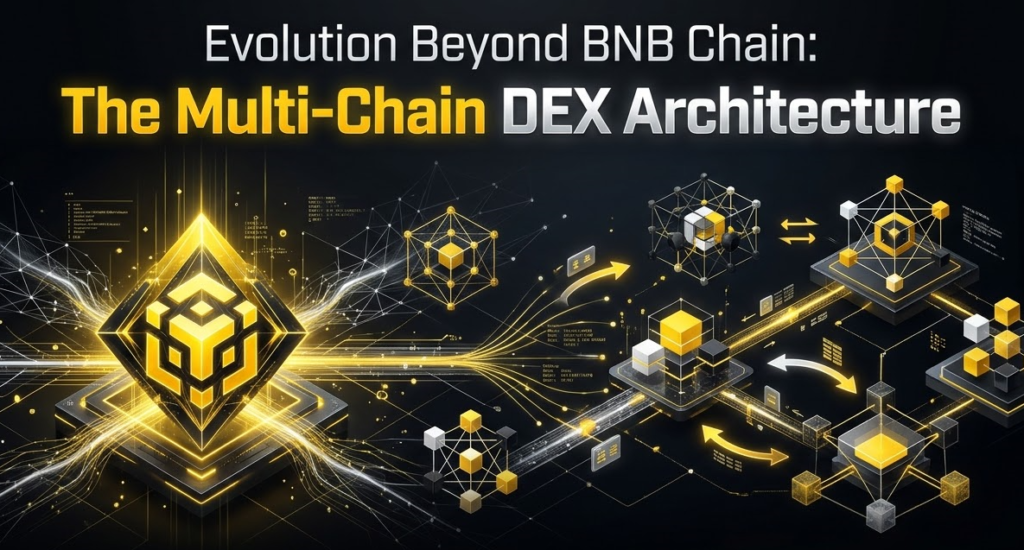
When PancakeSwap launched in 2020, its identity was closely tied to BNB Chain. The network offered relatively inexpensive transactions and a growing ecosystem of tokens, making it a natural environment for an AMM DEX aimed at retail users.
That early positioning helped PancakeSwap gain traction. Users could swap tokens without opening an account at a centralized exchange, while liquidity providers could deposit assets into pools and earn a share of trading fees.
But DeFi does not stay in one place for long. As Ethereum Layer 2 networks expanded and alternative ecosystems attracted users, a BNB-only strategy would have limited PancakeSwap’s reach. The protocol gradually expanded its deployment footprint, bringing versions of its trading and liquidity products to additional networks.
From BNB Chain pioneer to a multi-chain ecosystem
PancakeSwap’s expansion has included major EVM networks such as Ethereum, Arbitrum, Base, opBNB, zkSync Era, Linea, and Polygon zkEVM, alongside non-EVM ecosystems such as Aptos and Solana. Its product pages and announcements have also reflected newer network integrations, including Monad.
The exact list depends on the product. For example, a network may support a swap interface without supporting every version of V3 liquidity, yield farming, or token launch functionality. That distinction matters more than a headline count of supported chains.
PancakeSwap’s business partnership documentation lists its multi-chain deployments and explains that launchpad availability differs by network. Its product overview provides another view of the supported ecosystem.
Why does this expansion matter?
Imagine that you hold ETH on Arbitrum, USDC on Base, and BNB on BNB Chain. You may prefer to trade on the network where your assets already sit, rather than bridge everything to one chain before using a DEX.
A multi-chain deployment can make PancakeSwap accessible to users with different assets, wallets, and transaction-cost preferences. It also gives token projects more opportunities to reach traders and liquidity providers.
However, multi-chain access does not mean that all assets are interchangeable or that every deployment shares one pool of liquidity. A CAKE token on one network may be represented through a bridged or cross-chain token mechanism. Liquidity on Base is not automatically available to a trader swapping on BNB Chain.
You should always confirm the network shown in your wallet and the token contract address before approving a transaction.
Why PancakeSwap’s multi-chain strategy matters
The expansion offers several potential benefits:
- More users: Traders can access PancakeSwap from networks they already use.
- More trading markets: Each deployment can support tokens and liquidity native to its ecosystem.
- Broader project distribution: Token teams can reach users across different networks.
- More liquidity opportunities: LPs can choose pools based on the chain, trading pair, and fee structure that suit them.
- Less dependence on one ecosystem: Activity is not tied exclusively to BNB Chain.
There are also trade-offs. Liquidity can fragment across chains, and users may face bridging costs, different gas tokens, and different smart contract risks. A token pair with deep liquidity on BNB Chain may have a much thinner market on another network.
For this reason, I would not evaluate PancakeSwap’s multi-chain strategy only by counting deployments. The more useful questions are whether each deployment attracts real traders, whether pools have meaningful depth, and whether the products available on that chain are actively maintained.
Smart Router: How PancakeSwap finds trading routes
A DEX can have several liquidity sources for the same token pair. There may be a V2 pool, multiple V3 pools with different fee tiers, a StableSwap pool, and even an integrated market maker offering a direct quote.
If a trader manually checked every source, finding the best route would be inconvenient. This is where PancakeSwap’s Smart Router comes in.
The Smart Router is an execution algorithm that evaluates available liquidity sources and selects a route for a swap. Depending on the network and supported integrations, it can use V2, V3, StableSwap, and approved market makers.
The router may choose a direct route through one pool, use multiple pools in sequence, or split a trade across liquidity sources when doing so improves the expected execution.
PancakeSwap’s Smart Router documentation explains that V3 routing can draw on several liquidity sources, including V2 and StableSwap on BNB Chain, as well as market-maker liquidity on supported networks.
This is useful because the pool with the lowest advertised fee is not necessarily the pool that gives you the best final output. A low-fee pool with shallow liquidity can produce more price impact than a pool with a slightly higher fee but much deeper reserves.
The router therefore needs to consider more than the nominal fee. It evaluates the trade path and the amount of liquidity available along that path.
Market-maker integration and off-chain quotes
PancakeSwap’s Smart Router can also compare AMM liquidity with quotes from designated market makers on supported networks.
A market maker is a professional trading entity that continuously provides buy and sell quotes. Unlike a conventional AMM pool, it can offer a specific amount of an asset at a quoted price without requiring the trade to be executed against a public pool’s constant-product curve.
PancakeSwap’s market-maker integration documentation describes how the Smart Router can compare eligible market-maker quotes with AMM prices and route a trade to whichever source offers better execution.
There is a practical limitation, though: market makers do not necessarily quote every asset or every trade size. Their availability can also change during volatile markets, maintenance periods, or major economic events. A large order may exceed the amount a market maker is willing to execute.
This is why you should review the final quote instead of assuming that Smart Router always guarantees the best possible price under every market condition.
Does Smart Router eliminate slippage?
No. It can help reduce slippage, but it cannot remove the economic effects of limited liquidity.
Slippage occurs when the final execution price differs from the expected price. It can happen because the pool is shallow, the trade is large, the market moves before confirmation, or the selected route has insufficient depth.
Smart Router attempts to improve the outcome by comparing available sources. It does not create unlimited liquidity.
Before confirming a swap, check:
- The estimated amount you will receive.
- The minimum amount accepted after slippage tolerance.
- The route selected by the router.
- The fee charged by each relevant pool.
- Whether the token has transfer taxes or other special mechanics.
- Whether the transaction is taking place on the intended network.
PancakeSwap’s trading guide explains how to inspect the route and confirm a swap. It is worth becoming familiar with those details, particularly if you trade less liquid tokens.
How PancakeSwap V3 Works
PancakeSwap V3 introduced one of the most important changes to the protocol’s liquidity model: concentrated liquidity.
In a traditional V2 pool, liquidity is spread across the full possible price curve. This is simple for liquidity providers because they do not need to decide where the market will trade. The trade-off is that a large amount of capital may sit far away from the current market price and rarely participate in swaps.
V3 changes that arrangement. Liquidity providers choose a price range and concentrate their capital within it.
The result can be much greater capital efficiency, but it also requires more active management.
V2 constant-product pools vs. V3 concentrated liquidity
The classic constant-product AMM is often represented by:
[x \times y = k]
In this formula, (x) and (y) are the quantities of two assets in the pool, while (k) is the constant product. When a trader buys one asset, the pool’s balance changes, and the price adjusts according to the curve.
In a V2-style pool, liquidity is generally available across the full price range. This means the pool can continue facilitating trades even when the market price moves substantially.
V3 takes a different approach. Instead of spreading capital across the entire curve, an LP selects a lower and upper price boundary.
For example, imagine that ETH is trading at $3,000 and you want to provide liquidity to an ETH/USDC pool. You might choose a range from $2,700 to $3,300.
Your liquidity is active while the market price remains within that interval. If ETH moves above $3,300 or below $2,700, your position becomes inactive for trading until the price returns to the selected range.
PancakeSwap’s V3 liquidity documentation explains that liquidity providers can customize their active price ranges and that positions outside those ranges stop participating in trades and earning trading fees.
| Feature | V2 liquidity | V3 concentrated liquidity |
|---|---|---|
| Price range | Broad, generally full curve | Customizable range |
| Capital efficiency | Lower when much capital is far from market price | Potentially higher within selected range |
| LP management | Relatively simple | Requires price-range decisions |
| Fee earning | Based on pool participation | Only while position is active |
| Position representation | Fungible LP tokens in standard pools | Individual position records, commonly represented as NFTs |
| Main risk | Impermanent loss and market exposure | Impermanent loss, range selection, and inactive liquidity |
The advantage is clear when the selected range matches the market’s actual trading behavior. The same amount of capital can provide more liquidity near the current price than it would in a full-range pool.
But concentrated liquidity introduces a new challenge: you need to think about where the price might move.
How V3 improves capital efficiency
Suppose two LPs each deposit $1,000 worth of assets into the same trading pair.
The first LP uses a V2 pool, distributing liquidity across the full curve. The second LP uses V3 and concentrates liquidity around the price range where most trading activity occurs.
If the market stays within the second LP’s selected range, that position can provide more active liquidity per dollar of capital.
This may allow the V3 LP to earn a larger share of the fees generated within that range. It can also improve execution for traders because more liquidity is available near the current price.
However, the result is not automatic. A narrow range can become inactive quickly if the market moves sharply. Once the price leaves the range, the LP may stop earning swap fees and may end up holding mostly one asset.
This is why concentrated liquidity should not be described as a guaranteed way to earn higher returns. It is a tool for allocating capital more precisely, and the quality of the result depends on the LP’s strategy.
Understanding price ranges and inactive positions
Let’s use a simple ETH/USDC example.
You provide liquidity with a range of $2,800 to $3,200 while ETH trades at $3,000. Your position is active and can be used by traders swapping between ETH and USDC.
If ETH rises above $3,200, your position becomes inactive. Depending on the position’s mechanics, it will have shifted toward holding one asset rather than maintaining the original balance.
If ETH falls below $2,800, the position also becomes inactive, but the asset composition shifts in the opposite direction.
This creates two practical issues:
- You may stop earning trading fees while the price is outside your range.
- Your portfolio may become heavily exposed to one side of the pair.
A wider range reduces the likelihood of becoming inactive, but it also reduces the capital-efficiency advantage of concentrating liquidity.
A narrow range can generate more fees per dollar while active, but it requires more attention and can expose you to greater inventory changes.
Impermanent loss still matters
Concentrated liquidity does not eliminate impermanent loss. In some circumstances, it can make the effects more pronounced because the position is concentrated around a smaller price interval.
Impermanent loss occurs when the value of assets held in an LP position differs from the value those assets would have had if they had simply remained in the wallet.
The exact result depends on the price movement, the position’s range, and the pool’s fee income.
A position can earn substantial trading fees and still underperform holding the underlying assets. Conversely, a well-positioned LP can earn enough fees to offset some or all of the divergence loss.
Before providing V3 liquidity, I would ask three questions:
- How much price movement can I tolerate before the position becomes inactive?
- Am I comfortable holding more of one asset if the market moves toward a range boundary?
- Are expected trading fees sufficient to compensate for the risks and management effort?
If you cannot answer those questions, start with a wider range and a smaller position while learning how the interface behaves.
Single-token Zap: Adding liquidity with less friction
One of the most convenient features in PancakeSwap’s liquidity interface is Zap.
Normally, adding liquidity to a two-token pool requires you to hold both assets in the appropriate proportions. If you want to provide liquidity to ETH/USDC but only hold ETH, you first need to swap part of your ETH into USDC.
Zap simplifies that process. You can provide one token, and the interface can perform the required swaps and balancing steps to create the liquidity position.
PancakeSwap’s Zap documentation explains that users can supply a single token, a pair of tokens, or multiple tokens. The feature automatically balances the deposit for the selected pool and price range.
That is particularly helpful for users who do not want to calculate the exact token ratio themselves.
Still, Zap is not free from trading costs. The process may involve swaps, price impact, a Zap fee, and the normal transaction costs of the network. The official guide specifically recommends checking the estimated price impact, remaining funds, and maximum slippage before confirming.
There is also a network limitation. The documentation describes V3 Zap support across all pools on BNB Chain and selected pools on Ethereum and Arbitrum, while Infinity Zap support is limited to eligible CLAMM pools on BNB Chain. Availability can change, so check the current interface rather than assuming that every pool supports it.
V3 fee tiers and LP income
PancakeSwap V3 offers different fee tiers. The official swap documentation lists 0.01%, 0.05%, 0.25%, and 1% tiers for V3 pools.
Different pairs need different fee structures. A stablecoin pair may have relatively low volatility and high trading volume, making a lower fee tier appropriate. A volatile or less liquid token pair may require a higher fee to compensate LPs for additional risk.
The fee tier influences the cost traders pay and the fee income available to LPs. But a higher fee does not necessarily mean higher LP returns. If traders avoid a pool because its fees are too expensive, volume may be lower.
You can inspect the applicable fee and route in the swap details. PancakeSwap’s token swap documentation explains the fee differences between V2, V3, and StableSwap pools.
CAKE Tokenomics 3.0
CAKE’s tokenomics have changed significantly since PancakeSwap’s early days.
In its initial growth phase, the protocol relied on relatively high token emissions to attract liquidity providers and reward ecosystem participation. That strategy helped bootstrap trading markets, but it also created a familiar problem: if tokens are distributed faster than demand grows, selling pressure can weigh on the market.
PancakeSwap gradually changed its approach. The 2025 Tokenomics 3.0 redesign retired veCAKE and gauge voting, reduced emissions, and placed more emphasis on product revenue and controlled token supply.
In January 2026, the community approved another major change: lowering the maximum CAKE supply from 450 million to 400 million tokens.
The 400 million CAKE hard cap
Yes, CAKE has a maximum supply cap of 400 million tokens.
This is confirmed in PancakeSwap’s official tokenomics documentation, which explains that the cap was reduced from 450 million following a governance proposal in January 2026.
The proposal was discussed on January 13, 2026, and the official implementation took place on January 19. PancakeSwap’s January 2026 Kitchen Report confirmed that the community had voted in favor of the reduction.
A hard cap is useful because it limits the maximum number of CAKE tokens that can exist under the current token design. But it is important to distinguish three supply metrics:
- Maximum supply: The upper limit on the number of tokens that can exist.
- Total supply: Tokens that have been created and have not been permanently removed.
- Circulating supply: Tokens considered available in the market.
These numbers are not interchangeable.
For example, a token can have a 400 million maximum supply while its circulating supply is substantially lower. Some tokens may remain in ecosystem allocations or other designated reserves, while previous burns permanently remove tokens from supply.
The cap also does not mean that PancakeSwap will immediately have 400 million tokens in circulation. It is a ceiling, not a target that must be reached.
What changed under Tokenomics 3.0?
Tokenomics 3.0 was approved in April 2025 and began implementation on April 23, 2025.
One of its most important changes was the retirement of veCAKE and the associated gauge-voting system. The old model allowed users to lock CAKE to receive veCAKE, vote on liquidity incentives, and access related rewards.
That structure was replaced with a simpler model focused on managing emissions and using product revenue to support burns.
PancakeSwap’s official Tokenomics 3.0 implementation announcement explains the transition, including the retirement of veCAKE and gauge voting.
The redesign also reduced daily emissions from roughly 40,000 CAKE to around 22,500 CAKE per day at the time of implementation. The precise emission policy can change through later governance decisions, so historical daily figures should not be presented as a permanent rate.
The overall objective was to make CAKE’s supply more sustainable while directing incentives toward the liquidity and products that contribute most to the ecosystem.
How the CAKE burn mechanism works
A token burn permanently removes tokens from circulation by sending them to an address or mechanism from which they cannot be recovered.
PancakeSwap uses buyback-and-burn mechanisms connected to activity across several products. The protocol’s tokenomics documentation identifies the following contribution rates:
| Product | Contribution described in official tokenomics |
|---|---|
| Spot trading | 15–23% of trading fees |
| Perpetual trading | 20% of profits |
| CAKE.PADs | 100% of fees |
| Prediction | 3% of each round |
| Lottery | 20% of CAKE played |
These rates are product-specific. They should not be simplified into a claim that 100% of all PancakeSwap revenue is used to burn CAKE.
The official CAKE tokenomics page explains how these product-level mechanisms contribute to the broader supply-reduction strategy.
The basic process is straightforward:
- A PancakeSwap product generates eligible fees or revenue.
- The relevant portion is allocated according to that product’s burn mechanism.
- CAKE is purchased or otherwise collected as specified by the mechanism.
- The tokens are sent to a burn address or permanently removed from supply.
- The burn is reflected in the protocol’s supply data.
The exact implementation differs by product. Some mechanisms involve converting fees into CAKE before burning; others involve CAKE that is already used within the product.
Is CAKE actually deflationary?
PancakeSwap has reported a sustained period in which more CAKE was burned than minted.
The protocol’s February 2026 burn report stated that January 2026 marked the 29th consecutive month of net supply reduction. It reported a net reduction of approximately 2.79 million CAKE for that month, with more than 42.17 million CAKE cumulatively removed net since September 2023.
The January 2026 CAKE burn report provides the monthly figures and explains how PancakeSwap calculates net minting.
By its August 2026 burn report, PancakeSwap reported 36 consecutive months of total supply reduction. For August, it reported 674,316 CAKE minted and 2,746,334 burned, producing a net reduction of 2,072,018 CAKE.
That is evidence of historical net deflation, but it is not a guarantee that every future month will be deflationary. Emissions, product activity, governance decisions, and market conditions can change.
It is also worth distinguishing a deflationary token from a token whose price must rise. Supply reduction can improve scarcity, but market price depends on both supply and demand. If trading activity declines or users lose interest in the ecosystem, a lower token supply alone may not create meaningful buying pressure.
The 20% supply-reduction target by 2030
Tokenomics 3.0 set a target of reducing CAKE’s total supply by approximately 20% by 2030. PancakeSwap has also described an annual deflation objective of around 4%.
These are targets, not fixed guarantees. The amount burned depends on product activity and the relationship between burns and emissions.
The protocol’s mid-year 2026 recap reported that total supply had fallen to approximately 335 million CAKE, with more than 56 million tokens burned cumulatively by that point. It also reported that the protocol had recorded 34 consecutive months of net supply reduction through the first half of 2026.
Those are dated figures, not real-time supply data. For the latest numbers, use PancakeSwap’s CAKE burn dashboard and tokenomics resources, rather than relying on an old article or market-data screenshot.
The October 2026 proposal: The Flip
There is another important development that readers should understand.
On October 14, 2026, PancakeSwap’s Kitchen introduced a governance discussion titled The Flip: Liquidity Should Get Paid More. The proposal suggests increasing the LP share of swap fees to 88% on V3 and Infinity pools across 11 supported chains, while directing the remaining 12% protocol fee to the Treasury.
The discussion also proposes reducing effective CAKE emissions from 22,500 to 7,000 tokens per day, with the 7,000 CAKE allocated to an ecosystem growth fund called the Pantry.
The proposal argues that paying LPs a larger share of fees could attract more liquidity, improve trading depth, and reduce price impact for users. It also acknowledges that the change would reduce the amount of CAKE being burned through the affected V3 and Infinity fee arrangements if the proposal is implemented as described.
This is a significant economic trade-off. LPs could receive a larger share of fees, while the protocol would rely more heavily on deeper liquidity and future volume growth. CAKE holders, meanwhile, may receive less direct value capture from those particular pools.
As of October 31, 2026, this should be described as a proposal under governance discussion, not an already implemented fee structure. The official The Flip governance discussion contains the proposal details and community responses.
This is exactly why tokenomics articles need dates. A statement that was accurate in early 2026 may no longer describe the policy being debated later in the year.
Beyond Swaps: Syrup Pools, IFOs, Perpetuals, Prediction Markets and Gaming
PancakeSwap’s broader product ecosystem is one of the reasons it has remained relevant beyond its original BNB Chain launch.
Some users come to the platform to trade. Others want to provide liquidity, earn token rewards, participate in new token launches, or access on-chain financial products.
These products are not interchangeable, and each has its own risk profile. A Syrup Pool is not the same as a V3 liquidity position, while perpetual futures introduce risks that do not exist in a simple spot swap.
Syrup Pools: Staking CAKE to earn other tokens
Syrup Pools are one of PancakeSwap’s best-known earning products.
The basic idea is simple: users stake CAKE in a pool and receive rewards in another token, or in CAKE where the relevant pool supports it.
For a project launching a new token, a Syrup Pool can provide a way to distribute rewards to PancakeSwap users. For CAKE holders, it offers a way to put tokens to work without actively managing a liquidity position.
However, the reward rate is not guaranteed. It depends on the amount of rewards allocated, the number of participants, the pool’s duration, and any product-specific rules.
You should also distinguish between flexible and fixed-term staking if both are offered. A fixed-term product may offer different reward conditions but can restrict access to your tokens until the term ends.
PancakeSwap’s Syrup Pool documentation and general FAQ explain how staking differs from yield farming.
Initial Farm Offerings and CAKE.PADs
Initial Farm Offerings (IFOs) are PancakeSwap’s token-launch mechanism. They allow selected projects to distribute tokens to users through a structured launch event.
The model gives new projects access to PancakeSwap’s community and ecosystem, while participants gain an opportunity to acquire tokens during an offering.
CAKE has historically played a role in IFO participation, although the exact requirements and mechanisms have changed over time. Tokenomics 3.0 also references CAKE.PADs as a product whose fees contribute to the CAKE burn mechanism.
It is important not to assume that every historical IFO rule remains active. Each launch can have its own participation requirements, allocation model, sale price, and claim schedule.
Before joining an offering, read the project’s documentation and the specific PancakeSwap event rules. Pay attention to:
- The token sale price and valuation.
- The total amount being offered.
- Eligibility and participation requirements.
- Whether there is a commitment or staking requirement.
- Vesting and token-claim schedules.
- Smart contract and project risks.
A launchpad listing is not an endorsement that a token will perform well. New tokens can lose value quickly, and some projects may never develop meaningful adoption.
Perpetual futures trading
PancakeSwap also provides perpetual trading products.
A perpetual contract is a derivatives instrument that allows traders to take long or short positions without owning the underlying asset directly. Unlike a traditional futures contract, it does not have a fixed expiration date.
For example, if you believe ETH will rise, you can open a long position. If you expect the price to fall, you can open a short position.
Leverage allows you to control a larger position with a smaller amount of collateral. That can amplify gains, but it also magnifies losses and increases liquidation risk.
PancakeSwap’s documentation describes different perpetual trading engines. Perpetuals V1 uses an order-book model with off-chain execution, while Perpetuals V2 uses on-chain settlement and liquidity pools. Availability differs by network.
The official perpetual trading overview explains the distinction between these models.
Do not assume that every PancakeSwap perpetual product supports 100x leverage. Maximum leverage depends on the market, engine, collateral, and current product rules. Check the trading interface before opening a position.
If you are new to derivatives, start by understanding margin, liquidation price, funding payments, and the difference between isolated and cross-margin exposure. A high leverage setting can liquidate an account after a relatively small adverse price movement.
Prediction markets
PancakeSwap Prediction allows users to speculate on whether an asset’s price will move up or down over a defined period.
The documented product has offered five-minute rounds for assets including BNB, BTC, and ETH on BNB Chain. Users choose a direction and commit an amount. If the outcome matches the rules for that round, they receive a payout; otherwise, they lose the amount committed.
This is closer to a short-duration prediction product than conventional spot trading.
The PancakeSwap Prediction documentation explains the round structure and settlement rules.
The risk is easy to underestimate because the interface is simple. A five-minute price prediction is highly speculative, and repeated participation can lead to rapid losses. Treat it as a high-risk product, not a substitute for a long-term investment strategy.
Lottery and Web3 gaming
PancakeSwap has also included entertainment-oriented products such as its CAKE lottery and other ecosystem activities.
The lottery uses CAKE to purchase tickets with randomly generated number combinations. Its documentation describes the use of Chainlink‘s Verifiable Random Function (VRF) for randomness.
The official lottery guide explains ticket pricing, number matching, and prize mechanics.
These products add another source of activity to the ecosystem, but they should be treated as entertainment with financial risk. A lottery ticket is not an investment, and the expected outcome for an individual participant may be a loss.
Common Pitfalls and Misconceptions About PancakeSwap (CAKE)
PancakeSwap has evolved enough that some descriptions from its early years are now outdated. Here are the misunderstandings I would avoid when evaluating the protocol.
Misconception: PancakeSwap only operates on BNB Smart Chain
PancakeSwap originated on BNB Chain, but it is now a multi-chain protocol.
Its deployments and product availability have expanded to networks such as Ethereum, Arbitrum, Base, Aptos, Solana, opBNB, zkSync Era, Linea, and others.
However, not every product is available on every chain. Check the network-specific documentation before assuming that a particular pool, launchpad, or staking feature is supported.
Misconception: CAKE still has unlimited inflationary supply
CAKE’s early tokenomics relied on substantial emissions, but the current model is different.
The maximum supply was reduced to 400 million in January 2026. Tokenomics 3.0 also introduced more controlled emissions and product-linked burns.
That does not mean CAKE can never experience net inflation in any future period. The relevant question is whether the amount minted exceeds the amount burned over the period being measured. PancakeSwap’s monthly reports provide historical evidence of net supply reduction, but future results depend on actual policy and product activity.
Misconception: CAKE is guaranteed to rise because it is deflationary
A declining supply can support scarcity, but price is determined by demand as well.
If the number of tokens decreases while trading activity, user growth, and demand for CAKE also fall, the market price may still decline.
You should evaluate tokenomics alongside the health of the underlying protocol: trading volume, fee generation, active users, liquidity depth, and the usefulness of CAKE within the ecosystem.
Misconception: PancakeSwap is just a simple swap interface
The swap interface is only one part of the product suite.
PancakeSwap also offers V3 concentrated liquidity, Infinity pools, yield farming, Syrup Pools, IFOs and CAKE.PADs, perpetual trading, prediction markets, and lottery products.
The ecosystem is broad, but each product has different mechanics and risks. A user who only swaps tokens does not need to understand every feature, while an LP or derivatives trader should read the relevant documentation carefully.
Misconception: V3 guarantees higher returns for LPs
Concentrated liquidity can improve capital efficiency, but it does not guarantee higher profits.
An LP can earn more fees while the position is active, but may stop earning when the price moves outside the chosen range. Impermanent loss and inventory exposure still apply.
A narrow range can be efficient in stable conditions and painful during a sharp market move.
Misconception: Smart Router always guarantees the best execution
Smart Router compares available liquidity sources and selects a route based on its algorithm and available quotes. It cannot guarantee that every market maker is online, that every pool has enough depth, or that the market will not move before the transaction is confirmed.
Always review the final quote, route, minimum received amount, and slippage tolerance.
Misconception: veCAKE and gauge voting are still the current governance system
This is outdated.
As part of Tokenomics 3.0, PancakeSwap retired veCAKE and gauge voting starting April 23, 2025. The official veCAKE sunset documentation explains the retirement schedule and the end of related rewards.
CAKE continues to have governance relevance, but you should not describe the old veCAKE locking and gauge-voting model as an active, standard mechanism.
PancakeSwap System Architecture
PancakeSwap can be understood as a set of connected layers.
At the foundation are the supported blockchains. These networks provide transaction execution, asset custody through smart contracts, and the gas infrastructure needed to interact with the protocol.
Above that sits the trading layer. V2 pools provide conventional AMM liquidity, V3 pools support concentrated liquidity, and PancakeSwap Infinity adds newer pool designs and hooks. Smart Router evaluates supported liquidity sources to build trading routes.
The earning layer includes liquidity provision, yield farms, and Syrup Pools. These products let users earn trading fees or token rewards according to their specific rules.
The launch and activity layer includes IFOs, CAKE.PADs, prediction markets, lottery products, and other ecosystem services.
Finally, CAKE connects users to the protocol’s token economy. It is used in staking and reward products, participates in governance, and is affected by the protocol’s emission and burn policies.
The relationships can be summarized as follows:
| Component | Main role | Relationship with CAKE |
|---|---|---|
| BNB Chain and other networks | Transaction and settlement infrastructure | CAKE can exist on supported networks |
| V2 AMM | Conventional pool-based swaps | A portion of V2 fees contributes to CAKE burns |
| V3 concentrated liquidity | Custom price-range liquidity | Fee and protocol allocation rules influence tokenomics |
| PancakeSwap Infinity | Modular pool infrastructure | Subject to its own fee and governance arrangements |
| Smart Router | Selects trading routes | Routes users across eligible liquidity sources |
| Syrup Pools | Token staking and reward distribution | Users can stake CAKE in eligible pools |
| IFOs / CAKE.PADs | Token launches | Product fees contribute to the burn framework |
| Perpetuals | Leveraged derivatives trading | A portion of eligible profits contributes to burns |
| Prediction and lottery | Speculative and entertainment products | Defined portions contribute to burns |
| CAKE | Ecosystem token | Utility, governance, incentives and supply management |
The key point is that CAKE’s economics depend on the activity of the broader ecosystem. A successful DEX can generate fees and attract liquidity, but the token’s value capture depends on the specific rules governing how that activity is allocated.
How to Swap, Provide V3 Liquidity, and Stake CAKE
If you are new to PancakeSwap, I would start with a basic swap before experimenting with concentrated liquidity or staking products. The interface is designed to be accessible, but the transactions are still on-chain and can be irreversible.
Use the official PancakeSwap application and verify the domain before connecting your wallet.
Phase 1: Connect your wallet and choose a network
- Open the official PancakeSwap application.
- Connect a compatible wallet, such as MetaMask for supported EVM networks or an appropriate wallet for another supported ecosystem.
- Select the network where your assets are held.
- Confirm that your wallet has the correct native gas token for that network.
- Check the token contract address if you are importing an asset manually.
For example, BNB is used for gas on BNB Smart Chain, while ETH is used on Ethereum and many Ethereum Layer 2 networks. Other chains use their own native gas assets.
Do not assume that selecting the same token symbol automatically selects the correct network or contract.
Phase 2: Execute a token swap
Once your wallet is connected:
- Open the Swap page.
- Choose the token you want to sell.
- Choose the token you want to receive.
- Enter the amount.
- Review the estimated output and route.
- Check the price impact, trading fee, and slippage tolerance.
- Approve the token if this is your first interaction with the relevant contract.
- Confirm the swap in your wallet.
PancakeSwap’s official trading guide walks through the process.
For a small trade in a liquid pair, the process is usually straightforward. For a larger order or a low-liquidity token, spend more time reviewing the route and minimum received amount.
Phase 3: Provide V3 concentrated liquidity
Providing V3 liquidity requires more thought than simply depositing two tokens into a pool.
- Open the Liquidity section.
- Select the V3 product and the trading pair.
- Choose an available fee tier.
- Set the lower and upper price boundaries for your position.
- Enter the token amounts.
- Review the estimated liquidity position and token ratio.
- Approve the required tokens.
- Confirm the liquidity transaction.
If you hold only one of the required assets, you may be able to use Zap for an eligible pool. The interface can swap and balance your deposit automatically, but you should still inspect the price impact and Zap fee before confirming.
PancakeSwap’s V3 liquidity guide provides the detailed steps for adding and removing liquidity.
After depositing, monitor the position. If the market price moves outside your selected range, the position may become inactive and stop earning trading fees.
Phase 4: Stake CAKE in Syrup Pools
If you want to stake CAKE:
- Open the Syrup Pools section.
- Review the available pools and reward tokens.
- Check whether the pool is flexible or fixed-term.
- Read the lock-up, withdrawal, and reward conditions.
- Enter the amount of CAKE to stake.
- Approve the token if required.
- Confirm the staking transaction.
- Monitor accrued rewards and any pool-specific conditions.
Do not choose a pool based only on the highest displayed APR. Check the reward token, duration, liquidity, and whether the rate is likely to change as more users join.
Phase 5: Participate in governance
PancakeSwap’s governance process allows the community to discuss and vote on protocol changes.
If you want to participate, read the proposal itself rather than relying on a social media summary. Pay attention to the voting period, eligible voting power, implementation conditions, and whether the proposal is a discussion or a binding vote.
The October 2026 “The Flip” discussion is a good example. It proposes changes to LP fee allocations and emissions, but a discussion thread should not be confused with an approved and implemented governance decision.
What You Should Check Before Using PancakeSwap
PancakeSwap is a long-running DeFi protocol with public smart contracts and a published audit library. That is useful, but no audit can guarantee that a smart contract or financial product is risk-free.
The protocol’s audit documentation lists reports from security firms including PeckShield, SlowMist, BlockSec, Halborn, OtterSec, and Zellic across different products and contract versions.
It is important to check the audit that corresponds to the specific product you intend to use. An audit of V2 does not automatically cover V3, Infinity, a cross-chain deployment, or a third-party token.
Smart contract risk
PancakeSwap relies on smart contracts to hold liquidity, execute swaps, manage positions, and distribute rewards. A vulnerability or configuration error can put funds at risk.
Even audited contracts can contain undiscovered vulnerabilities, and an audit is not the same as insurance.
Impermanent loss and liquidity risk
LPs face market risk when the relative price of deposited assets changes. Concentrated liquidity adds the possibility that a position becomes inactive outside its selected range.
A pool can also have insufficient liquidity for a large trade, causing higher price impact.
Token risk
Not every token listed on PancakeSwap is trustworthy. Permissionless token creation means users may encounter scams, counterfeit assets, honeypots, or tokens with restrictive transfer mechanics.
Always verify token addresses through reliable sources and be cautious with unfamiliar projects.
Cross-chain and bridging risk
Multi-chain participation can involve bridges, wrapped tokens, and network-specific contracts. These introduce additional risks beyond those of a single-chain swap.
Check the origin and destination networks carefully. Never assume that a token with the same ticker has identical contract or redemption properties across chains.
Governance and tokenomics risk
CAKE’s tokenomics have changed several times, and future proposals may alter emissions, fee allocations, or product incentives.
The 400 million hard cap is an important constraint, but the economic impact of the token depends on the policies operating below that cap. Monitor official governance proposals and implementation announcements.
Derivatives and prediction risk
Perpetual trading uses leverage and can result in rapid liquidation. Prediction markets and lottery products are speculative by design.
If you are primarily interested in long-term DeFi participation, there is no need to use these products simply because they are available in the same ecosystem.
Frequently Asked Questions About PancakeSwap
What is PancakeSwap (CAKE) and how does it work?
PancakeSwap is a multi-chain decentralized exchange and DeFi ecosystem that originated on BNB Smart Chain. It uses automated market maker pools to facilitate token swaps and offers additional products such as V3 concentrated liquidity, yield farming, Syrup Pools, token launches, perpetual trading, prediction markets, and lottery products.
CAKE is its native ecosystem token, with a maximum supply of 400 million under the current tokenomics framework.
What is the utility of the CAKE token?
CAKE is used across PancakeSwap’s ecosystem for staking and reward products, governance participation, and other product-specific functions. It is also central to the protocol’s tokenomics, as fees from several products contribute to buybacks and burns.
The exact utility depends on the product and current rules. CAKE should not be described as automatically providing every historical benefit, since veCAKE and gauge voting were retired in April 2025.
Does CAKE have a maximum token supply?
Yes. CAKE has a maximum supply cap of 400 million tokens. The cap was reduced from 450 million after a governance proposal passed in January 2026.
The maximum supply is different from circulating supply, which represents tokens considered available in the market.
Is CAKE deflationary?
PancakeSwap has reported sustained net supply reductions since September 2023, with burns exceeding emissions over the periods reported. Tokenomics 3.0 uses product-linked burn mechanisms and controlled emissions to pursue a longer-term supply-reduction target.
However, deflation is not guaranteed in every future period. It depends on actual minting, burns, product activity, and governance decisions.
Is PancakeSwap available only on BNB Smart Chain?
No. PancakeSwap has expanded to multiple networks, including Ethereum, Arbitrum, Base, Aptos, Solana, opBNB, zkSync Era, Linea, and others.
Product availability varies by chain. Not every network supports every pool type, staking product, launchpad, or trading feature.
How does PancakeSwap V3 concentrated liquidity work?
V3 allows liquidity providers to select a lower and upper price boundary for their capital. Their liquidity is active while the market price remains within that range.
This can improve capital efficiency and provide deeper liquidity near the current price, but a position stops earning trading fees when the market moves outside its selected range.
What is PancakeSwap Smart Router?
Smart Router is an algorithm that evaluates eligible liquidity sources and chooses a route for a token swap. Depending on the network, it can use V2, V3, StableSwap, and approved market makers.
It aims to improve execution, but it does not guarantee zero slippage or unlimited liquidity.
What are PancakeSwap Syrup Pools?
Syrup Pools allow users to stake CAKE and earn rewards in CAKE or other tokens, depending on the pool. They provide a simpler earning product than managing a liquidity position, but reward rates and pool conditions can change.
What happened to veCAKE?
PancakeSwap retired veCAKE and gauge voting as part of Tokenomics 3.0. The retirement began on April 23, 2025, and related rewards ended according to the published sunset schedule.
The old veCAKE locking model should not be presented as the current standard staking mechanism.
What is PancakeSwap’s Tokenomics 3.0?
Tokenomics 3.0 is the redesigned CAKE economic model introduced in April 2025. It retired veCAKE and gauge voting, reduced emissions, and expanded the role of product-linked buybacks and burns.
Its stated long-term objective is to reduce total CAKE supply by approximately 20% by 2030.
Does PancakeSwap guarantee profits for liquidity providers?
No. LP returns depend on trading volume, fee income, price movements, liquidity range, and the assets in the pool. Concentrated liquidity can improve capital efficiency, but it can also become inactive when the market moves outside the selected range.
Final Thoughts
PancakeSwap has come a long way from its beginnings as a BNB Chain token swap platform. Its multi-chain deployments, V3 concentrated liquidity, Smart Router, Infinity architecture, and wider DeFi product suite make it one of the more comprehensive DEX ecosystems in the market.
For traders, Smart Router and the range of liquidity sources can make it easier to find competitive execution. For liquidity providers, V3 offers more control over capital allocation, although that control comes with additional management and market risk. For CAKE holders, Tokenomics 3.0 represents a major shift toward controlled emissions and product-linked supply reduction.
The 400 million hard cap is an important part of the story, but I would not evaluate CAKE on scarcity alone. The October 2026 “The Flip” discussion shows that the protocol is still debating how to balance LP incentives, treasury resources, and direct token value capture. Those decisions matter because a DEX needs competitive liquidity to attract traders, while token holders need a clear understanding of how ecosystem activity translates into CAKE’s economics.
If you are considering using PancakeSwap, start with the product that matches your needs. A simple swap is a very different activity from managing a concentrated-liquidity position or trading leveraged perpetuals. Read the current rules, check the network, verify token contracts, and understand the risks before committing capital.
PancakeSwap’s strongest long-term case is not simply that CAKE has a lower maximum supply. It is that a large, actively used multi-chain DeFi ecosystem can generate enough real activity to sustain liquidity, trading volume, and meaningful token utility over time. Whether it achieves that is something to judge through its actual usage, governance decisions, and on-chain results—not through the hard cap alone.