Shiba Inu’s Key Specifications
Shiba Inu is a useful example of how a cryptocurrency project can evolve beyond its original meme-coin identity. It began in 2020 as an Ethereum token inspired by the Shiba Inu dog meme, but its community and developers gradually built a wider collection of products, including a decentralized exchange, a Layer 2 network, governance tools, and additional ecosystem tokens.
There is an important distinction to keep in mind from the start: SHIB is not the same thing as Shibarium. SHIB is an ERC-20 token that exists on Ethereum. Shibarium is a separate blockchain network designed to extend the ecosystem with lower-cost transactions and EVM-compatible applications. On Shibarium, BONE—not SHIB—is the native gas token.
| Dimension | Specification |
|---|---|
| Original launch | August 2020 |
| Pseudonymous founder | Ryoshi |
| Public-facing developer identity | Shytoshi Kusama, a pseudonym |
| SHIB’s original blockchain | Ethereum |
| SHIB token standard | ERC-20 |
| Layer-2 ecosystem network | Shibarium |
| Shibarium gas token | BONE |
| Other ecosystem tokens | LEASH and TREAT |
| Decentralized exchange | ShibaSwap |
| Governance | ShibDAO and ecosystem DAOs |
| Initial SHIB supply | 1 quadrillion tokens |
| Approximate current supply | Around 589 trillion total tokens; circulating figures vary by tracker and methodology |
| Major historical burn | Approximately 410.2 trillion SHIB sent to an inaccessible address by Vitalik Buterin in May 2021 |
The supply figures deserve a little care. Trackers distinguish between total supply, circulating supply, and tokens sent to burn addresses, and their numbers can differ depending on how they classify wallets. For a live snapshot, compare the Shibburn supply and burn tracker with a market-data provider such as CoinMarketCap’s SHIB page. Treat any number as a timestamped estimate rather than a permanent specification.
How Shiba Inu Works?
The original SHIB token is only one part of the project’s design. Over time, the ecosystem added BONE, LEASH, and TREAT, each intended to serve a different purpose. That matters because treating every Shiba Inu token as if it were simply another version of SHIB can lead to a poor understanding of the project’s economics.
SHIB, BONE, LEASH, and TREAT: What Each Token Does
SHIB: The flagship token
SHIB is the best-known asset in the ecosystem. It is an ERC-20 token on Ethereum, with a fixed original supply of one quadrillion tokens and no ordinary minting mechanism in its token contract. Holders can transfer it, trade it, provide it to supported liquidity pools, and use it in applications that accept SHIB.
The project has also positioned SHIB as an ecosystem asset for gaming, community participation, and token-burning initiatives. However, it is important to separate a token’s intended utility from actual demand: a token being accepted by an application does not automatically mean that application generates meaningful economic activity.
BONE: Gas, network security, and governance
BONE has a more infrastructure-focused role. It is the native gas currency shown in Shibarium’s network configuration, meaning users generally need BONE to pay transaction fees when interacting with smart contracts and applications on that network. The official Shibarium network documentation lists BONE as the network currency and identifies Shibarium as an Ethereum-connected, EVM-compatible environment.
BONE also plays a role in Shibarium’s Proof-of-Stake architecture. Validators stake BONE, while the network’s Heimdall and Bor layers handle validator coordination, checkpoints, block production, and transaction execution. The official architecture guide describes this structure and its relationship with Ethereum.
In practical terms, think of BONE as the token that helps keep the network operating. You may hold SHIB because you believe in the ecosystem, but if you want to interact with a Shibarium dApp, BONE is the token you should expect to need for gas.
LEASH: A limited-supply ecosystem token
LEASH was introduced as a more limited-supply asset within the Shiba Inu ecosystem. Its role has been associated with premium access, ecosystem incentives, and governance-related privileges rather than everyday network gas payments. It is not a substitute for BONE on Shibarium.
The word store of value sometimes appears in descriptions of LEASH, but I would be careful with that label. A limited token supply does not guarantee that an asset will preserve purchasing power. Its market value still depends on demand, liquidity, utility, and confidence in the ecosystem.
TREAT: Rewards and additional ecosystem utility
TREAT is another ecosystem token intended to support rewards and utility across Shiba Inu products. Its role is distinct from SHIB’s flagship-token identity and BONE’s gas function. The project’s ShibDAO documentation describes governance participation across several ecosystem tokens, including SHIB, BONE, LEASH, and TREAT.
The exact benefits attached to each token can change as products and governance arrangements evolve. Before buying or staking any of them, check the current official documentation and the contract address on the network you intend to use.
| Token | Main role | What it is not |
|---|---|---|
| SHIB | Flagship ecosystem token; transfers, trading, and burn asset | Not Shibarium’s native gas token |
| BONE | Shibarium gas, validator staking, and core governance utility | Not the same asset as SHIB |
| LEASH | Limited-supply token with premium ecosystem and governance-related utility | Not a guaranteed store of value |
| TREAT | Rewards and additional ecosystem utility | Not a replacement for BONE gas |
ShibaSwap: Swapping, Liquidity, “Dig,” and “Bury”
A decentralized exchange is one of the main ways a token ecosystem becomes useful beyond simple buying and selling. ShibaSwap was designed to give SHIB holders and other participants tools to exchange tokens, supply liquidity, and stake assets through smart contracts.
You will often see two distinctive terms associated with ShibaSwap: Dig and Bury. They sound like playful branding, but they describe familiar DeFi activities.
Dig: Providing liquidity
Dig refers to adding assets to a liquidity pool. In a typical automated market maker, a pool contains two tokens—for example, SHIB and ETH. A user deposits both assets according to the pool’s requirements and receives a liquidity position representing their share.
When other traders swap through that pool, they pay trading fees. Liquidity providers may receive a portion of those fees, depending on the pool’s rules and the protocol’s fee structure.
But there is a catch: providing liquidity is not the same as earning a guaranteed return. If the relative prices of the two deposited assets move significantly, you can experience impermanent loss. In some situations, the value of simply holding the original assets would have been higher than the value of your liquidity position after withdrawal.
Before using Dig, check:
-
The exact token pair and pool contract.
-
The pool’s liquidity and recent trading volume.
-
The fee tier and how fees are distributed.
-
Whether incentives are active and what token they pay.
-
The risk of impermanent loss and smart-contract vulnerabilities.
Bury: Staking tokens
Bury is ShibaSwap’s original term for staking. In the earlier model, users locked SHIB, LEASH, or BONE in staking contracts and received corresponding receipt tokens, such as xSHIB, xLEASH, or tBONE. The original reward design included ecosystem-token distributions and other incentives.
However, you should not assume that every historical Bury feature or reward schedule is still active. Shiba Inu’s newer Bury 2.0 documentation describes a different staking interface: users can lock SHIB, BONE, LEASH, or TREAT to receive vote-escrowed tokens and governance power. The documentation currently says Bury 2.0 is in beta and does not offer staking rewards at present; it also describes lock periods and an early-withdrawal penalty. Check the current Bury 2.0 guide before committing funds.
This is a good example of why older crypto guides can become misleading. A tutorial written when BONE emissions were active may still explain the original mechanics correctly, but it may not describe the product you see today.
Shibarium Layer 2
Shibarium is one of the most important developments in the Shiba Inu project because it gives the ecosystem an execution environment beyond Ethereum mainnet. Instead of requiring every application interaction to happen directly on Ethereum, users can move supported assets to Shibarium and interact with applications there.
The project describes Shibarium as an Ethereum Layer 2. Its architecture, however, deserves a more precise explanation than simply saying that it is a rollup that inherits all of Ethereum’s security properties. The official technical documentation describes a Proof-of-Stake network with validator and block-production layers, using Ethereum staking and checkpoint contracts as part of its design. That architecture is closer in important respects to a Polygon PoS-style system than to a conventional optimistic or zero-knowledge rollup.
How Shibarium’s Architecture Works
Shibarium is EVM-compatible, which means developers can build or adapt smart contracts using tools and programming patterns familiar from Ethereum. That compatibility is useful: wallets, contract interfaces, and decentralized applications built for the Ethereum Virtual Machine can often be adapted without starting from scratch.
The official Shibarium architecture guide describes three main components:
-
Ethereum mainnet: Hosts staking and checkpoint contracts that connect the network’s validator and checkpoint processes to Ethereum.
-
Heimdall: The Proof-of-Stake coordination layer. It manages validator-related activity, coordinates checkpoints, and relays information to Ethereum.
-
Bor: The block-production and execution layer. It processes transactions and executes EVM-compatible smart contracts.
The broad idea is to move routine execution to a network designed for faster and cheaper interactions, while using Ethereum as an important part of the broader security and checkpoint framework.
A simplified view of Shibarium
Ethereum Mainnet
Staking contracts · Checkpoints · Ethereum-based assets
Validator and checkpoint coordination
Heimdall
Proof-of-Stake coordination, validator management, and checkpoints
Bor
Block production, EVM execution, and smart contracts
Shibarium applications
Token transfers · Swaps · Liquidity pools · Games · Other dApps
Conceptual overview based on the project’s published architecture; not a complete protocol-level diagram.
This distinction matters when you evaluate risk. A network being EVM-compatible does not mean it has exactly the same security assumptions as Ethereum mainnet. You still need to consider validator concentration, bridge design, smart-contract implementation, checkpoint processes, and the possibility of operational failures.
Why BONE Is the Gas Token
Every blockchain transaction requires some mechanism to pay for computation and network resources. On Ethereum, users generally pay gas in ETH. On Shibarium, the native gas currency is BONE.
That means a wallet holding only SHIB may not have enough to perform a transaction on Shibarium. You could have a large SHIB balance and still be unable to swap it, provide liquidity, or interact with a dApp if you have no BONE available for gas.
The distinction is straightforward:
-
SHIB is the flagship ecosystem token.
-
BONE is the native gas token on Shibarium.
-
ETH is generally needed to pay gas on Ethereum when initiating an Ethereum-side bridge transaction or interacting with Ethereum contracts.
The official Shibarium network page lists Chain ID 109 and BONE as the network currency. Always verify network settings from the official documentation before adding a chain manually to your wallet. A fake RPC endpoint or a copied token address can put your assets at risk.
How the Shibarium SHIB Burn Mechanism Works
SHIB burns are a central part of the ecosystem’s tokenomics story. The basic idea is simple: tokens are sent to an address from which they cannot be spent, reducing the supply available to ordinary holders.
But how does a network that collects gas fees in BONE end up burning SHIB?
The mechanism is not simply that every transaction destroys a small amount of SHIB. The process described for Shibarium involves accumulating part of the network fees in BONE, then using that BONE to acquire SHIB and send the acquired tokens to a burn address.
The Shibarium burn initiative known as ShibTorch was introduced to make this process visible and accessible to the community. The project’s publication described a two-stage process: BONE accumulates in a burn contract on Shibarium, and once a predetermined threshold is reached, the burn can be initiated. The BONE is bridged to Ethereum, exchanged for SHIB, and the SHIB is then sent to an inaccessible address. You can read the project’s explanation of the launch in The Shib Daily’s ShibTorch announcement.
The important mechanics are:
-
A Shibarium transaction generates fees. The user pays gas in BONE.
-
A portion of the base fees is accumulated. Priority fees and base fees have different roles in the network’s fee design.
-
BONE is used to acquire SHIB. The accumulated value is converted through the relevant bridge and swap process.
-
SHIB is sent to a burn address. Once sent to an address that cannot be controlled, the tokens are effectively removed from circulation.
The burn process is therefore linked to network usage, but it is not a magical supply-reduction switch. If Shibarium activity is low, the fee pool may grow slowly. If activity increases, more fees could potentially accumulate, but the ultimate amount of SHIB burned also depends on the fee structure, conversion costs, execution of the burn process, and SHIB’s market price.
It is also worth distinguishing Shibarium’s burn process from ordinary community burns. A holder can voluntarily send SHIB to a dead address without using Shibarium at all. Those transfers reduce accessible supply too, but they are separate from the network-fee mechanism.
Does Every Shibarium Transaction Burn SHIB Automatically?
Not necessarily in the way many social media posts imply. A transaction can contribute fees to the mechanism, but the process described for ShibTorch includes accumulation and a subsequent burn action. That is different from a protocol rule that destroys SHIB directly with every transaction.
For readers who want to verify rather than rely on promotional claims, check the burn portal, the relevant contract activity, and the transaction records on Ethereum and Shibarium explorers. The official SHIB token page describes SHIB’s burn-related ecosystem features, while Shibburn provides a community-facing tracker of burn transactions and supply estimates.
One final point: burning tokens does not automatically create value. A burn changes the supply side of the equation. The market price still depends on demand, liquidity, expectations, and the wider crypto environment. If the number of tokens falls but demand falls faster, the price can still decline.
Shiba Inu vs Dogecoin
Shiba Inu and Dogecoin are often placed in the same category because both use a dog-themed identity and became popular through internet culture. That comparison makes sense at the branding level, but their technical foundations are quite different.
Dogecoin is a cryptocurrency with its own blockchain and Proof-of-Work consensus system. SHIB, by contrast, is an ERC-20 token on Ethereum, with Shibarium providing an additional EVM-compatible environment for applications.
Ethereum ERC-20 vs Dogecoin’s Own Proof-of-Work Blockchain
Dogecoin does not depend on Ethereum to process DOGE transfers. It operates on its own network, where miners use Proof of Work to validate transactions and add blocks. The Dogecoin project’s official repository FAQ explains its Scrypt-based Proof-of-Work design and block reward structure.
SHIB works differently. Its original token contract is deployed on Ethereum and follows the ERC-20 standard. That standard defines common functions for transferring tokens, checking balances, and approving other contracts to spend tokens. The Ethereum ERC-20 documentation explains why this shared interface allows tokens to interact with wallets, exchanges, and decentralized applications.
| Feature | Shiba Inu (SHIB) | Dogecoin (DOGE) |
|---|---|---|
| Main asset | SHIB | DOGE |
| Native blockchain | Ethereum for original SHIB token | Dogecoin blockchain |
| Technical model | ERC-20 token; also supported in Shibarium ecosystem | Independent Proof-of-Work blockchain |
| Consensus for native chain | Ethereum consensus for SHIB on Ethereum; Shibarium has its own PoS architecture | Scrypt Proof of Work |
| Smart-contract ecosystem | Ethereum and EVM-compatible Shibarium applications | Not natively designed around Ethereum-style general-purpose smart contracts |
| Typical ecosystem emphasis | DeFi, swaps, liquidity, staking, governance, and community applications | Peer-to-peer payments and currency use |
| Network gas | ETH on Ethereum; BONE on Shibarium | DOGE |
The practical implication is that SHIB can be integrated into a broad smart-contract environment. It can be used in decentralized exchanges, liquidity pools, staking contracts, and other applications that support ERC-20 tokens. DOGE’s native network is more focused on transferring its own coin as a payment asset.
That does not mean Dogecoin cannot interact with decentralized finance. Wrapped versions, bridges, custodial services, and external protocols can provide additional functionality. But those are not the same thing as saying the native Dogecoin chain has the same smart-contract environment as Ethereum.
Smart Contracts, NFTs, and DeFi Capabilities
Ethereum’s smart-contract infrastructure gives the Shiba Inu ecosystem a wider set of building blocks. A developer can deploy a contract that handles token swaps, liquidity positions, NFT ownership, lending rules, or governance voting, provided the relevant contracts and applications are built and supported.
Shibarium extends that approach with a network intended to make routine interactions less expensive. The project’s product documentation lists swaps, liquidity pools, Bury 2.0, ShibDAO, a bridge, and other services among its ecosystem products. Its official product overview is a useful place to check which features are currently documented.
Shiba Inu has also promoted gaming and metaverse-related initiatives, including SHIB: The Metaverse and Shiba Eternity. These projects help explain why the ecosystem has tried to position itself as more than a single meme token. Still, announcements and roadmaps should not be confused with active adoption. If a game is described as coming soon, or a feature appears in a roadmap, that does not prove it has a large active user base.
I would assess the two projects based on what you actually want from them. If your interest is a straightforward cryptocurrency for transfers, Dogecoin’s native design is relatively easy to understand. If you want exposure to an ecosystem of EVM-compatible applications, tokens, and DeFi products, Shiba Inu offers a more elaborate architecture—but also more moving parts and more smart-contract, bridge, and governance risks.
Tokenomics and Supply Scarcity
SHIB’s supply is one of the first things you should understand before forming a price expectation. The original supply was enormous: one quadrillion tokens, or 1,000,000,000,000,000 SHIB.
That number was part of the project’s early design. It allowed holders to own millions, billions, or even trillions of tokens at a very low unit price. The approach helped create the familiar meme-coin appeal: a person could buy a large-looking balance without spending a fortune.
But a large token balance can be psychologically misleading. Owning 100 million SHIB does not necessarily mean you own a large share of the project’s economic value. What matters is the price per token, the total supply, the circulating supply, and the market capitalization implied by that price.
The 410-Trillion SHIB Burn by Vitalik Buterin
The most famous event in SHIB’s early token history happened in May 2021, when Ethereum co-founder Vitalik Buterin received a very large allocation of SHIB and then removed a substantial portion from circulation.
The original SHIB distribution had sent roughly half of the one-quadrillion supply to Buterin’s wallet. The project’s early WoofPaper described this unusual allocation as part of its launch strategy. The team treated the transfer as a way of making the project’s fate dependent on an external holder rather than keeping the entire supply under the founders’ control.
But Buterin did not simply hold the tokens indefinitely. In May 2021, he sent approximately 410.2 trillion SHIB to an inaccessible burn address. He also donated a substantial amount of SHIB to the India COVID-Crypto Relief Fund, which was a separate transaction and should not be counted as a burn.
This distinction is important because people sometimes compress the story into one sentence: “Vitalik burned 41% of SHIB.” That is broadly correct as a description of the burn, but it leaves out the separate donation and the fact that the tokens were originally transferred to his wallet rather than being destroyed at launch.
The burn was historically significant because it removed more than 410 trillion tokens from practical circulation. It did not, however, mean that the entire remaining supply was automatically scarce. Hundreds of trillions of SHIB still existed after the event.
How Much SHIB Has Been Burned?
The total burned amount has continued to change as holders and ecosystem mechanisms send more tokens to inaccessible addresses. At the time of writing, the Shibburn tracker reports that approximately 410.8 trillion SHIB have been burned since the original supply was created, or roughly 41.08% of that initial supply.
The tracker also separates its reported total supply from its estimate of circulating supply. That distinction matters: tokens can be held in wallets that are not considered actively circulating, and different data providers may use different classification methods.
For example, a live market-data page may report a circulating supply slightly different from Shibburn’s estimate. This is not necessarily evidence that one source is fraudulent. It may reflect different definitions, update times, or treatment of specific addresses. If you are using supply figures in a serious analysis, record the source and date rather than copying a number without context.
Community Burns: Do They Make SHIB More Valuable?
Community burns are voluntary or application-driven transfers of SHIB to addresses from which the tokens cannot be recovered. They can be small, frequent transactions or much larger events initiated by holders, projects, or ecosystem mechanisms.
The logic is straightforward: if fewer tokens are available while demand remains constant or rises, each remaining token could represent a larger share of the available supply. But that is only one side of the market.
Imagine a project has 100 tokens and buyers collectively want to hold all 100. If 10 are permanently removed, the remaining 90 may become more valuable if demand remains unchanged. Now imagine demand falls sharply at the same time. The reduced supply might not be enough to prevent the market price from falling.
This is why I would not treat a burn-rate headline as a price forecast. A burn tracker can tell you how many tokens have been sent to burn addresses. It cannot, by itself, tell you whether the ecosystem is attracting new users, whether liquidity is improving, or whether buyers are willing to pay more.
Useful questions include:
-
How many SHIB were burned over the past 30 days, rather than in one isolated transaction?
-
What percentage of the total supply does that represent?
-
Is the burn tied to recurring network activity or a one-off community event?
-
Is Shibarium usage increasing in a way that can sustain fee accumulation?
-
Are users actually using the ecosystem’s applications, or are they mainly trading the token?
A burn figure is most informative when you place it beside adoption, transaction activity, liquidity, and demand.
Could SHIB Ever Reach $0.01 or $1?
This is one of the most common questions in the Shiba Inu community. The answer becomes much clearer when you stop looking at the number of zeros in the price and start calculating market capitalization.
Market capitalization is generally calculated as:
Using an illustrative circulating supply of 589 trillion SHIB, the implied market capitalization at different prices would be:
| SHIB price | Approximate implied market cap |
|---|---|
| $0.00001 | $5.89 billion |
| $0.0001 | $58.9 billion |
| $0.001 | $589 billion |
| $0.01 | $5.89 trillion |
| $0.10 | $58.9 trillion |
| $1.00 | $589 trillion |
These are arithmetic illustrations, not price predictions. They assume the supply stays at roughly 589 trillion, which is not guaranteed because further burns can reduce it over time.
Still, the scale is revealing. At $0.01, SHIB would imply a market capitalization of nearly $5.9 trillion. At $1, the implied valuation would be around $589 trillion. That is an extraordinary amount of value for any single crypto asset to command.
Could supply reduction change the calculation? Yes. If SHIB’s circulating supply fell substantially, the same token price would imply a lower market capitalization. But reducing hundreds of trillions of tokens is a very different challenge from burning a few million or even a few billion.
For example, burning 1 billion SHIB sounds impressive in a headline, but against a supply of roughly 589 trillion, it represents only about 0.00017% of the supply. The percentage is what gives the event context.
My advice is simple: do not build an investment thesis around a target price without doing the market-cap calculation first. A token’s low unit price does not make it undervalued by itself. Supply matters.
Common Misconceptions About Shiba Inu (SHIB)
Shiba Inu’s expanding ecosystem can make it confusing, particularly when people use SHIB, Shibarium, BONE, and ShibaSwap as if they were interchangeable. Let’s clear up some of the most common misunderstandings.
Misconception: SHIB Has Its Own Standalone Layer-1 Blockchain
It does not. The original SHIB token is an ERC-20 token deployed on Ethereum. It uses Ethereum’s token infrastructure rather than operating as the native coin of its own independent Layer-1 blockchain.
Shibarium is a separate network in the ecosystem. It provides an EVM-compatible environment for transactions and applications, and the project describes it as an Ethereum Layer 2. But owning SHIB does not mean you are holding the native coin of a standalone SHIB Layer 1.
The distinction is similar to the difference between owning a token issued on Ethereum and owning ETH itself. Both can be used within the same broad ecosystem, but their technical roles are not identical.
Misconception: SHIB Pays Gas Fees on Shibarium
This is another common mistake. Shibarium’s native gas currency is BONE, not SHIB. If you want to perform a transaction on Shibarium, you should expect to need BONE for network fees.
You may be swapping SHIB, providing SHIB liquidity, or interacting with an application that uses SHIB, but the network still requires its designated gas token. The official Shibarium documentation identifies BONE as the network currency.
Also remember that moving assets between networks can involve more than one gas payment. Bridging from Ethereum to Shibarium generally requires an Ethereum-side transaction, so you need ETH to pay that source-network fee. Once your assets are on Shibarium, BONE is used for transactions there.
Misconception: Every SHIB Burn Directly Raises the Price
A burn reduces the supply that can be accessed, but it does not guarantee that the market price will increase. Price is determined by buyers and sellers, not by the burn counter alone.
If demand weakens, liquidity dries up, or the broader crypto market enters a downturn, SHIB can fall even while the total burned supply rises. A burn can support a scarcity narrative, but it cannot manufacture sustainable demand.
Misconception: Bury Always Pays Staking Rewards
Not necessarily. ShibaSwap’s older Bury model included reward arrangements, but the current Bury 2.0 documentation describes staking as a way to obtain governance voting power and explicitly says rewards are not currently available in that beta product.
The original ShibaSwap Bury interface and the newer Bury 2.0 system should not be treated as one unchanged product. Check which network, contract, and staking interface you are using. The Bury 2.0 guide is the relevant starting point for the newer system.
Misconception: A Large SHIB Balance Means a Large Investment
A wallet containing billions of SHIB can look impressive, but the number of units is not the same as the value of the holding. If SHIB trades at a very small fraction of a dollar, billions of tokens may still represent a relatively modest position.
You should evaluate the amount invested, the market capitalization, liquidity, and downside risk—not just how many tokens appear in your wallet.
Shiba Inu’s System Architecture
It helps to look at the ecosystem as a set of connected components rather than one giant token project. Each part has a different job, and the relationship between them is what gives Shiba Inu its broader design.
Shiba Inu Ecosystem
│
├── Ethereum
│   └── SHIB ERC-20 token
│
├── Shibarium
│   ├── EVM-compatible execution environment
│   ├── BONE gas token
│   ├── Validators and checkpoints
│   └── Applications and token transfers
│
├── Token Economy
│   ├── SHIB: flagship ecosystem token
│   ├── BONE: gas, staking, governance
│   ├── LEASH: limited-supply ecosystem utility
│   └── TREAT: rewards and additional utility
│
├── DeFi Applications
│   ├── ShibaSwap
│   ├── Dig: liquidity provision
│   └── Bury: staking and governance participation
│
└── Supply Reduction
    ├── Vitalik Buterin's historical burn
    ├── Community-led burns
    └── Shibarium-related SHIB burns
This structure also shows why it is misleading to assess Shiba Inu by looking at SHIB’s price alone. The token’s longer-term relevance depends partly on whether the wider ecosystem attracts users and developers, whether applications are maintained, and whether its governance and token incentives remain useful.
A network can have several tokens and a long list of products without all of them becoming successful. What matters is whether people have a reason to use those products beyond speculation.
How to Bridge Assets to Shibarium and Stake Tokens
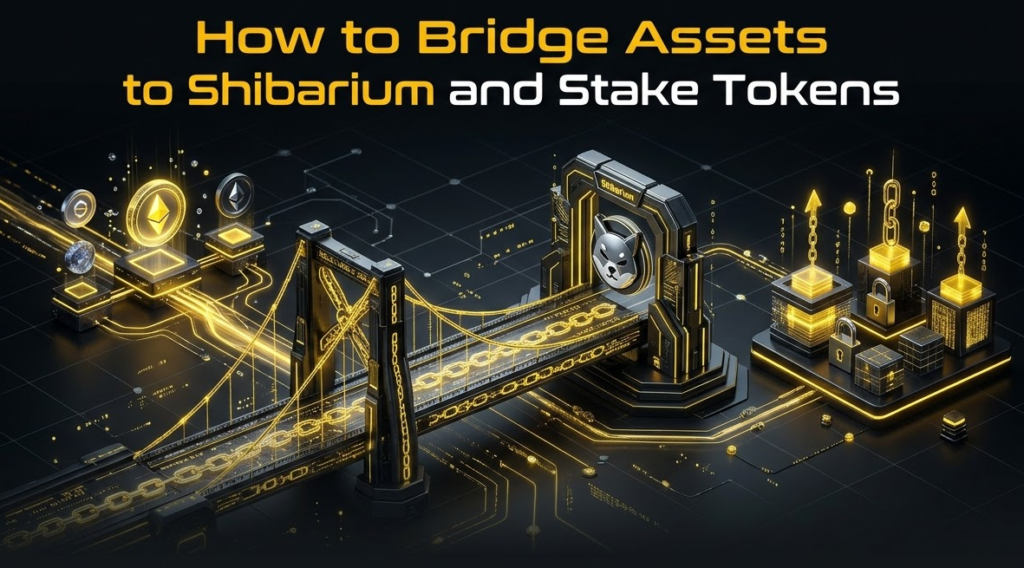
If you already hold SHIB or BONE on Ethereum and want to explore Shibarium, the bridge is one of the main tools you may need. The process is not especially complicated, but you should understand which network you are using and what each transaction will cost.
Phase One: Bridge Assets from Ethereum to Shibarium
Step: Prepare a compatible Web3 wallet
Use a wallet that supports Ethereum and custom EVM-compatible networks. MetaMask is one familiar option, although other compatible wallets may work.
Before connecting, make sure you have:
-
The token you want to bridge on Ethereum.
-
Enough ETH to pay the Ethereum transaction fee.
-
A small amount of BONE available for transactions after reaching Shibarium, or a plan to obtain it through a supported route.
-
The correct official bridge address.
Do not rely on sponsored search results, unsolicited direct messages, or links posted by anonymous accounts. Start from the official Shiba Inu bridge documentation, which points users to the bridge interface at shib.io/bridge.
Step: Open the official bridge and connect your wallet
Visit the bridge through the official documentation rather than searching for a random bridge website. Connect your wallet and confirm that it is set to Ethereum mainnet.
A legitimate wallet connection should not require you to reveal your seed phrase or private key. If a website asks for either, stop immediately. A bridge only needs the permissions required to interact with the relevant smart contracts.
Step: Choose the asset and destination network
Select the token you want to move and check that it is supported by the bridge. The official token compatibility page lists supported assets and explains that token compatibility depends on the asset and network.
Enter the amount and review the transaction details carefully. Check the token contract, destination network, expected fees, and estimated arrival time. Do not assume every token with the same ticker symbol is the same asset; counterfeit tokens can use familiar names.
Step: Confirm the Ethereum transaction
Your wallet will display the transaction request. Review the details before signing. The Ethereum-side transaction requires ETH for gas.
Once confirmed, wait for the bridge process to complete. The official bridge guide describes both deposits and withdrawals, including different bridge mechanisms and their respective processing times. Those times are not a guarantee that every transfer will complete within an exact window, so check the live interface and current network conditions.
Step: Confirm the assets on Shibarium
After the transfer completes, switch your wallet to Shibarium and check your balance. The official network documentation lists:
| Network setting | Shibarium mainnet |
|---|---|
| Network name | Shibarium |
| Chain ID | 109 |
| Currency symbol | BONE |
| RPC endpoint | https://rpc.shibarium.shib.io |
| Block explorer | https://shibariumscan.io |
Only use network settings copied from the official documentation. If the token balance does not appear automatically, verify the correct token contract address before importing a token manually.
Phase Two: Stake Tokens and Participate in Governance
Staking in the Shiba Inu ecosystem has changed over time, so first decide which product you intend to use. The older ShibaSwap Bury feature and the newer Bury 2.0 interface have different mechanics and should not be confused.
Step: Open the current official staking interface
Start with the official Bury 2.0 documentation. It explains which tokens are supported, how vote-escrowed tokens work, and what restrictions apply.
At the time of writing, the documentation says Bury 2.0 supports SHIB, BONE, LEASH, and TREAT on Shibarium. It also states that the product is in beta and staking currently provides governance voting power rather than staking rewards.
Step: Choose the token and lock duration
Review the available token options and lock periods before committing anything. The current documentation describes lock durations ranging from one week to four years. Longer locks can provide more voting power, while the voting power decays as the lock approaches its expiry.
This is not a risk-free savings account. Locking a token can limit your flexibility, and the token’s market price can change substantially while it is locked.
Step: Review penalties and contract permissions
The Bury 2.0 documentation warns that early withdrawals incur a 30% penalty. Read the latest interface terms before confirming, because a penalty can materially change the economics of an early exit.
Also inspect the wallet approval request. A token approval can allow a smart contract to move assets up to the approved amount. Avoid unlimited approvals when a smaller allowance is sufficient, and periodically review permissions you no longer need.
Step: Confirm the transaction and review your voting power
After you approve and submit the staking transaction, check that the position appears in the official dashboard. The interface should show the relevant vote-escrowed token balance and governance power.
Step: Participate in governance
Shiba Inu’s governance system is described through ShibDAO and the four Doggy DAOs. The official Doggy DAO documentation describes distinct governance areas associated with BONE, TREAT, SHIB, and LEASH.
Before voting, read the proposal itself. Look at what it changes, who can execute it, whether it requires an on-chain transaction, and what risks or trade-offs it introduces. Governance participation is more meaningful when you understand the consequences rather than simply voting based on a social-media slogan.
Important Risks Before You Bridge or Stake
A few practical precautions can prevent expensive mistakes:
-
Bridge risk: Cross-chain systems involve smart contracts, validators, and asset representations. A bridge exploit or operational failure can affect withdrawals or asset backing.
-
Network selection: Sending tokens to an address on the wrong network can result in loss of funds.
-
Contract risk: A legitimate-looking interface can still interact with a vulnerable contract. Verify the official domain and contract addresses.
-
Price risk: SHIB, BONE, LEASH, and TREAT can be volatile. A staking position does not protect you from price declines.
-
Liquidity risk: A token may be difficult to sell quickly at a fair price if market depth is limited.
-
Lock-up and penalty risk: Staking can restrict access to your tokens, and early withdrawal penalties may apply.
-
Gas risk: You may need ETH for Ethereum-side actions and BONE for Shibarium transactions.
The safest approach is to begin with a small test transaction, confirm that it arrives correctly, and only then consider moving a larger amount.
FAQ
What is Shiba Inu (SHIB), and how does it work?
Shiba Inu (SHIB) is a community-driven cryptocurrency launched in August 2020 as an ERC-20 token on the Ethereum blockchain. It began as a meme coin but has expanded into a wider ecosystem that includes Shibarium, ShibaSwap, governance tools, and other tokens such as BONE, LEASH, and TREAT. SHIB can be transferred and traded like other Ethereum tokens, while supported applications provide additional ways to use it.
How does Shiba Inu differ from Dogecoin?
Dogecoin operates on its own Proof-of-Work blockchain and uses DOGE as its native coin. SHIB is an ERC-20 token on Ethereum, with additional ecosystem applications available through Shibarium. This gives SHIB access to Ethereum-compatible smart contracts and DeFi applications, while Dogecoin’s native network is primarily designed around peer-to-peer transfers of DOGE.
What is Shibarium, and what is BONE used for?
Shibarium is an EVM-compatible network developed for the Shiba Inu ecosystem and described by the project as an Ethereum Layer 2. It is designed to support lower-cost transactions and decentralized applications. BONE is its native gas token and is also used in validator staking and ecosystem governance.
How does the SHIB burn mechanism work?
SHIB burns permanently remove tokens from practical circulation by sending them to inaccessible addresses. Burns can come from voluntary community transactions and ecosystem initiatives. Shibarium’s burn mechanism accumulates part of its transaction fees in BONE, then uses the accumulated value to acquire SHIB and send it to a burn address. The amount burned depends on network activity and the mechanism’s execution; a burn does not guarantee that SHIB’s price will rise.
How did Vitalik Buterin burn 41% of the SHIB supply?
In May 2021, Vitalik Buterin sent approximately 410.2 trillion SHIB—more than 41% of the original one-quadrillion supply—to an inaccessible burn address. He also donated a separate large amount of SHIB to the India COVID-Crypto Relief Fund. The donation and the burn were different events and should not be combined into one figure.
Does SHIB have its own blockchain?
No. The original SHIB token is an ERC-20 token on Ethereum. Shibarium is a separate network within the ecosystem, but SHIB itself is not the native coin of an independent Layer-1 blockchain.
Does SHIB pay gas fees on Shibarium?
No. BONE is the native gas token on Shibarium. You generally need BONE to pay for transactions on that network. ETH is needed for Ethereum mainnet transactions, including the Ethereum-side part of a bridge transfer.
What is the difference between SHIB, BONE, and LEASH?
SHIB is the flagship ecosystem token. BONE is used for Shibarium gas fees, validator staking, and core governance functions. LEASH is a limited-supply ecosystem token associated with premium features and governance-related privileges. TREAT is another ecosystem token designed for rewards and additional utility.
Is ShibaSwap still relevant?
ShibaSwap remains part of the Shiba Inu ecosystem and offers decentralized exchange and liquidity-pool functionality. Its documentation describes both classic and concentrated-liquidity pool designs. However, users should check which version, network, and incentives are currently active rather than relying on older tutorials.
Does staking SHIB guarantee passive income?
No. Staking rewards depend on the specific product and its current rules. The current Bury 2.0 documentation says the beta product provides governance voting power and does not currently offer staking rewards. Other ShibaSwap features may have different fee or incentive structures, so always check the terms of the exact contract you intend to use.
Can SHIB realistically reach $1?
At an illustrative supply of roughly 589 trillion tokens, a $1 SHIB price would imply a market capitalization of approximately $589 trillion. That is an extraordinarily high valuation. Further burns could reduce supply, but small burns do not change the arithmetic enough to make a $1 target realistic by themselves. Any price discussion should begin with supply and market capitalization, not just the number of tokens held.
Is Shiba Inu a good investment?
That depends on your risk tolerance, investment horizon, and view of the ecosystem’s long-term adoption. SHIB is a volatile crypto asset, and the wider ecosystem adds risks involving bridges, smart contracts, liquidity, governance, and token incentives. A growing list of products does not guarantee that users will adopt them or that token prices will appreciate. Research the technology and token economics, and never invest money you cannot afford to lose.
Final Thoughts
Shiba Inu has travelled a long way from its August 2020 launch. What started as a dog-themed Ethereum token has developed into a broader ecosystem with its own Layer-2-style network, decentralized exchange, governance structure, and several tokens with different responsibilities. That evolution is real, and it makes SHIB more technically interesting than a simple meme-token description might suggest.
But there are two sides to that story.
On the positive side, Shibarium gives developers an EVM-compatible environment, BONE provides a clear network-gas role, ShibaSwap offers trading and liquidity tools, and the burn mechanisms connect some ecosystem activity to SHIB supply reduction. The project has also continued to develop governance and staking products rather than relying entirely on the original meme-coin narrative.
On the other hand, a larger ecosystem is not automatically a successful one. Each additional network, bridge, token, and smart contract creates new technical and economic dependencies. Users must consider validator and bridge security, liquidity, token incentives, governance execution, and whether applications are attracting meaningful activity. The distinction between the older ShibaSwap staking model and the current Bury 2.0 documentation is a reminder that product features and reward arrangements can change.
If I were evaluating SHIB, I would keep four questions in front of me:
-
Is the ecosystem being used? Look beyond social-media attention and examine actual application activity, transactions, liquidity, and developer participation.
-
Are the tokens doing useful jobs? Understand why SHIB, BONE, LEASH, and TREAT exist, and whether their functions create real demand.
-
Are burns meaningful relative to supply? Compare the amount burned with the hundreds of trillions of tokens that remain.
-
Are the risks transparent? Check official documentation, contract addresses, bridge mechanics, governance proposals, and current staking conditions.
The most useful way to understand Shiba Inu is not to think of it as a guaranteed path to a particular price target. Think of it as an evolving crypto ecosystem whose long-term relevance depends on adoption, execution, security, and sustainable demand.
SHIB may have started as a meme, but its future will be determined by much more than memes.