OKX vs Kraken Feature Matrix
When you compare OKX vs. Kraken in 2026, you’re looking at two exchanges with noticeably different priorities. OKX combines centralized crypto trading with a broad Web3 toolkit, while Kraken has built its reputation around exchange security, compliance, and a growing range of financial products.
Neither platform is automatically better for everyone. A trader who moves between spot markets, perpetual futures, and decentralized applications may value OKX’s integrated ecosystem. Someone who cares more about a long-established exchange, fiat funding options, and a clearly documented fee schedule may prefer Kraken.
Before comparing the details, there’s one important update to the supplied outline: Kraken Pro’s entry-level spot taker fee should not be assumed to be 0.40% in October 2026. Kraken’s updated cross-platform fee schedule, last updated October 19, 2026, lists a Tier 1 spot fee of 0.40% maker and 0.80% taker. The fee schedule was changed on July 9, 2026, and tiers can now be based on either qualifying spot volume or assets held on the platform. Check Kraken’s current official fee schedule before using any older rate in a cost calculation.
OKX’s published regular-user spot rate for standard fee pairs is 0.08% maker and 0.10% taker under the referenced schedule, but regional entities and special pairs may have different pricing. Its official fee rules explain the applicable rates and tiers.
Here is the practical comparison.
| Feature | OKX | Kraken |
|---|---|---|
| Main strength | Integrated crypto trading, Web3 wallet, and on-chain access | Established exchange operations, security practices, and fiat connectivity |
| Standard spot fees | A common regular-user rate is 0.08% maker / 0.10% taker for standard pairs | Current global Tier 1 schedule lists 0.40% maker / 0.80% taker; regional or product-specific fees may differ |
| Futures fees | Product-, region-, and tier-dependent; published schedules must be checked by contract | Kraken Derivatives lists 0.02% maker / 0.05% taker at the entry tier on the referenced schedule |
| Native exchange token | OKB, with ecosystem utilities and applicable fee benefits depending on the current terms | No comparable native exchange utility token |
| Web3 | OKX Wallet supports self-custody and on-chain interactions | Kraken Wallet provides self-custody access to supported blockchain assets |
| Layer 2 | X Layer, an Ethereum-compatible Layer 2 network | Ink, a Layer 2 network associated with the Kraken ecosystem |
| Tokenized equities | Product availability depends on the relevant OKX entity and market | xStocks offers tokenized stock and ETF exposure to eligible non-U.S. clients |
| Proof of Reserves | Publishes cryptographic reserve and liability verification material | Publishes reserve-related information and other security disclosures |
| U.S. access | Depends on the specific OKX U.S. offering, product, and eligibility rules | Available products vary by state and regulatory permissions |
| Best suited to | Traders who want crypto markets and Web3 tools in one ecosystem | Users who value an established exchange and a broad financial-services approach |
Kraken’s fee structure is particularly important to understand because its main retail app and Kraken Pro are not interchangeable pricing environments. The fee charged for an instant purchase can differ from the maker/taker commission on an order-book trade, and the current Pro schedule has also changed over time.
For both platforms, treat the fee table as a starting point. Your actual rate depends on your account, market, product, region, and applicable tier.
OKX Fees vs Kraken Fees in 2027
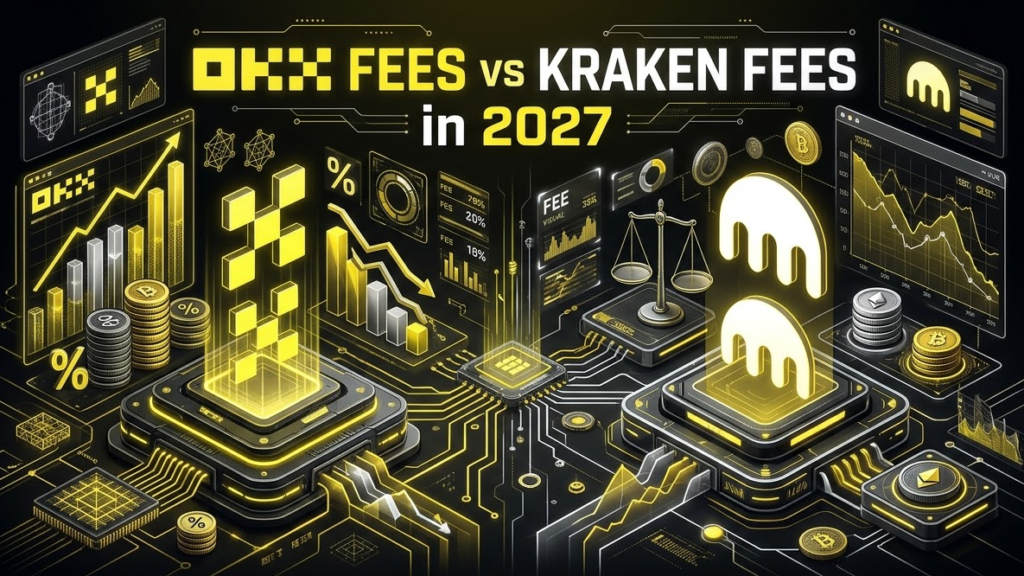
Fees are one of the easiest areas to compare numerically and one of the easiest to get wrong. A comparison that uses an old Kraken rate, an OKX rate from a different regional entity, or a derivatives fee for a spot trade may produce a misleading result.
I would compare the two exchanges in three steps: identify the exact product, confirm the maker/taker rate for your account, and calculate the cost using the amount you actually expect to trade.
Spot Trading: How Much Cheaper Is OKX?
For standard spot pairs under the referenced OKX schedule, a regular user pays 0.08% as a maker and 0.10% as a taker. Kraken’s current global Tier 1 schedule lists 0.40% maker and 0.80% taker, although Kraken’s regional entities and particular products may have different rates.
The following example assumes a $10,000 order that fills entirely as a taker order. It compares the published rates shown above, not every regional version of the two exchanges.
| Exchange and assumed rate | Taker fee | Fee on a $10,000 order |
|---|---|---|
| OKX standard spot pair | 0.10% | $10 |
| Kraken Tier 1 spot schedule | 0.80% | $80 |
At those rates, the Kraken fee is eight times the OKX fee for the same notional trade. That is a substantial difference for a frequent trader, but the comparison is only valid if those are the rates that apply to your account and trading pair.
This is also why older claims that Kraken Pro always charges 0.40% taker are no longer reliable. Kraken’s published cross-platform fee update changed the schedule in July 2026, and the current fee page lists 0.80% as the Tier 1 taker rate. You can review the current tiers in Kraken’s fee schedule.
Why the maker/taker distinction matters
A maker order adds liquidity to the order book, usually by placing a limit order that does not execute immediately. A taker order matches against available orders already on the book. Market orders are generally taker orders, while a limit order can be either maker or taker depending on how it executes.
If you’re trading a liquid market with a limit order, you may be able to reduce your costs by avoiding unnecessary taker executions. But a limit order does not guarantee a fill, and the price can move away before the order executes. You need to balance the cost of immediate execution against the risk of waiting.
For example, imagine that Bitcoin is trading near $100,000 and you want to buy $10,000 worth. A market order prioritizes execution at available prices, but it may fill across several price levels if the order book is thin. A limit order may give you more control over the maximum price, but it can remain unfilled if the market moves higher.
The exchange fee is only one part of the decision. Spread, slippage, and the quality of the available liquidity all affect your real entry cost.
What about Kraken’s standard app?
Kraken offers different purchase and trading experiences. Its standard retail app may use an instant-buy or conversion process with pricing that includes spread and applicable fees, while Kraken Pro uses an order-book interface with maker/taker pricing.
Don’t compare an instant-buy quote on one platform with an order-book commission on another and assume the result is an apples-to-apples fee comparison. For a fair test, compare the final cost of buying the same asset, in the same amount, using the same execution approach.
Before placing an order, review the quoted price, commission, spread, and any funding or conversion charges. If you’re making a recurring purchase, repeat the comparison over several transactions rather than relying on one quote.
Futures Trading: Similar Entry Rates, Different Product Conditions
The supplied outline identifies a 0.02% maker fee and 0.05% taker fee as a common baseline for futures on both platforms. Kraken’s official derivatives schedule does list those rates at the entry tier for the relevant contracts. OKX also publishes product-specific derivatives schedules, but you should confirm the exact rate for the contract and regional entity you’re using rather than assume every market has the same pricing.
For Kraken, the official derivatives fee schedule states that fees are calculated against the notional value of each matched trade and decrease as qualifying 30-day volume increases.
Here’s how a 0.05% taker fee works on a $10,000 futures trade:
[$10{,}000 \times 0.0005 = $5]
That is $5 for one execution at the assumed rate. If you open and close the same notional position using taker orders, the combined trading fee would be approximately $10, assuming both executions occur at that rate and ignoring any change in position size.
Leverage does not make the commission disappear. A trader using $1,000 of margin to control a $10,000 position is still exposed to fees calculated on the relevant traded notional value, not simply on the $1,000 deposited as margin.
OKB versus Kraken’s volume and asset-based tiers
OKX has a native token, OKB, which serves as an ecosystem asset and may provide benefits under applicable platform terms. However, the exact fee benefits depend on the current rules, account type, and eligible product. Don’t assume that holding OKB automatically grants a fixed percentage discount on every spot and futures trade.
Kraken does not offer a directly comparable native exchange utility token. Its fee structure relies on qualifying activity and assets held on the platform. Under its updated cross-platform model, the qualifying measure is the one that places the account in the better tier, rather than requiring the user to satisfy both the volume and asset thresholds.
That distinction creates two different approaches:
- OKX: Check the applicable OKB utility and fee conditions, then calculate whether the benefits justify holding the token.
- Kraken: Check the fee tier available from your trading volume or eligible platform assets, without assuming that a token purchase is necessary.
In both cases, read the current terms. Exchange-token benefits can change, and the token itself can fluctuate in price. Buying an exchange token solely to reduce commissions introduces an additional market risk that should be included in your calculation.
Don’t forget funding rates and liquidation risk
Perpetual futures can involve funding payments that are separate from trading commissions. Depending on the funding rate and your position direction, you may pay or receive funding. The rate can change as market conditions shift.
For a short-term trade, execution costs may dominate. For a position held over several funding intervals, those payments can become more important. Spread, slippage, liquidation fees, and the cost of maintaining collateral may also affect your total result.
I wouldn’t choose an exchange because its futures taker fee is a fraction of a basis point lower without checking contract liquidity, funding conditions, and the risk controls available in the trading interface. A slightly cheaper commission is not much help if the market you’re trading has a poor order book or your position is exposed to an avoidable liquidation.
Kraken’s Track Record vs OKX’s Cryptographic Verification
When someone asks me whether Kraken is safer than OKX, I wouldn’t answer with a simple yes or no. Security is not a single metric, and an exchange can have strong cryptographic verification while still carrying operational, governance, or counterparty risks.
A better comparison looks at the evidence each platform publishes, how its custody systems are designed, how it responds to incidents, and what legal protections are available to the customer.
Kraken’s Security Reputation and Wyoming Banking Framework
Kraken has operated since 2011 and has built much of its brand around security, custody controls, and regulatory engagement. That history is relevant, but the claim that it has had “14+ years without a single custodial hack or customer fund loss” should not be treated as a formally verified guarantee. Public incident histories can be incomplete, and an absence of a known core exchange breach does not mean that every user account, third-party integration, or service has been immune to security incidents.
What you can evaluate more concretely is Kraken’s security documentation, its account-protection features, and its legal structure.
Kraken offers security controls that may include two-factor authentication, withdrawal protections, device and session management, and account monitoring. The exact controls available depend on the product and account configuration. For a user, the practical benefit comes from enabling these protections rather than assuming that the exchange’s overall reputation will protect a poorly secured account.
What does Kraken Financial’s Wyoming charter mean?
Kraken Financial is a Wyoming-chartered Special Purpose Depository Institution (SPDI). This is a specific legal banking framework under Wyoming law, not a blanket declaration that every Kraken service is a conventional insured bank account.
In March 2026, the Federal Reserve Bank of Kansas City approved a limited-purpose account for Kraken Financial. The Federal Reserve’s official announcement says the approval included restrictions and limitations tailored to the institution’s business model and risk profile.
This is meaningful because access to Federal Reserve payment infrastructure can support certain settlement and payment activities. But don’t confuse a Federal Reserve account with FDIC insurance on crypto holdings, or assume that every asset held on Kraken receives the protections of a traditional insured bank deposit.
The Wyoming Division of Banking’s SPDI information explains the legal framework and its requirements. The important distinction is that a regulatory charter defines what an institution is authorized to do; it does not eliminate all risks associated with crypto assets or exchange custody.
OKX’s Monthly Proof of Reserves and zk-STARK Verification
OKX publishes Proof of Reserves reports that include reserve and liability data and cryptographic verification materials. Its reserve portal lists reports using zk-STARK v2 and provides files for users to examine. The official OKX Proof of Reserves page includes reports dated October 3, September 8, and earlier dates in 2026.
A zk-STARK is a type of cryptographic proof that can help demonstrate that a computation or statement satisfies specified conditions without requiring every detail of the underlying data to be publicly disclosed. In a Proof of Reserves context, cryptographic methods can help users verify parts of the relationship between reported assets, account liabilities, and inclusion in a published snapshot.
That is useful transparency, but the terminology can sound more comprehensive than it really is. A cryptographic proof can support the validity of a particular calculation without proving every aspect of an exchange’s financial condition.
When evaluating a reserve report, ask:
-
Which crypto assets and customer liabilities are included?
-
What is the date of the snapshot?
-
Can you independently verify that your account is included in the liability data?
-
Are the published reserves sufficient to cover the liabilities for the assets covered by the report?
-
Does the methodology explain the limitations of the verification?
A reserve ratio above 100% indicates that the reported reserves exceed the included liabilities under the report’s methodology. It does not automatically prove that all corporate obligations have been captured, that assets are free from every encumbrance, or that the exchange will never suspend withdrawals.
I would therefore describe OKX’s zk-STARK reports as a useful cryptographic transparency mechanism, not as proof that the exchange is invulnerable.
Is OKX backed by a corporate insurance shield?
Be careful with phrases such as “multi-billion-dollar insurance shield.” An exchange may have insurance arrangements, reserve funds, or other risk-management resources, but these are not interchangeable. Coverage can have exclusions, limits, and conditions, and a corporate fund is not necessarily an insurance policy that guarantees every customer will be reimbursed.
Before relying on any protection claim, look for the named policy or fund, the legal entity providing it, the scope of covered events, the applicable limits, and the conditions under which customers can make a claim. If those details are not clearly documented, don’t assume that a large headline figure represents money available to cover every possible loss.
OKX’s U.S. Legal History: A Necessary Part of the Comparison
Security and regulatory compliance are related, but they are not the same thing. An exchange can publish strong technical verification while still facing serious compliance issues.
On February 24, 2025, the U.S. Department of Justice announced that Aux Cayes FinTech Co. Ltd., which operated OKX, pleaded guilty to operating an unlicensed money-transmitting business and agreed to penalties totaling more than $504 million. The Department of Justice’s official announcement describes the case and its outcome.
That event should be included in any serious assessment of OKX’s compliance history. At the same time, the existence of a settlement or guilty plea does not, by itself, tell you the full state of a platform’s current compliance program or the terms under which a particular regional entity now operates. Those require separate, current verification.
If you’re a U.S. customer, confirm the exact OKX service available to you. A U.S. spot offering does not automatically mean that international derivatives, margin products, or every feature in the global app is available to U.S. residents.
Which Exchange Is Safer for Long-Term Storage?
Neither exchange should be treated as risk-free storage simply because it has a well-known brand or publishes reserve information. Proof of Reserves, banking permissions, security controls, and incident history answer different questions.
Here’s how I would weigh the evidence:
| Security consideration | What to look for at OKX | What to look for at Kraken |
|---|---|---|
| Reserve transparency | Dated reserve and liability reports, cryptographic verification | Published reserve and security information, including scope and methodology |
| Custody controls | Current security documentation and withdrawal protections | Current security documentation and account-protection controls |
| Regulatory structure | Which OKX entity serves the account and which products it may offer | Which Kraken entity serves the account and the scope of its permissions |
| Incident history | Public disclosures, regulatory outcomes, and response procedures | Public disclosures, regulatory outcomes, and response procedures |
| Customer recourse | Applicable terms, complaint process, and local legal rights | Applicable terms, complaint process, and local legal rights |
For trading capital that you need to access regularly, keeping some assets on an exchange may be practical. For long-term holdings, consider whether self-custody is appropriate for you. Self-custody removes some exchange-counterparty exposure but introduces the responsibility of protecting your private keys and recovery phrase. If you lose those credentials or sign a malicious transaction, there may be no central support team capable of reversing the loss.
The right answer is not “always use a wallet” or “always trust the exchange.” It’s to understand which risks you’re taking and choose the custody method you can manage responsibly.
OKX Web3 Wallet and X Layer vs Kraken xStocks and Ink

One of the biggest differences between OKX and Kraken is how each connects centralized crypto services with other parts of the digital-asset ecosystem.
OKX places considerable emphasis on Web3 access: self-custody, decentralized exchanges, and blockchain applications. Kraken has expanded beyond centralized crypto trading through its wallet products, Layer 2 ecosystem, and tokenized equities offering.
These products serve different needs, so comparing them as if they were direct substitutes misses the point.
OKX Web3 Wallet: Self-Custody and On-Chain Access
The OKX Web3 Wallet is designed to let users manage blockchain assets and interact with decentralized applications without treating the centralized exchange account as the only gateway to crypto.
A self-custody wallet differs from a centralized exchange account in a fundamental way: control of the relevant private keys rests with the wallet user, rather than being managed solely through the exchange’s custody system. That gives you more direct control over on-chain transactions, but it also makes you responsible for signing the right transactions and safeguarding your credentials.
The OKX wallet ecosystem includes tools for interacting with decentralized applications and discovering or routing trades across supported networks. Depending on the feature and network, users may be able to swap tokens, explore decentralized finance protocols, manage NFTs, or connect to other Web3 services.
A DEX aggregator can search across supported decentralized liquidity sources to identify potential routes for a swap. That can improve price discovery, but it doesn’t guarantee the best possible execution. Routes may involve several transactions, different gas costs, slippage, or smart-contract risks. Always inspect the quoted amount and network fees before confirming a transaction.
Why self-custody is not the same as being risk-free
A self-custody wallet can protect you from some exchange-specific risks, but it cannot protect you from every risk in the wider crypto ecosystem.
Consider these common problems:
-
Phishing: A fake website may trick you into revealing a recovery phrase or signing a harmful transaction.
-
Malicious approvals: A token approval can give a smart contract permission to move specified assets, sometimes for longer than you realize.
-
Network mistakes: Sending an asset through an unsupported network can make recovery difficult or impossible.
-
Smart-contract vulnerabilities: A decentralized application may contain a bug or be exploited.
-
Irreversible transactions: Most blockchain transactions cannot simply be reversed by contacting support.
If you use the OKX Web3 Wallet, verify the website and contract address, read transaction prompts carefully, and avoid connecting your wallet to unfamiliar applications just because they offer unusually high returns.
X Layer: OKX’s Ethereum-Compatible Layer 2
X Layer is OKX’s Ethereum-compatible Layer 2 network. Layer 2 networks aim to process transactions using infrastructure that can reduce costs or increase throughput relative to executing every operation directly on the underlying Layer 1 chain.
For users, the potential benefit is cheaper and faster interaction with supported applications. But a Layer 2 network is not automatically interchangeable with Ethereum mainnet or every other EVM-compatible chain. You need to confirm that the wallet, token, and application all support the same network.
Before transferring assets to X Layer, check the deposit and withdrawal options available in the destination service. A token displayed under the same ticker on two networks may represent different contracts, and a deposit address alone does not guarantee that a receiving exchange supports the network.
It’s also worth separating the wallet from the chain. The wallet is the interface and key-management tool; X Layer is the blockchain network. Using the OKX Wallet does not mean every transaction happens on X Layer, and using X Layer does not mean every application on it is operated or guaranteed by OKX.
Kraken Wallet: A Different Route Into Web3
Kraken also offers a self-custody wallet for users who want to hold supported assets and interact with decentralized applications. Like any self-custody product, it shifts responsibility for private-key security and transaction approval toward the user.
If your main goal is to store and move supported blockchain assets, the practical comparison should focus on the networks you need, supported tokens, transaction visibility, recovery options, and how easily the wallet connects to the applications you use.
Don’t assume that a wallet from an exchange is automatically safer or more compatible than an independent wallet. The important question is whether it supports your workflow and whether you understand how to secure it.
Kraken xStocks: Tokenized Stock and ETF Exposure
Kraken’s xStocks product is a different kind of innovation. Rather than focusing primarily on decentralized applications, xStocks provides tokenized representations of stocks and ETFs to eligible customers in supported jurisdictions.
Kraken’s xStocks FAQ, updated September 18, 2026, describes xStocks as tokenized representations of real U.S. stocks and ETFs backed 1:1 by the underlying equity held in regulated custody. The tokens are issued on supported networks, including Solana, Ethereum, TON, and Ink.
Kraken’s FAQ reports 131 assets in total at the time of that update: 100 stocks, 27 ETFs, and four specialist assets. Availability can change, so check the current product list rather than assuming that the same number or assets will remain available indefinitely.
This structure can make stock-price exposure accessible through blockchain-based infrastructure, but xStocks are not identical to owning ordinary shares through a traditional brokerage account.
Kraken explains that xStocks do not confer shareholder rights such as voting. Dividend-related economic benefits are reflected through a rebasing mechanism rather than being paid as ordinary cash dividends directly to the token holder. The product also has geographic restrictions: Kraken states that xStocks are unavailable to customers in the United States, Canada, the United Kingdom, Australia, and certain other restricted regions.
That last point matters. If you’re in one of those locations, you should not assume that xStocks are available just because the product appears in a global comparison article.
What does “backed 1:1” actually mean?
A 1:1 backing statement describes the issuer’s relationship between the tokenized representation and the underlying asset under the product’s legal and custody structure. It does not mean that the token carries every right of a shareholder, that its market price can never diverge from the reference asset, or that a token holder has exactly the same protections as someone holding shares through a conventional brokerage.
Before buying a tokenized equity, check:
-
The issuer and legal structure behind the token.
-
How the underlying shares are held and what the backing arrangement covers.
-
Whether you have voting rights or direct shareholder status.
-
How dividends and corporate actions are handled.
-
Which country and account types are eligible.
-
Whether the token can be transferred to a self-custody wallet and which networks are supported.
Kraken’s xStocks product page explains its offering and highlights geographic restrictions. Read the legal and product disclosures before treating tokenized stock exposure as a substitute for traditional equity ownership.
Ink: Kraken’s Layer 2 Ecosystem
Ink is associated with Kraken’s Layer 2 strategy and is designed to support on-chain applications. Its role is closer to X Layer than to xStocks: both are blockchain infrastructure initiatives, while xStocks is a tokenized-asset product.
Still, the two networks should not be treated as identical. They can differ in supported applications, liquidity, bridging options, network fees, and security assumptions. If you plan to use either network, verify the current documentation and make sure the specific token or application is supported.
A Layer 2 network can reduce friction for certain blockchain activities, but it adds decisions about bridging, network compatibility, and application security. Those are not just technical details; they affect whether you can move assets when you need to.
OKX Web3 Wallet vs Kraken xStocks: Which Is Better?
These two products solve different problems, so one is not a direct replacement for the other.
| Your goal | More relevant product to investigate | Why |
|---|---|---|
| Interact with decentralized applications | OKX Web3 Wallet or Kraken Wallet | Both support self-custody workflows, subject to network and feature availability |
| Explore on-chain token swaps | OKX Web3 Wallet | Its ecosystem emphasizes decentralized trading and route aggregation |
| Use an Ethereum-compatible Layer 2 ecosystem | X Layer or Ink, depending on the applications you need | Network choice depends on supported protocols, liquidity, and fees |
| Gain tokenized exposure to certain U.S. stocks and ETFs | Kraken xStocks, if eligible | It offers tokenized equity exposure, but not the full legal rights of ordinary shareholders |
| Hold crypto for long-term storage | A suitable self-custody wallet, after evaluating your needs | Self-custody changes the risk model but does not remove all risks |
If you want a Web3 gateway, focus on wallet security, network coverage, and application support. If you want exposure to tokenized equities, focus on the backing structure, legal rights, trading conditions, and whether you are eligible to use the product.
Critical Knowledge Gaps and Common Pitfalls
Even a detailed OKX vs. Kraken comparison can lead to poor decisions if you assume that every advertised feature is available to every customer or that every percentage applies to every order.
Here are the most important traps to avoid.
Misconception: Kraken Pro Always Charges a 0.40% Taker Fee
The 0.40% taker figure in older comparison material is not the current global Tier 1 figure shown in Kraken’s updated October 2026 schedule. The current table lists 0.40% maker and 0.80% taker for Tier 1, with lower rates at higher tiers.
The distinction matters because a $10,000 taker order costs $80 at 0.80%, not $40 at 0.40%. Before trading, check the rate displayed for your account and product.
Also make sure you’re comparing Kraken Pro order-book fees with the equivalent order-book fees on OKX. Instant-buy services may include spread or different charges.
Misconception: OKX’s 0.10% Spot Rate Applies to Every Pair and Region
The 0.08% maker and 0.10% taker rates are a useful baseline for standard spot pairs under the referenced schedule, but OKX’s fee rules distinguish between account tiers, products, regions, and pair groups.
The exchange explains that users can check the rate for a specific instrument in the trading interface. Its trading fee rules FAQ explains how to find the currently applicable rate.
Don’t calculate a trade’s cost using a headline number if the order-placement panel shows a different fee. Use the rate that actually applies to the instrument you’re trading.
Misconception: OKB Guarantees a Fixed Discount on Every Trade
OKB has a role in the OKX ecosystem, but the benefits available to a particular account depend on current program rules and product eligibility. Avoid assuming that holding OKB automatically reduces all spot, margin, futures, and options fees by the same percentage.
If the fee discount is the reason you’re considering buying OKB, calculate the likely savings first. Include the cost of acquiring the token, any applicable transaction fees, and the risk that its market price could fall.
A discount can be valuable for someone who trades frequently, but it is not necessarily worthwhile for someone who trades occasionally.
Misconception: Kraken Has No Tokenized-Asset Products
Kraken’s xStocks offering demonstrates that its product range extends beyond conventional crypto spot markets. However, tokenized stock exposure is not the same as ordinary stock ownership, and it is not available in every jurisdiction.
If you want tokenized equities, read the product’s legal terms and verify the list of supported assets. If you want actual shareholder rights, a traditional brokerage account may be more appropriate than a tokenized representation.
Misconception: A Proof-of-Reserves Report Guarantees That an Exchange Cannot Fail
A reserve report is a snapshot. It can provide useful evidence about specified assets and liabilities, but it does not guarantee that an exchange will always remain solvent or process withdrawals without interruption.
OKX’s cryptographic verification materials and Kraken’s security disclosures should be read as parts of a wider due-diligence process. Neither replaces careful account security, a review of the applicable terms, or a decision about how much capital to leave on a centralized platform.
Misconception: A Regulatory Licence Makes Every Product Available
Licences and authorizations are specific to a legal entity and a set of permitted activities. An exchange may have permission to provide certain services in one jurisdiction while restricting other products or customers.
Kraken Financial’s Wyoming charter, for example, is distinct from the permissions governing every other Kraken product. Similarly, the availability of an OKX U.S. spot offering does not imply that the global derivatives suite is available to U.S. residents.
Before opening an account, verify the platform’s current country restrictions and the legal entity that will serve you. If you’re moving countries, don’t assume your existing account will retain access to every product.
U.S. Access and Regulatory Rules
The U.S. regulatory landscape is not a simple exchange-wide yes-or-no question. Product availability can differ between spot trading, margin, futures, options, tokenized securities, and payment services.
OKX’s 2025 legal case is an important part of its history, but it should not be used as the only evidence of its current U.S. product availability. Check the exact U.S. platform and its current terms before depositing assets.
Kraken also has different regulatory permissions across its services. Its derivatives products have specific eligibility rules, and xStocks are explicitly unavailable to U.S. customers under the current product disclosures.
If you’re in the United States, do not infer eligibility from a global website, an app-store listing, or the fact that another customer can access a product. Confirm the relevant service, state-level availability where applicable, and any product-specific restrictions.
Using a VPN to conceal your location does not change your legal eligibility and may create account or withdrawal problems. If your circumstances are unclear, contact official support before moving assets to the platform.
Step-by-Step Guide: How to Transfer Crypto from Kraken to OKX

Transferring crypto between exchanges is usually a straightforward process, but a mistake with the network or destination details can make recovery difficult. Take your time, particularly if you’re sending a token to an address you have never used before.
Only transfer assets after confirming that both accounts and the intended services are available to you under the applicable rules.
Phase One: Generate a Deposit Address on OKX
Open your verified OKX account. Go to the Assets section and select Deposit. Menu labels can vary slightly between the mobile app and website.
Choose the asset. Select the cryptocurrency you intend to receive, such as USDT, BTC, or ETH. Make sure you choose the exact asset rather than relying on a ticker symbol alone.
Select the blockchain network. Confirm that OKX supports deposits for the chosen asset on that network. USDT, for example, can exist on multiple blockchains, and the networks are not interchangeable simply because the token name is the same.
Copy the deposit address. Use the address generated by OKX, and check whether the asset requires a memo, destination tag, or other identifier. Some assets, including XRP in many exchange workflows, may require a destination tag.
Check deposit conditions. Review any minimum deposit, confirmation requirement, token-standard restrictions, or maintenance notice displayed by OKX. If deposits are suspended for the network, wait until the service resumes.
Phase Two: Withdraw from Kraken
Open Kraken or Kraken Pro. Navigate to the funding or portfolio area and select Withdraw, then choose the asset you want to send.
Add the OKX destination address. Paste the address you copied from OKX. If Kraken requires you to add and confirm a new withdrawal address, complete the authorization process through the official interface.
Match the network exactly. Select the same network that you selected on OKX. Do not choose a different chain just because its withdrawal fee is lower.
Review the withdrawal amount and fee. Confirm the net amount expected to arrive at OKX, including any withdrawal fee and minimums. Withdrawal costs are separate from trading commissions.
Complete security verification. Follow Kraken’s current authorization steps, which may include two-factor authentication or confirmation of the new address. Never share authentication codes with anyone claiming to be support staff.
Phase Three: Test the Transfer and Confirm Receipt
If you’re transferring a substantial amount to a new address, consider sending a small test transaction first. The test costs an additional withdrawal fee, but it can help you verify that the address and network are correct before sending the rest.
After initiating the transfer, save the transaction ID and monitor the transaction on the relevant blockchain explorer. Then check OKX’s deposit history for the incoming transfer.
If the blockchain shows that the transaction has been confirmed but the funds do not appear in OKX, compare the transaction ID, asset, network, amount, and any required tag before contacting official support.
Do not assume that an incorrect-network transfer can always be recovered. Recovery may be impossible or require a manual process, and there may be fees or other conditions.
Frequently Asked Questions
Which exchange has lower trading fees?
OKX generally has lower standard spot fees under the schedules compared here. A common OKX regular-user rate for standard spot pairs is 0.08% maker and 0.10% taker, while Kraken’s current global Tier 1 schedule lists 0.40% maker and 0.80% taker. However, regional rates, fee tiers, and product-specific schedules can differ, so verify your own account before trading.
For derivatives, Kraken’s published entry-level fee schedule lists 0.02% maker and 0.05% taker for the relevant contracts. Compare that with the exact OKX contract and fee tier rather than assuming the same rate applies to every derivatives market.
Is Kraken safer than OKX for storing crypto?
Neither platform can be declared universally safer based on a single metric. Kraken has a long operating history and a Wyoming-chartered financial entity, while OKX publishes cryptographic Proof of Reserves reports using zk-STARK verification. Those are useful but different forms of evidence.
Reserve reports do not eliminate every solvency or custody risk, and a regulatory charter does not automatically provide deposit insurance for crypto holdings. Consider each platform’s disclosures, custody controls, incident history, legal structure, and your own security practices.
Can U.S. residents use OKX and Kraken?
Access depends on the specific platform, product, and applicable rules. OKX’s U.S. offering should not be assumed to include the same features as its global platform. Kraken’s products also have different eligibility conditions, and some services are restricted by state or customer category.
Check the current terms for the exact service you want to use. A platform’s global website is not proof that a product is available to you.
What is the difference between OKX Web3 Wallet and Kraken xStocks?
The OKX Web3 Wallet is a self-custody tool for managing supported blockchain assets and interacting with decentralized applications. Kraken xStocks provides tokenized exposure to certain stocks and ETFs for eligible customers in supported jurisdictions.
They serve different purposes: one is a Web3 wallet, while the other is a tokenized-equity product. xStocks do not provide all the rights of ordinary shareholders and are unavailable in several jurisdictions, including the United States, Canada, the United Kingdom, and Australia under the current disclosures.
Does Kraken have a native exchange token like OKB?
Kraken does not have a directly comparable native exchange utility token. OKB is part of the OKX ecosystem, and certain benefits may apply under current platform terms. Kraken’s fee tiers instead use qualifying trading activity and eligible assets held on the platform.
If you’re considering OKB purely for fee savings, compare the expected discount with the cost and price risk of holding the token. Confirm the current terms before buying it.
Final Verdict
The OKX vs. Kraken decision comes down to your priorities, not a single universal winner.
OKX is worth considering if you want competitive spot trading fees and a platform that connects centralized trading with Web3 tools. Its wallet, on-chain integrations, and X Layer ecosystem can be useful if you regularly interact with decentralized applications. But you should verify the exact fee schedule and understand the responsibilities that come with self-custody.
Kraken is worth considering if you value an established exchange, clearly documented product-specific fee schedules, and an expanding range of services that connect crypto with traditional finance. Its Wyoming-chartered financial entity and xStocks offering are relevant features, but neither should be interpreted as a guarantee of safety or universal product access.
My recommendation is to compare the actual transaction you plan to make. Confirm the fee shown for your account, check the liquidity of the market, understand withdrawal costs, and verify that the product is available in your jurisdiction. If you’re comparing long-term storage options, weigh the exchange’s custody model against the responsibility of managing your own wallet.
A lower fee can save money, and a transparent reserve report can provide useful evidence, but neither can make a risky trade safe. Choose the platform that fits your needs, understand what each product really offers, and avoid leaving more assets on an exchange than you need for your intended activity.