Key Specifications & Architectural Overview of Mantle
Mantle is best understood as more than a low-cost Ethereum network. It is a modular Layer-2 ecosystem built around an optimistic-rollup model, a separate data-availability layer, a native gas token, and a treasury-backed collection of DeFi products. Its design aims to make Ethereum-compatible applications cheaper to use while giving developers and users access to a wider set of financial applications.
One important distinction is worth making at the outset: Mantle is an optimistic rollup, but it does not use the same data-availability arrangement as a rollup that posts all transaction data directly to Ethereum. Mantle has integrated EigenDA for this role. That can reduce the amount of data that needs to be published to Ethereum, but it also means users should understand the assumptions behind the external data-availability system rather than treating every L2 as technically identical.
| Metric | Mantle specification |
|---|---|
| Network | Mantle Network |
| Native token | MNT |
| Origin | BitDAO governance transition and rebrand |
| Token migration | BIT to MNT at a 1:1 ratio under the approved migration |
| Network type | Ethereum Layer-2 optimistic rollup |
| Data availability | EigenDA |
| Native gas asset | MNT |
| Governance asset | MNT |
| Liquid staking product | mETH Protocol |
| Restaking-related product | cmETH |
| Bitcoin-linked ecosystem asset | FBTC |
| Maximum MNT supply | Approximately 6.219 billion MNT |
| Ecosystem funding | Mantle Treasury and governance-approved initiatives |
The maximum-supply figure is commonly displayed as approximately 6.219 billion MNT. Exact figures can differ slightly between token trackers and contract displays because of decimal precision and rounding. For example, the token contract’s maximum-supply display on Etherscan includes fractional token units. It is therefore more accurate to describe the cap as approximately 6.219 billion rather than imply that every data source will show an identical whole-token figure.
What Mantle is designed to do
At a practical level, Mantle aims to solve three connected problems:
-
Transaction costs: Move much of the transaction execution away from Ethereum mainnet, reducing the cost of routine smart-contract interactions.
-
Data availability: Use EigenDA to publish and distribute rollup data through a specialized system rather than relying exclusively on Ethereum’s own data-publishing capacity.
-
Ecosystem utility: Use MNT for network fees and governance while supporting applications such as liquid staking, lending, trading, and Bitcoin-linked DeFi.
These features are connected, but they should not be confused with guaranteed investment returns. A low transaction fee does not guarantee a profitable DeFi strategy, and a large treasury does not guarantee that MNT’s market price will rise. The technology, the token, and the applications built around the network each have different risk profiles.
The BitDAO Merger and Evolution into Mantle
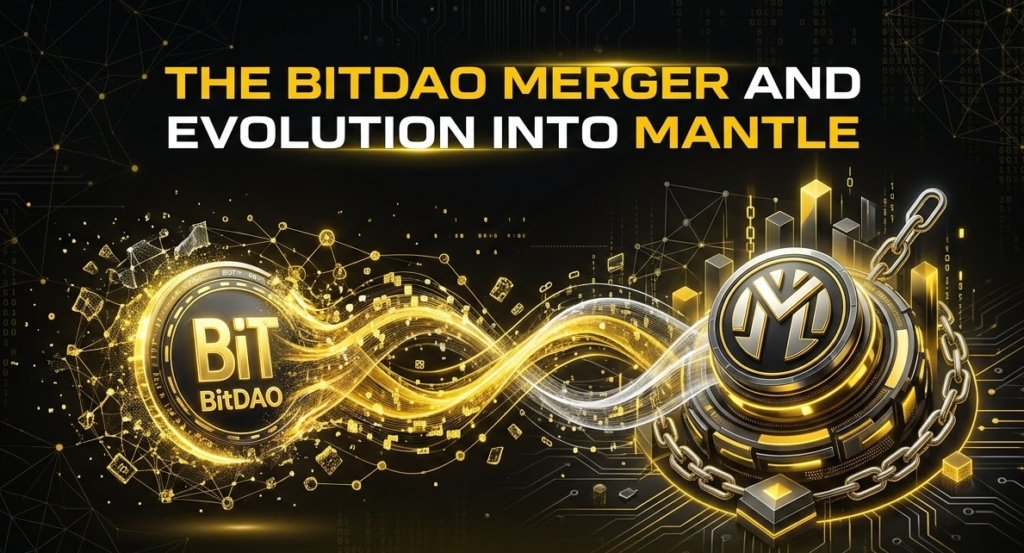
The BitDAO unification and BIT-to-MNT token conversion
Mantle’s history is closely tied to BitDAO, a decentralized autonomous organization established to support the development and adoption of blockchain technology. BitDAO accumulated a substantial treasury and supported a range of ecosystem initiatives. Rather than launching Mantle as an entirely unrelated project, the community used governance to bring the network and the existing DAO structure under a unified Mantle identity.
This transition mattered for two reasons. First, it connected the new Layer-2 network to an existing community and treasury instead of starting with a blank organizational structure. Second, it gave holders of the legacy BIT token a defined migration route into MNT, the token used by the Mantle ecosystem.
The approved migration was set at one BIT for one MNT. Mantle’s migration guide describes the one-way conversion process and explains that migrated MNT was initially received on Ethereum Layer 1, after which holders could bridge it to Mantle Network. The historical instructions are documented in the BIT-to-MNT migration guide.
It is useful to distinguish the final migration terms from earlier governance discussion. An earlier BitDAO forum discussion explored different conversion parameters, including a 3.14 ratio. That was part of the proposal-development process, not the final conversion rate used for the migration. The approved migration documentation specifies the 1:1 conversion.
The transition can be understood as a sequence:
-
BitDAO provided the governance and treasury foundation.
-
The community approved the Mantle direction and the token transition.
-
The Mantle brand became the umbrella for the network and related ecosystem initiatives.
-
BIT holders received access to the MNT migration process.
-
MNT became the token used for Mantle Network gas and governance.
The distinction between a rebrand and a token migration is important. A rebrand changes the identity and strategic direction of an organization or ecosystem. A token migration changes the asset holders use to participate in that ecosystem. In Mantle’s case, both happened as part of a broader governance-led transition.
Strategic exchange alignment and ecosystem treasury backing
Bybit has played a significant role in Mantle’s history and ecosystem development. BitDAO received substantial early support from Bybit, and the exchange has remained an important distribution and ecosystem partner. However, it would be misleading to describe Mantle simply as a Bybit-owned blockchain. Mantle has a governance and treasury structure, and the network’s direction is shaped through its own ecosystem processes.
The Mantle Treasury is one of the project’s defining characteristics. It provides capital that can be allocated to ecosystem development, liquidity initiatives, grants, investments, and other activities approved through governance. That gives Mantle a different funding profile from networks that rely primarily on venture-capital funding rounds or individual application teams.
One example is the Mantle EcoFund. Its original proposal described a target capital pool of $200 million, combining $100 million from the Mantle Treasury with an intended $100 million in matching capital from strategic venture partners. The proposal’s stated purpose was to support founders, infrastructure providers, and applications building within the Mantle ecosystem. The structure and objectives are set out in the Mantle EcoFund proposal.
There is an important nuance here: a proposed or targeted fund size is not the same thing as cash immediately available for every project. Matching capital depends on the participation of outside investors, and actual deployment depends on investment decisions, governance processes, and the terms of each initiative.
For users, the treasury has several potential implications:
-
It can help fund developer incentives and ecosystem growth.
-
It can support liquidity initiatives for applications that need deeper markets.
-
It can give Mantle more flexibility to pursue partnerships and integrations.
-
It can also create governance and treasury-management risks if capital is deployed poorly.
A large treasury is therefore an advantage only if it is managed responsibly. You should look at the actual governance decisions, asset holdings, spending disclosures, and results of funded initiatives rather than relying on a headline figure.
Bybit’s later activity also illustrates the relationship between the exchange and the network. In March 2026, Bybit announced the expansion of Mantle Vault to Mantle Chain, describing integrations with Aave and CIAN and reporting that the product had surpassed $150 million in assets under management before the expansion. These are company-reported figures, not independent proof that every strategy is low-risk or that the reported assets will remain in the product. The announcement is available in Bybit’s March 2026 update.
How Mantle Works?
Modular architecture versus monolithic rollups
To understand why Mantle is described as a modular Layer-2, it helps to look at the different jobs a blockchain has to perform. A blockchain is not simply a database that records transactions. It must execute transactions, agree on the order in which they occur, make the relevant data available, and provide a way to settle or verify the resulting state.
On a conventional monolithic blockchain, these responsibilities are handled within one tightly integrated system. Ethereum, for example, executes smart contracts, reaches consensus, and provides data availability through its own validator and block infrastructure. That integrated design is powerful, but it can become expensive when demand for blockspace rises.
A modular architecture takes a different approach. Instead of requiring one layer to handle every responsibility, it separates selected functions and allows specialized infrastructure to perform them.
Mantle follows this general model. Its execution environment processes transactions and runs smart contracts, while EigenDA provides a separate data-availability service. Ethereum remains the underlying settlement and security anchor for the rollup design.
The main components can be described as follows:
| Component | What it does | Why it matters |
|---|---|---|
| Execution | Processes transactions and executes smart contracts | Gives users and applications an environment in which to interact |
| Sequencing | Orders transactions and coordinates their processing | Determines the order in which transactions are included |
| Data availability | Makes transaction data available for verification and reconstruction | Allows participants to obtain the information needed to check the rollup state |
| Settlement | Anchors the rollup’s state and verification process to Ethereum | Connects the L2 to Ethereum’s security and settlement environment |
These components are related, but they are not interchangeable. A sequencer ordering transactions does not, by itself, prove that all transaction data is available. Similarly, a data-availability provider does not execute the smart contracts that change account balances.
This separation is the core idea behind Mantle’s modular design. The network can optimize different parts of the transaction lifecycle without forcing every component to operate in exactly the same way.
Mantle is still an Ethereum Layer-2, not an independent Layer-1 that merely happens to support Ethereum tools. Its purpose is to extend Ethereum’s execution capacity while maintaining a connection to Ethereum’s settlement environment.
EigenDA integration: what it changes
Data availability is one of the less visible parts of blockchain infrastructure, but it is essential to the security of a rollup.
Imagine that you submit a token swap on an L2. The network processes your transaction and updates the relevant balances. For other participants to verify that update, they need access to the underlying transaction data. If the system publishes only a summary or commitment while the actual data is unavailable, independent parties may be unable to reconstruct the state or challenge an invalid transition.
This is why data availability matters. A rollup must provide a reliable way for users and verifiers to obtain the data needed to check its operation.
Mantle uses EigenDA for this function. EigenDA is a data-availability system associated with EigenLayer. Rather than placing every piece of rollup data directly into Ethereum’s execution-layer calldata, the system distributes data through a specialized network of operators and uses cryptographic commitments and attestations as part of its design.
At a simplified level, the process looks like this:
-
Mantle’s transaction-processing system collects and batches user transactions.
-
The batch data is prepared for publication through the data-availability system.
-
EigenDA distributes the data among participating operators using its data-dispersal design.
-
Operators provide attestations related to the availability of the data.
-
The rollup uses the relevant commitments and verification mechanisms as part of its broader settlement process.
The exact technical workflow involves more than simply uploading a file and receiving a confirmation. EigenDA uses erasure coding and a distributed operator model. Erasure coding allows data to be divided into pieces in a way that can support reconstruction even if some pieces are unavailable. The operator network and its economic-security assumptions are therefore important parts of the design.
You can explore the technical implementation through the Mantle Network code repository, which describes EigenDA as the network’s data-availability technology, and through the EigenDA documentation, which explains the broader data-availability architecture.
Why not publish everything directly to Ethereum?
The simple answer is cost and capacity. Ethereum mainnet has limited blockspace, and publishing large amounts of rollup data directly to it can become expensive. A specialized data-availability layer can offer a different cost and throughput profile.
That does not mean EigenDA is automatically safer or better in every respect. It means the network is making a design trade-off: it uses a specialized external data-availability system and its associated operator and cryptoeconomic assumptions instead of relying exclusively on Ethereum’s native data-publication path.
When evaluating this arrangement, I would focus on several questions:
-
How many operators participate in the relevant EigenDA quorums?
-
What stake or economic guarantees support those operators?
-
What happens if operators fail to serve data when users need it?
-
How are data commitments verified?
-
What mechanisms are available for users to exit or recover funds under adverse conditions?
These are more meaningful questions than simply asking whether a project uses a modular architecture. Modularity can improve flexibility and efficiency, but it also makes the relationships between components more important to understand.
EigenDA is not the same thing as Ethereum data availability
A common mistake is to treat EigenDA as if it were just another name for Ethereum blobs. They are different systems.
Ethereum’s data-availability mechanisms are part of Ethereum’s own protocol infrastructure. EigenDA is a separate system that uses its own operator architecture and cryptoeconomic design. A rollup that uses EigenDA therefore has a different data-availability trust model from a rollup that posts all its transaction data directly to Ethereum.
This distinction matters when comparing Mantle with other Ethereum scaling networks. A lower data-publication cost can help reduce fees, but users and developers should also understand the additional assumptions that come with an external data-availability layer.
How transactions move through Mantle
From a user’s perspective, the process is relatively straightforward. You connect a wallet, submit a transaction, and pay the network fee in MNT. The more interesting details happen behind the interface.
A simplified transaction lifecycle looks like this:
-
Transaction submission: You sign a transaction in your wallet and send it to Mantle’s network infrastructure.
-
Sequencing: The transaction is ordered with other transactions for processing.
-
Execution: The EVM-compatible environment processes the transaction and calculates the resulting state changes.
-
Data publication: Transaction data is made available through the network’s data-availability arrangement.
-
Settlement and verification: The rollup’s state and relevant commitments are connected to Ethereum through its settlement and verification mechanisms.
This is a simplified educational description, not a complete protocol specification. Sequencer design, proof systems, upgrades, and network operating procedures can evolve. Developers building infrastructure should consult the current technical documentation and deployed contract configuration rather than rely on a high-level summary.
Mantle versus Arbitrum versus Optimism
The keyword Mantle vs Arbitrum vs Optimism is useful because all three networks are associated with Ethereum scaling, but they should not be treated as identical implementations.
Mantle uses an optimistic-rollup design with EigenDA as its data-availability layer. Arbitrum One‘s rollup mode publishes transaction data to Ethereum, while Arbitrum’s broader technology stack also supports alternative arrangements such as AnyTrust for chains that choose a data-availability committee. Optimism’s OP Stack is designed as a modular framework for building chains, with configurations and components that can differ across deployments.
| Dimension | Mantle | Arbitrum One | Optimism Mainnet |
|---|---|---|---|
| General category | Ethereum Layer-2 | Ethereum Layer-2 | Ethereum Layer-2 |
| Rollup approach | Optimistic rollup | Optimistic rollup | Optimistic rollup |
| Data availability | EigenDA integration | Ethereum data availability in Rollup mode | Ethereum data availability |
| Native gas asset | MNT | ETH | ETH |
| EVM compatibility | Yes | Yes | Yes |
| Ecosystem emphasis | Modular scaling, treasury-backed ecosystem, mETH and DeFi | DeFi, applications, Orbit chain ecosystem | OP Stack, Superchain ecosystem, DeFi and applications |
The table compares the broad architecture of the flagship networks. It does not mean every Arbitrum Orbit chain or every OP Stack deployment has the same configuration as Arbitrum One or Optimism Mainnet.
Arbitrum’s documentation distinguishes between Rollup mode, where transaction data is posted to the parent chain, and AnyTrust mode, where a data-availability committee is involved. Its data-availability documentation explains those options. This is useful context because it shows that alternative data-availability arrangements are not unique to Mantle; the specific trust model depends on the chain and its configuration.
The practical differences are worth considering:
-
Mantle: Its EigenDA integration is a central part of its modular scaling strategy, and MNT is used for gas on the network.
-
Arbitrum One: It has a mature DeFi ecosystem and uses ETH for transaction gas. Its rollup mode posts data to Ethereum.
-
Optimism Mainnet: It is part of the OP Stack ecosystem and uses ETH for gas. The wider Superchain vision makes interoperability and shared infrastructure important strategic themes.
Which one is best depends on what you want to do. A developer may care most about tooling, liquidity, and the applications their users already rely on. A trader may care about execution costs, market depth, and bridge routes. A user holding assets for the long term may care more about withdrawal procedures, data-availability assumptions, and the security of the applications they plan to use.
There is no universal winner based on architecture alone.
Native Gas and Ecosystem Yield: MNT, mETH Protocol & FBTC
MNT token utility: transaction gas fees and governance
MNT is the native token of Mantle Network. Its two central functions are paying transaction fees and participating in ecosystem governance.
This is a meaningful difference from many Ethereum Layer-2 networks. Arbitrum One and Optimism Mainnet generally use ETH for gas, while Mantle uses MNT as its native gas asset. If you want to interact with Mantle applications directly, you should keep some MNT available in the wallet you use on the network.
This detail can catch new users off guard. Someone may bridge ETH or USDC to Mantle, see the balance arrive, and then discover that they cannot make a simple token transfer because they do not have enough MNT to pay the transaction fee.
The distinction is not that ETH becomes unusable on Mantle. ETH can still exist as an asset on the network and can be used in supported applications. The distinction is that ETH is not the native gas currency for ordinary Mantle transactions.
BitGo’s technical reference describes Mantle as using MNT for gas and explains that the network’s fee calculation accounts for both L2 and L1 components. You can review the Mantle network and fee reference for additional technical detail.
MNT as a governance token
MNT also serves as a governance asset. Mantle’s governance process allows token holders to participate in decisions about network development, treasury deployment, and ecosystem initiatives, subject to the rules of the relevant proposal and voting process.
Governance is important because Mantle has a substantial treasury and a broad ecosystem strategy. Decisions about grants, liquidity support, infrastructure, and strategic investments can influence how the network develops.
However, holding MNT should not be confused with owning a proportional share of a company or having an automatic claim on treasury assets. Governance rights are defined by the protocol’s rules. They do not necessarily give every holder direct control over every decision, nor do they guarantee dividends, revenue distributions, or a redemption right against the treasury.
A responsible token analysis should separate three concepts:
-
Utility: MNT is used to pay network fees and access network functions.
-
Governance: MNT holders can participate in governance under the applicable rules.
-
Investment exposure: MNT’s market value can rise or fall depending on demand, supply, liquidity, sentiment, and broader market conditions.
Those functions overlap, but one does not guarantee the others. A token can have real network utility and still decline in market price.
MNT total supply cap and token allocation
Mantle’s MNT supply is commonly reported at approximately 6.219 billion tokens. This is a maximum-supply figure, not the same thing as the circulating supply at any particular moment.
That distinction matters. A token may have a fixed maximum supply while a significant portion remains in a treasury or is otherwise not circulating. As tokens are released or allocated, the circulating supply can change even though the maximum cap remains the same.
Mantle’s MiCA-related token documentation describes the MNT supply as fixed and distinguishes between circulating tokens and treasury-held assets. It also explains that treasury-held tokens may be allocated over time through governance decisions. The MNT crypto-asset whitepaper provides a useful disclosure of these characteristics.
The document records a historical supply snapshot dated July 7, 2023, with approximately 3.046 billion MNT held in the Mantle Treasury and approximately 3.173 billion classified as circulating at that time. These are historical figures, not a current circulating-supply report. For current market metrics, check a live data provider such as CoinGecko’s MNT page or the token contract on Etherscan.
A few supply terms are worth keeping separate:
| Term | Meaning |
|---|---|
| Maximum supply | The maximum number of tokens that can exist under the token’s supply design |
| Total supply | Tokens currently created, subject to the data provider’s definition |
| Circulating supply | Tokens considered available in the market |
| Treasury holdings | Tokens controlled by the ecosystem treasury and potentially subject to governance allocation |
| Fully diluted valuation | Token price multiplied by the maximum or fully diluted supply, depending on the provider’s methodology |
A fixed cap can make long-term supply analysis easier, but it does not make MNT automatically scarce in an economic sense. Scarcity depends on demand as well as supply. If demand for the network and its token does not grow, a fixed maximum supply alone cannot guarantee price appreciation.
Liquid staking and restaking: mETH and cmETH
The mETH Protocol is one of the most important products in Mantle’s DeFi ecosystem. It allows users to stake ETH and receive mETH, a liquid staking token representing their position in the staking system.
On Ethereum, native staking generally involves depositing ETH into the validator system and accepting the operational responsibilities and withdrawal mechanics associated with staking. A liquid staking protocol makes that position more flexible by issuing a transferable token that represents the user’s claim within the protocol.
In simplified terms:
-
You deposit ETH through the mETH Protocol.
-
The protocol routes the ETH into its staking arrangements.
-
You receive mETH as a liquid representation of your staked ETH.
-
The value of the staking position can reflect accumulated staking rewards, protocol mechanics, and market pricing.
-
You may use mETH in supported DeFi applications rather than leaving the position entirely idle.
The Mantle Liquid Staking Platform repository describes mETH as a reward-accumulating, permissionless ERC-20 receipt token that can be used across applications on Ethereum, Mantle, and other supported environments. The Mantle LSP smart-contract repository provides technical information and deployed contract references.
Why mETH is called liquid staking
The word liquid is important. When you stake ETH directly, your capital is committed to the validator process and subject to the protocol’s withdrawal mechanics. With a liquid staking token, you receive a token that can potentially be transferred, traded, or used as collateral.
For example, a user who holds mETH may be able to:
-
Keep it in a wallet as a liquid staking position.
-
Supply it to a supported lending market.
-
Use it in a liquidity pool.
-
Trade it against other assets.
-
Bridge or transfer it where supported.
This flexibility can improve capital efficiency, but it introduces additional risks. mETH is not identical to ETH in every market or technical situation. It can trade at a premium or discount to its expected underlying value, and the ability to exit depends on liquidity, redemption mechanics, and the health of the protocol.
If you use mETH as collateral, you also take on the risks of the lending platform. A sharp price movement or a change in collateral parameters could trigger liquidation even if the underlying staking system continues to function.
What is cmETH?
cmETH is associated with the mETH Protocol’s restaking-related product stack. While mETH represents a liquid staking position in ETH, cmETH is designed to provide exposure to additional restaking-related opportunities and rewards within the protocol’s framework.
The distinction is important because staking and restaking are not the same activity.
-
Staking contributes ETH to Ethereum’s proof-of-stake security system and can generate validator rewards.
-
Restaking extends the use of staked assets or their associated economic security to additional services or protocols, subject to the restaking system’s rules.
Restaking can create additional reward opportunities, but it can also introduce additional slashing, operator, smart-contract, and integration risks. A user should not assume that a higher advertised reward is simply a higher version of ordinary ETH staking yield. It may reflect a different risk profile.
Before depositing into mETH or cmETH, check the protocol’s current documentation for the applicable fees, validator arrangements, withdrawal conditions, supported networks, and any restaking-specific risks. Product names and reward programmes can evolve, so old campaign announcements should not be treated as current yield commitments.
Where does mETH yield come from?
The base economic source is Ethereum staking rewards, subject to validator performance and the protocol’s fee structure. Additional rewards may be available through incentives or integrations, but these should be evaluated separately.
A common mistake in DeFi is to see several reward sources displayed together and assume they are all equally sustainable. They are not.
For example:
-
Ethereum staking rewards depend on the Ethereum validator economy.
-
Protocol incentives may be temporary and can change through governance.
-
Lending yield depends on borrower demand and the lending market’s risk parameters.
-
Liquidity-pool fees depend on trading activity and can be offset by impermanent loss.
-
Restaking rewards depend on the services and economic arrangements using the restaked assets.
When you assess a yield strategy, identify exactly where each portion of the return comes from. If the protocol cannot explain the source of the yield clearly, that is a reason to slow down rather than deposit more funds.
FBTC: Bitcoin exposure in the Mantle ecosystem
FBTC is a Bitcoin-linked asset designed to represent BTC across multiple blockchain environments. It is relevant to Mantle because it can bring Bitcoin-denominated liquidity into DeFi applications beyond Bitcoin’s native network.
It is important, however, not to describe FBTC as if it were simply native BTC on Mantle. It is a tokenized representation whose security depends on the mechanisms used to issue, custody, transfer, and redeem it.
A Bitcoin-linked token can be useful because Bitcoin itself does not natively support the same smart-contract functionality available on Ethereum-compatible networks. Tokenized BTC assets allow holders to interact with lending markets, decentralized exchanges, and other DeFi applications.
But there are trade-offs. You may gain access to DeFi functionality while accepting additional dependencies, including:
-
Custody or collateral arrangements behind the token.
-
Cross-chain messaging and bridging infrastructure.
-
Smart contracts that issue and transfer the asset.
-
Redemption procedures and any restrictions that apply.
-
Liquidity conditions on the networks where the token trades.
Also, the phrase yield-bearing Bitcoin needs careful handling. FBTC’s Bitcoin representation does not mean every FBTC holder automatically earns a native BTC staking reward. Bitcoin does not use Ethereum-style proof-of-stake staking. Any yield opportunity associated with FBTC generally comes from a separate DeFi strategy, lending market, incentive programme, or product arrangement. That strategy has its own risks and should not be confused with the underlying BTC exposure.
How MNT, mETH, cmETH, and FBTC fit together
The easiest way to understand the Mantle ecosystem is to think of these assets as serving different roles rather than as interchangeable tokens.
| Asset | Primary role | What it is not |
|---|---|---|
| MNT | Mantle gas and governance token | Not a liquid staking receipt for ETH |
| mETH | Liquid staking representation of ETH | Not the same as native ETH in every market or redemption scenario |
| cmETH | Restaking-related product token in the mETH ecosystem | Not simply another name for MNT or ordinary ETH |
| FBTC | Tokenized Bitcoin exposure | Not native BTC held directly on the Bitcoin network |
This distinction helps prevent a common DeFi mistake: assuming that all tokens associated with one ecosystem carry the same underlying risk. MNT depends on network demand and token economics. mETH depends on staking infrastructure and liquidity. cmETH adds restaking-related dependencies. FBTC relies on the arrangements that support its Bitcoin representation.
They may interact within the same ecosystem, but they are different financial instruments.
Common Pitfalls and Misconceptions About Mantle
Misconception: Mantle uses ETH for L2 transaction gas fees
This is probably the easiest mistake to make if you are already familiar with Arbitrum or Optimism.
On many Ethereum Layer-2 networks, ETH is the native gas asset. Users bridge ETH to the L2 and use it to pay transaction fees. Mantle works differently: MNT is the native gas token on Mantle Network.
You can still hold ETH, USDC, USDT, and other supported assets on Mantle. You can also use ETH in DeFi applications where it is supported. But holding those assets does not automatically give you the MNT balance needed to pay for an ordinary network transaction.
Here is a practical example:
Imagine you bridge 500 USDC from Ethereum to Mantle. Your wallet now displays 500 USDC on Mantle, but you have no MNT. You try to send 50 USDC to another wallet, and the transaction cannot proceed because you do not have enough native gas.
The solution is to obtain a small amount of MNT before interacting with the network.
When bridging, remember that gas requirements can exist on both sides of the transfer. An Ethereum deposit may require ETH for the Ethereum transaction, while activity after the funds arrive on Mantle requires MNT. A withdrawal back to Ethereum may also involve additional Ethereum gas.
The Mantle Bridge interface and the network’s technical fee reference are useful starting points for checking the relevant requirements.
Misconception: Mantle is just another monolithic optimistic rollup
Mantle does use optimistic-rollup technology, so describing it as an optimistic rollup is not incorrect. The mistake is assuming that this tells you everything about its architecture.
The distinguishing feature is its modular data-availability design, which integrates EigenDA. This changes the way transaction data is made available compared with a rollup that publishes all its data directly to Ethereum.
It is better to describe Mantle as a modular Ethereum Layer-2 using an optimistic-rollup approach and EigenDA for data availability.
That wording is more precise than saying Mantle is completely different from optimistic rollups. Its execution and settlement model still belongs to the optimistic-rollup family; its data-availability arrangement is what makes its architecture distinctive.
Misconception: BitDAO and Mantle are two unrelated projects
Mantle did not simply appear as an unrelated new network while BitDAO continued operating as a separate parallel ecosystem.
The Mantle transition brought BitDAO’s governance and ecosystem direction under the Mantle identity, alongside the migration from BIT to MNT. The community-approved token migration used a 1:1 ratio, and the historical process is documented in Mantle’s migration guide.
You may still encounter old BitDAO references in historical documents, token records, governance discussions, and exchange announcements. That does not mean BIT and MNT should be treated as two interchangeable current network tokens.
If you are reviewing an older wallet or exchange record, check the token contract and the date of the transaction rather than relying on the ticker alone.
Misconception: A large treasury guarantees MNT price appreciation
Mantle’s treasury is a significant part of its strategic identity, but it does not guarantee a higher MNT price.
Treasury assets can fund development, liquidity programmes, grants, and strategic investments. Those activities may support adoption, but their effectiveness depends on how capital is deployed and whether the resulting products attract sustained users.
A large treasury can also create governance questions:
-
Who decides how assets are allocated?
-
How transparent are treasury transactions?
-
Are grants producing sustainable applications?
-
How much capital is being used for short-term incentives?
-
Are ecosystem investments generating long-term activity?
For investors, the quality of treasury management matters more than the headline size of the treasury.
Misconception: mETH and cmETH are risk-free ETH equivalents
Liquid staking and restaking tokens are not risk-free substitutes for ETH.
mETH represents a staking-related position, and cmETH adds further restaking-related exposure. Their value and liquidity depend on the underlying protocol, smart contracts, validator arrangements, redemption mechanisms, and any external applications in which the tokens are used.
A token can be designed to track an underlying asset or represent a claim related to it without maintaining a guaranteed one-to-one market price at all times.
If you use mETH or cmETH as collateral, you also take on the risks of the lending protocol. A liquidation can happen because the collateral value falls, even if the staking protocol itself has not failed.
Mantle Ecosystem
The relationships between Mantle’s major components are easier to understand when viewed as a set of connected functions.
-
BitDAO’s legacy: Provides the governance and treasury history behind the Mantle ecosystem.
-
Mantle Network: Provides the Ethereum-compatible Layer-2 execution environment.
-
EigenDA: Provides the separate data-availability infrastructure.
-
MNT: Pays network gas fees and supports governance participation.
-
mETH Protocol: Provides ETH liquid staking functionality.
-
cmETH: Provides a restaking-related extension of the mETH ecosystem.
-
FBTC: Brings tokenized Bitcoin exposure into supported DeFi applications.
-
Mantle Treasury and EcoFund: Support ecosystem development and capital deployment.
-
Bybit: Acts as a major strategic and distribution partner.
These components should not be viewed as one single smart contract or one unified financial product. They are separate systems and initiatives connected through the broader Mantle ecosystem.
For example, a user might hold MNT to pay for transactions, acquire mETH through ETH staking, and then use mETH as collateral in a supported lending market. Each step involves a different protocol and a different set of risks.
That is the real significance of an ecosystem approach: users can move between infrastructure and financial applications without having to leave the network, but they also need to understand the dependencies between those applications.
How to Bridge, Stake, and Use DeFi on Mantle
If you want to try Mantle rather than simply read about it, the process is relatively accessible to anyone familiar with Ethereum wallets. Still, I would approach it in stages. There is no need to bridge a large amount of capital or experiment with several yield strategies on your first visit.
Phase 1: Set up a compatible Web3 wallet
Start with an Ethereum-compatible wallet that supports custom networks and the Mantle mainnet.
Before connecting to any website, verify that you are using the official domain. Phishing websites often imitate bridge interfaces, staking dashboards, and wallet connection pages.
You should also check that your wallet has a secure backup and that you understand the difference between a wallet’s public address and its private recovery information. Never enter a recovery phrase into a website claiming to help you configure Mantle.
The official Mantle website and documentation are the safest places to begin:
If your wallet does not automatically display Mantle, use the network details published through the official documentation or a reputable wallet provider. Avoid copying RPC information from random social-media posts.
Phase 2: Bridge assets from Ethereum to Mantle
Once your wallet is ready, you can transfer supported assets from Ethereum to Mantle.
The general process is:
-
Open the official Mantle Bridge.
-
Connect your wallet.
-
Select Ethereum as the source network and Mantle as the destination.
-
Choose a supported asset, such as ETH, USDC, USDT, or MNT, subject to the bridge interface’s current availability.
-
Enter the amount you want to transfer.
-
Review the receiving network, token, address, and estimated fees.
-
Approve the token if an approval transaction is required.
-
Confirm the deposit transaction in your wallet.
-
Wait for the bridge process to complete and check the destination balance.
Remember that approving a token and depositing it are separate actions. An approval gives a contract permission to spend a specified amount of your token; it does not itself transfer the funds.
Also, a bridge transfer is not necessarily an asset swap. A canonical bridge generally moves an asset between networks using the relevant token mapping. If you choose a third-party bridge or liquidity route, you may encounter additional fees, slippage, and different security assumptions.
After the transfer, check the destination balance and transaction status using the Mantle explorer.
Keep some MNT for gas. This is particularly important if you bridged ETH or stablecoins but did not transfer any MNT. Without native gas, you may be unable to move the assets you just received.
Phase 3: Stake ETH through the mETH Protocol
If your goal is to explore liquid staking, the next step is to review the mETH Protocol.
The general process involves:
-
Visit the official mETH Protocol interface.
-
Verify the domain and supported network.
-
Connect your wallet.
-
Review the staking asset, minimum deposit if applicable, fees, and expected receipt-token mechanics.
-
Enter the amount of ETH you want to stake.
-
Review the estimated mETH received.
-
Confirm the transaction in your wallet.
-
Check that the mETH balance appears after the transaction completes.
Do not assume the exchange rate between ETH and mETH will always be exactly one-to-one. Liquid staking tokens can reflect accumulated rewards and may trade at a premium or discount on secondary markets.
Before staking, review the current redemption process. You should know whether you can request an unstake directly, how long a withdrawal may take, and whether you would need to sell mETH on a secondary market to exit quickly.
The Mantle LSP contract repository is a useful technical reference for the protocol’s smart contracts.
Phase 4: Use mETH or FBTC in supported DeFi applications
Once you hold mETH or a supported Bitcoin-linked asset such as FBTC, you may be able to use it in lending markets, decentralized exchanges, or liquidity pools.
For example, a lending application may allow you to deposit mETH as collateral and borrow another asset. A decentralized exchange may offer an mETH trading pair. A liquidity pool may reward providers with a share of trading fees or additional incentives.
But the risk changes with every additional protocol you use.
| DeFi activity | Potential benefit | Main risks |
|---|---|---|
| Hold mETH | Maintain liquid staking exposure | Staking, smart-contract, and market-price risk |
| Supply mETH to lending | Earn lending interest | Protocol risk, collateral parameters, liquidity |
| Borrow against mETH | Access liquidity without selling the token | Liquidation and interest-rate risk |
| Provide liquidity | Earn trading fees and possible incentives | Impermanent loss and smart-contract risk |
| Use FBTC in DeFi | Put tokenized BTC exposure to work | Custody, bridge, redemption, and application risk |
Do not confuse advertised APY with guaranteed income. Yield rates change as lending demand, trading volume, incentives, and market conditions change.
If you are new to DeFi, start by understanding the underlying asset and the protocol that will hold it. Only then should you decide whether the additional yield is worth the additional risk.
Phase 5: Monitor positions and understand how to exit
Opening a position is only half the process. Before depositing funds, you should know how to withdraw them.
For each application, check:
-
Whether withdrawals are currently enabled.
-
Whether there are withdrawal queues or delays.
-
Whether the asset has sufficient secondary-market liquidity.
-
Whether collateral can be liquidated.
-
Whether the application charges withdrawal or performance fees.
-
Whether the relevant smart contracts have been audited and whether there have been material upgrades.
For leveraged positions, monitor collateral health rather than assuming that a position will remain safe because it was initially overcollateralized.
For liquid staking, understand the difference between requesting redemption through the protocol and selling the receipt token on a decentralized exchange. These can have different prices, waiting times, and risks.
A conservative approach is to test the process with a small amount before committing more capital.
Frequently Asked Questions About Mantle
What is Mantle and how does it work?
Mantle is an Ethereum Layer-2 network that uses an optimistic-rollup design and a modular data-availability architecture. It integrates EigenDA for data availability, while MNT is used for native network gas fees and governance.
The network processes transactions outside Ethereum mainnet and connects its rollup activity to Ethereum’s settlement environment. Its broader ecosystem includes applications and assets such as mETH, cmETH, and FBTC.
How did Mantle originate from BitDAO?
Mantle emerged from a governance-led transition that unified BitDAO’s ecosystem direction under the Mantle brand in 2023.
As part of the transition, holders could migrate legacy BIT tokens to MNT at a 1:1 ratio under the approved migration process. The migration guide explains the historical process and the associated token handling.
What is the difference between MNT, mETH, cmETH, and FBTC?
These assets serve different functions:
-
MNT: Native Mantle gas and governance token.
-
mETH: Liquid staking receipt token representing an ETH staking position.
-
cmETH: Restaking-related token within the mETH ecosystem.
-
FBTC: Tokenized Bitcoin exposure designed for use across supported blockchain environments.
They are not interchangeable. Each has different underlying mechanisms, market behavior, and risks.
Why does Mantle use MNT instead of ETH for transaction gas fees?
Mantle uses MNT as its native gas token, unlike networks such as Arbitrum One and Optimism Mainnet, which generally use ETH for gas.
This gives MNT a direct network utility: users need it to pay for ordinary transactions on Mantle. ETH can still be held and used as an asset on the network, but it does not replace native MNT for normal gas payments.
What is the total supply cap of MNT?
MNT has a maximum supply of approximately 6.219 billion tokens. The exact displayed figure may vary slightly depending on decimal precision and the data source.
Maximum supply is different from circulating supply. A portion of the total supply has been held in the Mantle Treasury and can be allocated through governance decisions. For current figures, check the token contract and reputable market-data providers rather than relying on historical snapshots.
Is Mantle an optimistic rollup or a modular blockchain?
Mantle is an optimistic-rollup-based Ethereum Layer-2 with a modular data-availability design.
The term modular describes how parts of the blockchain stack are separated into specialized components. Mantle’s integration of EigenDA is a major part of that design. It is therefore more accurate to call Mantle a modular optimistic rollup than to suggest that it is not an optimistic rollup at all.
What is EigenDA in Mantle?
EigenDA is the data-availability system integrated into Mantle’s modular architecture. It distributes rollup data through a specialized operator network and uses cryptographic commitments and attestations as part of its design.
Its purpose is to provide scalable data availability without requiring Mantle to publish all transaction data directly to Ethereum in the same way as a conventional rollup data-publication model.
Is mETH the same as ETH?
No. mETH is a liquid staking token representing an ETH staking position through the mETH Protocol.
It can be transferable and usable in supported DeFi applications, but it is not identical to native ETH in every respect. Its market price, liquidity, redemption mechanics, and smart-contract risks can differ from those of ETH.
Does mETH generate guaranteed passive income?
No. mETH is designed to represent a liquid staking position, and its underlying rewards are related to Ethereum staking. However, staking rewards are variable and depend on validator performance, network conditions, and protocol fees.
Additional DeFi rewards are separate from base staking returns and may involve further risks. Neither staking rewards nor advertised APYs should be treated as guaranteed income.
Is FBTC the same as native Bitcoin?
No. FBTC is a tokenized Bitcoin-linked asset intended to represent BTC across supported blockchain environments.
It can provide access to DeFi applications that native Bitcoin does not directly support, but it also introduces additional dependencies involving the asset’s issuance, custody or collateral arrangements, cross-chain infrastructure, and redemption mechanisms.
Can I use Mantle without holding MNT?
You can potentially receive assets on Mantle without already holding MNT, depending on the transfer route. However, you generally need native MNT to pay for transactions on the network.
If you bridge only ETH or stablecoins, make sure you obtain enough MNT to cover the transactions you plan to make.
Is Mantle better than Arbitrum or Optimism?
There is no universal answer. Mantle differentiates itself through its EigenDA integration, MNT gas token, and treasury-backed ecosystem strategy. Arbitrum has a major DeFi and Orbit ecosystem, while Optimism is closely associated with the OP Stack and Superchain vision.
The best choice depends on the applications you want to use, available liquidity, fees, security assumptions, bridge routes, and the assets you intend to hold.
Is Mantle safe to use?
Mantle’s connection to Ethereum, its rollup architecture, and its use of established infrastructure are relevant security considerations, but they do not make the network or its applications risk-free.
Users should consider the security of the rollup, EigenDA’s data-availability assumptions, bridges, smart contracts, staking protocols, lending markets, and wallet security. An audit is useful evidence, but it is not a guarantee that a protocol cannot be exploited.
Conclusion
Mantle is an interesting Ethereum scaling ecosystem because it combines several ideas that are often discussed separately: modular rollup architecture, external data availability, a native gas token, DAO treasury governance, liquid staking, and Bitcoin-linked DeFi assets.
Its technical identity is relatively clear. Mantle uses an optimistic-rollup approach, integrates EigenDA for data availability, and uses MNT for network fees and governance. Its history also gives it a distinctive funding and organizational background through the BitDAO transition and the Mantle Treasury.
The mETH Protocol expands the ecosystem beyond basic transaction execution by allowing ETH holders to access liquid staking. cmETH adds a restaking-related dimension, while FBTC gives users access to tokenized Bitcoin exposure in supported DeFi applications. These products broaden what users can do on Mantle, but they also mean that the ecosystem’s risk profile cannot be judged by the L2 architecture alone.
If you are evaluating MNT as an investment, I would look beyond the fixed supply cap and the size of the treasury. Pay attention to actual network activity, application adoption, liquidity, governance decisions, token distribution, and the sustainability of ecosystem incentives. If you are evaluating Mantle as a place to use DeFi, focus on the security and exit conditions of each individual application.
Ultimately, Mantle’s long-term success will depend on whether its modular infrastructure and ecosystem capital translate into durable usage. Low fees and a large treasury can help attract users and developers, but lasting adoption comes from applications that people continue to use when temporary incentives disappear.
Mantle is therefore worth understanding not just as another Ethereum Layer-2, but as a broader attempt to combine scalable infrastructure with a treasury-supported DeFi ecosystem.