
What is Hyperliquid (HYPE)?
Simple definition and value proposition
Hyperliquid is a Layer 1 blockchain built from the ground up for on-chain finance.
That description is more important than it sounds.
A lot of decentralized exchanges started with the blockchain first and the trading engine second. Hyperliquid took almost the opposite approach. Its infrastructure was built around the idea that a decentralized financial market should be able to offer the speed and order-book experience traders already understand from centralized exchanges.
The result is a blockchain where the order book itself is part of the chain’s execution state.
Hyperliquid’s current documentation describes the network as a Layer 1 optimized from first principles, using a custom HyperBFT consensus mechanism and splitting execution between HyperCore and HyperEVM. HyperCore contains the on-chain perpetual and spot order books, while HyperEVM provides general-purpose smart contracts. (Hyperliquid’s technical overview)
The performance numbers are a big part of the story.
Current Hyperliquid documentation reports approximately 0.2 seconds median end-to-end latency for an order submitted by a geographically co-located client, with a 99th-percentile figure of about 0.9 seconds. The same documentation currently reports approximately 200,000 orders per second of mainnet throughput. (Hyperliquid’s performance documentation)
That doesn’t mean every user everywhere experiences 200,000 orders per second or 0.2-second execution.
Network distance, internet connectivity, client software, market conditions, and execution details all matter.
Still, the numbers explain why Hyperliquid has attracted traders who normally wouldn’t be interested in using an on-chain exchange.
The core proposition is simple:
Put the trading engine on the blockchain without making the trading experience feel like a blockchain.
HYPE is the native token that sits underneath this infrastructure.
It is used as the native gas asset on HyperEVM and can be staked to validators for network security. Hyperliquid’s staking documentation also describes delegated proof-of-stake, validator commissions, and HYPE staking as part of the network’s consensus model. (Hyperliquid staking documentation)
So when you look at Hyperliquid, I think it helps to separate three things:
- Hyperliquid L1 – the underlying blockchain and consensus network.
- HyperCore – the high-performance trading and financial engine.
- HyperEVM – the general-purpose smart-contract environment.
That distinction makes almost everything else easier to understand.
Origins, core team and governance model
Hyperliquid was developed by a team of engineers associated publicly with the pseudonymous founders Jeff and Chameleon.
The project took a very different route from the standard crypto fundraising playbook.
Rather than launching with a conventional venture-backed token sale, Hyperliquid built its trading platform first and later introduced HYPE through a community-focused genesis distribution.
The HYPE genesis event took place on November 29, 2024, with 31% of the maximum supply allocated to the genesis distribution. Contemporary reporting from The Block documented the launch and the distribution of roughly 310 million HYPE to eligible users. (The Block’s report on the HYPE genesis event)
Hyperliquid’s current public materials continue to emphasize a community-first structure and state that there were no investors and no paid market makers associated with the network’s launch model. (Hyper Foundation)
That does not mean the project has no economic stakeholders.
Core contributors, the Hyper Foundation, community programs, future emissions, and validators all have roles in the network’s economics.
The important distinction is that the initial token distribution was not structured around a traditional private-investor allocation.
That became one of the defining characteristics of HYPE’s launch.
Key technical specifications at a glance
| Specification | Hyperliquid |
|---|---|
| Network type | Independent Layer 1 |
| Native token | HYPE |
| Consensus | HyperBFT |
| Consensus lineage | Inspired by HotStuff and successors |
| Core trading engine | HyperCore |
| Smart-contract environment | HyperEVM |
| HyperEVM Chain ID | 999 |
| Maximum HYPE supply | 1 billion |
| Perpetual collateral | USDC |
| Reported order throughput | ~200,000 orders/sec |
| Reported median end-to-end latency | ~0.2 seconds |
| Native EVM gas token | HYPE |
The official HyperEVM documentation currently lists Chain ID 999 for mainnet and identifies HYPE as the native gas token. It also confirms that HyperEVM inherits HyperBFT security rather than operating as a separate Layer 2. (HyperEVM documentation)
Dual-engine architecture: HyperCore vs. HyperEVM
This is where Hyperliquid gets genuinely interesting.
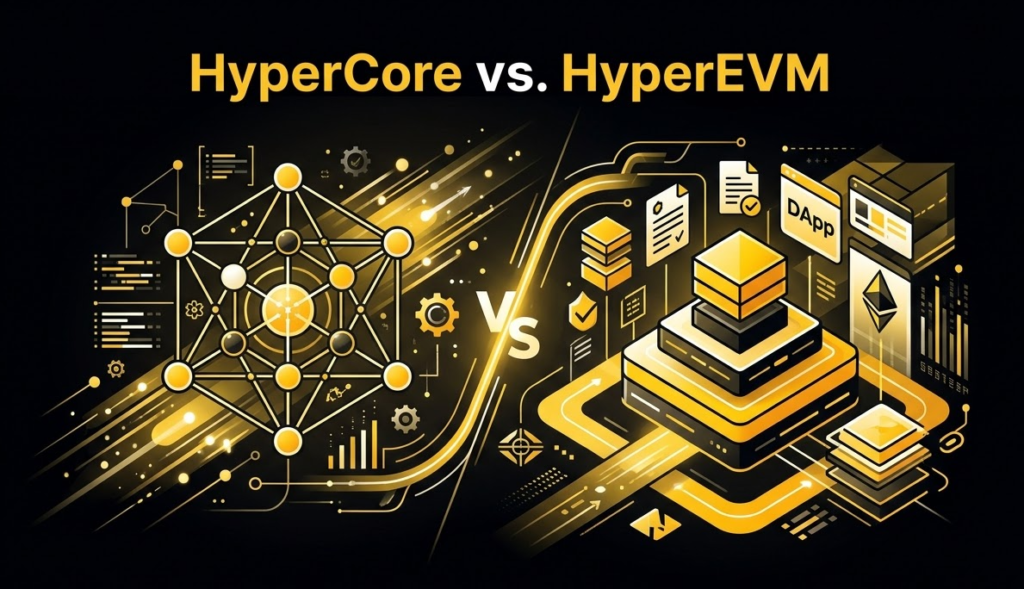
Instead of putting everything into one generic smart-contract environment, the network separates its execution architecture into two tightly connected components.
HyperCore handles financial primitives.
HyperEVM handles general-purpose applications.
They aren’t two unrelated chains.
They are two parts of the same Layer 1.
HyperCore: The high-performance on-chain CLOB engine
HyperCore contains the core trading infrastructure.
That includes:
- Perpetual futures
- Spot markets
- Order books
- Margin
- Liquidations
- Funding
- Trading positions
- Market-making infrastructure
The major difference from many DEXs is the order book.
Hyperliquid doesn’t maintain a traditional off-chain matching engine and periodically settle the results on-chain.
The order book itself is part of HyperCore’s state.
Current documentation explains that orders are matched using price-time priority, similar to centralized exchanges. (Hyperliquid order-book documentation)
That matters because traders understand order books.
You can place:
- Limit orders
- Market orders
- Trigger orders
- Take-profit orders
- Stop-loss orders
And the underlying market structure behaves much more like a professional trading venue than a simple AMM.
Another unusual detail is that HyperCore does not charge gas for every order in the same way a conventional smart-contract DEX would.
The order engine is part of the chain’s native execution environment.
That allows the system to process large numbers of trading actions without forcing traders to manually manage a gas balance for every order modification.
Liquidations are also integrated into the order book.
Hyperliquid’s documentation says that most liquidations are sent directly to the order book, allowing market participants to compete for the liquidation flow rather than routing everything through a centralized liquidation mechanism. (Hyperliquid liquidation documentation)
That creates an interesting design.
The blockchain isn’t just recording that a trade happened.
It is running the actual financial market.
HyperEVM: Ethereum-compatible smart contracts with shared state
HyperEVM is the general-purpose side of the architecture.
If you’re a Solidity developer, this is the part that feels familiar.
HyperEVM supports Ethereum-style smart contracts and uses Chain ID 999 on mainnet. It also supports EIP-1559-style fee mechanics. (HyperEVM documentation)
The major difference is that HyperEVM doesn’t sit on an independent blockchain next to HyperCore.
It is part of the same Hyperliquid execution environment and is secured by HyperBFT.
That gives developers access to something most conventional EVM chains don’t have:
Native access to a high-performance on-chain financial engine.
A developer could build a lending application, structured product, automated trading strategy, vault, or another financial application on HyperEVM and interact with information and functionality from HyperCore.
That creates a potentially powerful feedback loop.
More applications can create more users.
More users can create more liquidity.
More liquidity makes the underlying order books more useful.
And deeper order books make the platform more attractive to applications.
Bridgeless native state sharing via CoreWriter
This is one of the biggest technical differences between Hyperliquid and a typical multi-chain DeFi setup.
Usually, when an application on one chain wants to interact with assets or state on another chain, you need some kind of bridge, messaging system, or intermediary.
Bridges can introduce additional contracts, liquidity requirements, oracle dependencies, and attack surfaces.
Hyperliquid’s design takes a different route.
HyperCore and HyperEVM are secured by the same HyperBFT consensus.
HyperEVM contracts can use precompiles to read HyperCore information, while the CoreWriter system contract lets HyperEVM applications send actions to HyperCore. (Hyperliquid’s HyperCore interaction documentation)
The CoreWriter system contract currently sits at a fixed system address and can submit encoded actions for HyperCore processing.
This means an EVM application can interact with native trading infrastructure without wrapping the interaction into a conventional cross-chain transaction.
There is still a delay for some CoreWriter actions.
Hyperliquid’s documentation explicitly says order actions and vault transfers sent through CoreWriter are delayed by a few seconds to prevent applications from gaining an unfair latency advantage over the normal L1 mempool. (Hyperliquid’s CoreWriter documentation)
That’s an important detail.
“Shared state” doesn’t mean a smart contract can magically bypass the trading engine’s sequencing rules.
Hyperliquid still has to preserve fairness between direct traders and applications.
The architecture is better understood as:
HyperCore + HyperEVM + shared consensus + native read/write interfaces.
That’s considerably different from simply deploying an EVM chain next to an exchange.
The Hyperliquid vault ecosystem: HLP, user vaults and yield mechanics
HLP: Hyperliquidity Provider vault
HLP stands for Hyperliquidity Provider.
It’s one of the most interesting parts of Hyperliquid because it lets users participate in liquidity provision without personally running a professional market-making operation.
HLP is a protocol vault.
The official documentation says it performs several functions, including market making, liquidations, supplying USDC in Earn, and accumulating a portion of trading fees. (Hyperliquid protocol vault documentation)
Users can deposit USDC into HLP and share in its performance.
But this isn’t a savings account.
That’s worth emphasizing.
HLP takes actual trading risk.
If traders on the platform collectively generate profits against the strategies HLP is exposed to, the vault can lose money.
This makes HLP fundamentally different from simply depositing USDC into a lending protocol and collecting a variable interest rate.
The vault is participating in the market.
Hyperliquid’s documentation describes HLP as a community-owned protocol vault and notes a four-day withdrawal lockup after the most recent deposit. (Hyperliquid HLP documentation)
So before depositing, I would look at more than the displayed return.
I’d want to know:
- What strategy is HLP currently running?
- How has PnL behaved during volatile markets?
- How much capital is deployed?
- What portion is exposed to liquidation activity?
- What happens during extreme directional moves?
- How long will my capital be locked?
A large historical return doesn’t remove market risk.
User vaults and social copy-trading
Hyperliquid also supports user-created vaults.
These allow traders to create strategies that other users can deposit into.
It effectively creates a native social-trading layer.
You don’t have to hand someone your wallet keys.
Instead, your funds remain within the vault structure while the vault leader executes the strategy.
Hyperliquid’s documentation states that user vault leaders receive 10% of total profits under the documented vault model, while protocol vaults such as HLP have different fee treatment. (Hyperliquid vault documentation)
The user-vault model can be useful if you want exposure to another trader’s strategy without manually copying every position.
But it introduces a different risk.
You’re trusting the strategy.
A trader can have an excellent six-month record and still experience a catastrophic drawdown later.
The documentation itself warns users to evaluate the risks and historical performance of individual vaults rather than assuming past results will continue. (Hyperliquid vault documentation)
I would treat a vault exactly that way.
As a strategy allocation.
Not as passive income.
ERC-4626 strategy vaults on HyperEVM
The HyperEVM opens another door.
Instead of relying only on HyperCore’s native vault system, developers can create programmable strategies through smart contracts.
ERC-4626 is particularly relevant because it provides a standardized interface for tokenized vaults.
That makes it possible to construct products around strategies such as:
- Delta-neutral positions
- Basis trading
- Automated rebalancing
- Leveraged strategies
- Yield aggregation
- Structured products
The bigger idea is that HyperCore supplies the trading infrastructure while HyperEVM supplies the programmable application layer.
A developer could therefore build a vault that interacts with HyperCore liquidity rather than forcing users to move capital across unrelated protocols.
That’s the architecture Hyperliquid is trying to turn into a broader financial stack.
Ecosystem standards and permissionless scaling: HIP-1 to HIP-3

Hyperliquid Improvement Proposals, or HIPs, define important parts of the ecosystem’s protocol design.
One correction is important here.
The current official HIP documentation I found lists HIP-1, HIP-2 and HIP-3 as the main deployed HIPs in this section. I could not verify an official current HIP-4 prediction-market specification in the same documentation. (Hyperliquid HIP index)
So I would not present HIP-4 as an established Hyperliquid protocol standard without additional evidence.
The current architecture is already broad enough without inventing one.
HIP-1 and HIP-2: Native tokens and Hyperliquidity
HIP-1 provides a native fungible-token standard for Hyperliquid.
The standard defines parameters such as:
- Token name
- Decimal precision
- Maximum supply
- Initial balances
- Spot-market configuration
- Hyperliquidity settings
It also allows native spot order books between supported tokens. (HIP-1 documentation)
This is different from deploying an ERC-20 contract on a normal EVM chain.
The token becomes part of Hyperliquid’s native financial infrastructure.
That means it can interact directly with the order-book system.
Then there is HIP-2, called Hyperliquidity.
Hyperliquidity is an on-chain liquidity strategy inspired partly by AMM-style liquidity provision but integrated directly into Hyperliquid’s order book. The strategy logic is secured by the same consensus that runs the order book, rather than relying on an external operator. (HIP-2 documentation)
Currently, Hyperliquidity is documented for spot pairs against USDC.
One interesting parameter is its target spread behavior.
The current documentation describes a 0.3% spread and strategy updates at intervals of at least three seconds, subject to the protocol’s execution rules. (HIP-2 documentation)
The important innovation isn’t simply the spread.
It’s the combination:
AMM-like automated liquidity + native order book + on-chain execution.
That gives token issuers another way to bootstrap liquidity without abandoning the order-book model.
HIP-3: Permissionless perpetuals and RWA expansion
HIP-3 takes the idea further.
It allows builders to deploy their own perpetual markets on Hyperliquid.
The deployer defines the market, oracle configuration, leverage parameters, and operating rules.
The new market then inherits HyperCore’s high-performance margining and order-book infrastructure. (HIP-3 documentation)
There is a significant economic requirement.
The current mainnet specification requires the deployer to maintain 500,000 HYPE staked.
The documentation says this requirement is expected to decrease as the infrastructure matures. (HIP-3 documentation)
That is a clever mechanism.
Instead of asking the core Hyperliquid team to decide which markets should exist, the protocol can let third-party builders create markets while putting economic skin in the game.
That also introduces risk.
The deployer is responsible for its oracle and market design, and HIP-3 includes slashing mechanisms for poor-quality or problematic markets.
The result is a more permissionless derivatives platform.
It could potentially accommodate markets far beyond the standard crypto list.
That includes:
- Equity-related markets
- Commodity references
- FX
- Indices
- Other financial instruments
But there is an important distinction.
Being technically capable of creating an RWA-linked perpetual does not automatically make that market equivalent to owning the underlying asset.
A tokenized or synthetic perpetual referencing gold isn’t the same thing as owning physical gold.
A stock-linked perpetual isn’t the same thing as holding the stock.
That distinction matters for both risk and regulation.
What about HIP-4 and prediction markets?
The outline for this article includes HIP-4 as a prediction-market and event-contract standard.
I would not present that as established protocol functionality based on the current official documentation.
The current Hyperliquid documentation instead contains other mechanisms for expanding the product universe, including Hyperps and builder-deployed perpetuals. Hyperps, for example, are Hyperliquid-specific perpetual-style contracts that can exist before a conventional underlying spot market exists. (Hyperliquid Hyperps documentation)
So the broader idea in the outline – expanding beyond conventional crypto perpetuals – is valid.
The specific HIP-4 label, however, should be treated as unverified rather than stated as fact.
That’s an important distinction for an evergreen article.
HYPE tokenomics, value capture and the burn mechanism
Token allocation, distribution and lockup schedule
HYPE has a maximum supply of 1 billion tokens.
Its original allocation was unusual compared with many major crypto launches.
The disclosed categories were:
| Allocation | Share |
|---|---|
| Genesis distribution | 31.0% |
| Future emissions and community rewards | 38.89% |
| Core contributors | 23.8% |
| Hyper Foundation | 6.0% |
| Community grants | 0.3% |
| HIP-2 liquidity | 0.012% |
These figures are documented in public regulatory filings describing the HYPE supply and allocation. The filing states that 31% was distributed to past users, 38.89% was reserved for future emissions and rewards, and 23.8% was allocated to core contributors. (SEC filing describing HYPE token allocation)
The 31% genesis distribution is especially important.
Approximately 310 million HYPE represented the initial community distribution.
The remaining supply was reserved across future rewards, contributors, foundation activity, grants, and other protocol purposes.
The contributor allocation is subject to lockups and vesting rather than being immediately liquid.
That means you should distinguish between:
Maximum supply – 1 billion HYPE.
Circulating supply – the amount actually available in the market at a particular time.
Allocated supply – tokens assigned to a category but potentially still locked or reserved.
Those three numbers are not interchangeable.
Protocol fee buyback and burn engine
This is probably the part of HYPE tokenomics that gets the most attention.
Hyperliquid directs protocol trading-fee flows to community-oriented destinations, including HLP, the Assistance Fund, and deployers depending on the market.
The current fee documentation states that the Assistance Fund converts trading fees to HYPE through automated L1 execution, and HYPE in that fund is burned, removing it from circulating and total supply. (Hyperliquid fee documentation)
This creates a connection between trading activity and HYPE supply.
In simplified form:
Trading activity → protocol fees → HYPE purchases → HYPE burn
That is different from a token whose only source of demand is speculation.
However, I would avoid calling this a guaranteed “deflation engine.”
Why?
Because HYPE also has future emissions and staking rewards.
Supply can therefore move through both issuance and burning.
The economic question is the balance between them.
Higher protocol activity can increase fee generation and therefore potential HYPE burns.
But future emissions can add tokens to supply.
The result is a dynamic monetary system rather than a one-way supply reduction mechanism.
100% gas burning on HyperEVM
HyperEVM has another unusual property.
Its EVM transaction fees use HYPE as the native gas asset.
The chain supports EIP-1559.
But unlike many EVM networks, both base fees and priority fees are burned under the current implementation.
Hyperliquid’s documentation explicitly states that base fees are burned and that priority fees are also burned because HyperBFT does not depend on validator tips in the usual EVM manner. (HyperEVM documentation)
That creates another potential supply sink.
Imagine a popular DeFi application running on HyperEVM.
Users interact with contracts.
They pay gas.
The associated base and priority fees are burned.
The application doesn’t need to manually submit a separate buyback transaction for that part of the mechanism.
It is built into the network’s execution model.
Still, there is a useful distinction:
Gas burning doesn’t automatically mean HYPE’s total supply must continuously decline.
You have to consider emissions, staking rewards, Assistance Fund burns, and other protocol-level supply changes together.
Staking and HYPE network security
HYPE also has a direct role in consensus.
Hyperliquid uses delegated proof-of-stake.
Users can delegate HYPE to validators.
Current documentation says a validator must self-delegate 10,000 HYPE to become active. Delegations have a one-day lockup, while moving HYPE from the staking account back to the spot account currently involves a seven-day unstaking queue. (Hyperliquid staking documentation)
Validator rewards are linked to the amount of HYPE staked.
The current documentation gives an illustrative reward rate of approximately 2.37% annually at 400 million HYPE staked, with the rate inversely related to the square root of total HYPE staked. (Hyperliquid staking documentation)
That number should be treated as an example under the stated staking conditions, not a permanent APY.
The more important point is utility.
HYPE isn’t simply a governance token sitting outside the trading system.
It participates in:
- Consensus security
- HyperEVM gas
- Validator delegation
- Market deployment economics
- Trading fee discounts
- Protocol value flows
The current fee schedule also provides trading-fee discounts for users with different amounts of HYPE staked. (Hyperliquid fee documentation)
Hyperliquid vs. other derivatives platforms
Hyperliquid is easiest to understand when compared with other trading architectures.
| Attribute | Hyperliquid | dYdX | GMX | Binance |
|---|---|---|---|---|
| Core model | On-chain order book | App-specific trading chain | Liquidity-pool model | Centralized order book |
| Custody | Self-custodial | Self-custodial | Self-custodial | Custodial |
| Order-book trading | Yes | Yes | No traditional CLOB | Yes |
| General smart contracts | HyperEVM | Cosmos/CosmWasm architecture | Underlying EVM chains | No public equivalent |
| Native token | HYPE | DYDX | GMX | BNB |
| Main collateral model | USDC | USDC/stablecoins depending on market | Market-dependent | Exchange custody |
| Native L1 | Yes | Yes, dYdX Chain | No | No |
| On-chain matching | Yes | Chain-based | Pool/oracle based | No |
| RWA/permissionless perps | HIP-3 | Different listing model | More limited | Exchange-controlled |
The most important difference is not raw speed.
It’s where the trading engine lives.
A centralized exchange can keep its matching engine off-chain and use extremely optimized infrastructure.
That can deliver excellent latency.
Hyperliquid tries to move the matching engine itself into the decentralized state machine.
That is much harder.
The network has to maintain:
- Consensus
- Ordering
- Margin
- Liquidations
- Market data
- Execution
- State synchronization
while remaining fast enough for traders.
That’s why HyperBFT and the custom execution architecture matter so much.
Hyperliquid vs. dYdX
dYdX also moved toward its own Layer 1 architecture rather than remaining purely an application on Ethereum.
The difference is that Hyperliquid’s architecture is heavily centered on its own native order-book execution and the combination of HyperCore and HyperEVM.
Hyperliquid also makes native financial state accessible to general-purpose applications through its CoreWriter and precompile architecture.
Hyperliquid vs. GMX
GMX is built around a liquidity-pool and oracle-based trading model.
Hyperliquid instead operates a native order book.
This produces a different trading experience.
An order-book trader thinks in terms of bids, asks, depth, spreads, and execution priority.
A pool-based trader thinks more about available liquidity, oracle pricing, pool exposure, utilization, and trader-versus-pool PnL.
Neither structure automatically eliminates risk.
They’re simply different market designs.
Hyperliquid vs. centralized exchanges
This is probably the most important comparison for actual traders.
A centralized exchange still has an obvious advantage in infrastructure maturity, broad asset coverage, and traditional exchange-style user experience.
But the custody model is completely different.
On a centralized exchange, the exchange controls the private keys holding your assets.
On Hyperliquid, users interact through self-custodial infrastructure.
That means you get more direct control.
It also means you inherit more responsibility.
If you sign the wrong transaction, leak a private key, or make a deposit mistake, there isn’t necessarily a customer-support department that can reverse it.
That’s the trade-off.
How to trade, deposit and stake on Hyperliquid
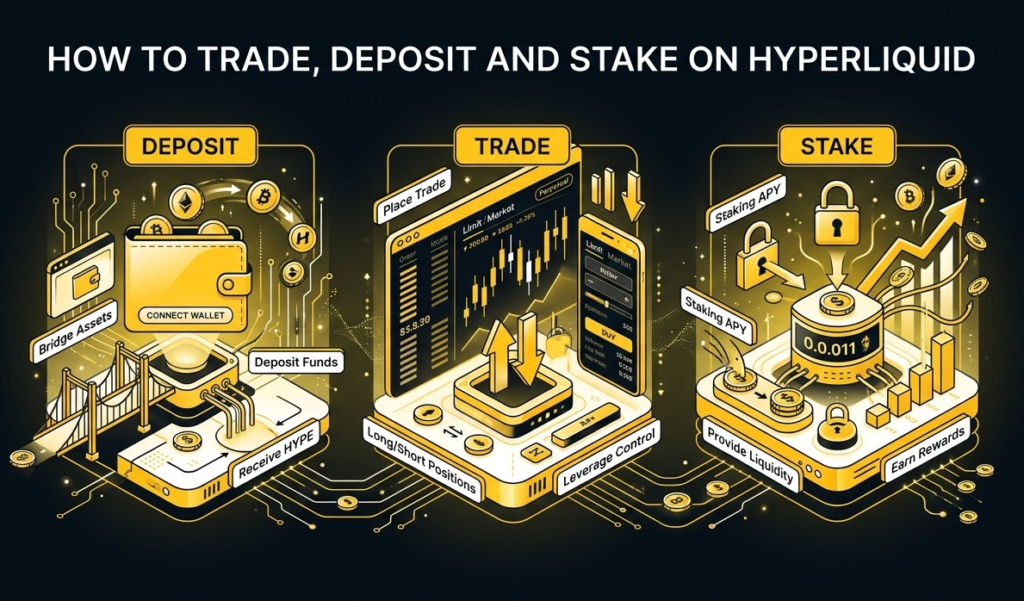
Deposit collateral
Hyperliquid’s onboarding documentation currently supports several deposit routes, but USDC on Arbitrum remains one of the primary routes for users starting with perpetual trading. (Hyperliquid onboarding documentation)
For a standard EVM-wallet workflow:
- Set up an EVM-compatible wallet such as Rabby or MetaMask.
- Hold USDC on Arbitrum.
- Keep enough ETH on Arbitrum for the deposit transaction’s network gas.
- Connect the wallet to Hyperliquid.
- Select Deposit.
- Confirm the transaction.
- Wait for the deposit to appear in the Hyperliquid account.
Hyperliquid’s documentation states that trading itself does not require gas in the conventional Ethereum sense, while the initial Arbitrum deposit does require ETH for the bridge transaction. (Hyperliquid onboarding guide)
The platform now supports additional deposit routes for assets from other ecosystems as well, so the exact onboarding options can change over time.
For that reason, I would check the current deposit screen rather than blindly following an old tutorial.
Execute trades
Once collateral is deposited, the trading interface behaves much more like a conventional derivatives platform.
You select an asset.
Then choose:
- Long or short
- Position size
- Leverage
- Market or limit order
- Stop-loss or take-profit parameters
Hyperliquid’s perpetual contracts use USDC as collateral, while many contract prices are denominated in USDT. (Hyperliquid contract specifications)
Funding is paid between traders rather than collected by Hyperliquid as a protocol fee.
The current funding documentation says funding is paid every hour, with the rate derived from the difference between the perpetual contract and its underlying oracle price. (Hyperliquid funding documentation)
This is one of the costs beginners often overlook.
You can enter a trade with a low trading fee and still lose money through:
- Funding
- Slippage
- Liquidation
- Borrowing or strategy costs
- Adverse price movement
Leverage magnifies all of them.
Provide liquidity through HLP
If you don’t want to actively trade perpetuals, HLP offers another route.
You can deposit USDC into the protocol vault and participate in its market-making and other strategies.
But remember the four-day withdrawal lockup.
And remember that HLP can lose money.
It isn’t a fixed-yield product.
Stake HYPE
To stake HYPE:
- Hold HYPE in your HyperCore spot balance.
- Transfer HYPE to the staking balance.
- Select a validator.
- Delegate your HYPE.
- Wait through the relevant lockup if you later decide to unstake.
Hyperliquid’s official staking guide says validator delegation has a one-day lockup, while moving funds from the staking account back to spot has a seven-day queue. (How to stake HYPE)
The validator choice matters.
Current documentation states that validators can charge commissions and that the commission structure has constraints designed to prevent sudden large increases after attracting delegators. (Hyperliquid staking documentation)
So don’t just click the first validator you see.
Look at:
- Validator identity
- Self-delegation
- Commission
- Reliability
- Historical participation
- Community reputation
Staking is part of the network’s security model, so choosing a validator is more meaningful than simply chasing the highest displayed reward.
Frequently asked questions
Is Hyperliquid a Layer 1 or an Ethereum Layer 2?
Hyperliquid is an independent Layer 1 blockchain, not an Ethereum Layer 2. HyperEVM provides Ethereum-compatible smart contracts, but it is secured by Hyperliquid’s own HyperBFT consensus. (Hyperliquid technical overview)
Can you lose money depositing into the HLP vault?
Yes. HLP participates in market-making and liquidation-related strategies, so its value can rise or fall. Hyperliquid describes HLP as a community-owned protocol vault rather than a guaranteed-yield product. (HLP documentation)
How does CoreWriter allow HyperEVM contracts to interact with HyperCore?
CoreWriter is a system contract on HyperEVM that encodes actions for processing by HyperCore. This allows smart contracts to interact with native HyperCore functionality without relying on a conventional external bridge. (CoreWriter documentation)
What gives HYPE its utility?
HYPE is the native gas asset on HyperEVM, can be delegated to validators for network security, is involved in market-deployment requirements such as HIP-3, and is connected to protocol fee and burn mechanisms. (HyperEVM documentation) (HIP-3 documentation)
Does Hyperliquid use an off-chain order book?
No. Hyperliquid’s current architecture places its spot and perpetual order books inside HyperCore. Orders are part of the blockchain’s state and are processed through Hyperliquid’s consensus and execution architecture. (Hyperliquid order-book documentation)
What is HyperCore?
HyperCore is the native financial engine of Hyperliquid. It contains the on-chain order books, margin system, perpetuals, spot markets, liquidations, and other trading-related state. (Hyperliquid overview)
What is HyperEVM?
HyperEVM is Hyperliquid’s general-purpose EVM environment. It allows developers to deploy Solidity-based applications while remaining connected to HyperCore through native interfaces and shared Layer 1 security. (HyperEVM documentation)
Is HYPE deflationary?
HYPE has both future emissions and burn mechanisms. Trading fees can be converted into HYPE and burned through the Assistance Fund, while staking rewards are funded from the emissions reserve, so the overall supply path depends on both sides of the equation. (Hyperliquid fee documentation) (Hyperliquid staking documentation)
The future of Hyperliquid in decentralized finance
Hyperliquid started with a very specific problem:
Can a decentralized exchange actually feel like a professional trading venue?
The answer so far has been to rebuild the underlying infrastructure rather than simply putting a conventional DEX interface on an existing chain.
That’s what makes Hyperliquid different.
HyperCore puts the order book, margin engine, liquidations, and trading state directly into the Layer 1.
HyperBFT provides the consensus layer needed to coordinate that activity at high speed.
HyperEVM then opens the system to developers who want to build applications around the liquidity and financial primitives already sitting on HyperCore.
And CoreWriter connects those two worlds.
That combination is the real story.
HYPE is important because it ties several parts of the system together.
It is the native gas asset for HyperEVM.
It secures the network through delegated staking.
It is required for certain permissionless market-deployment mechanisms.
It provides trading-related utility through staking discounts.
And protocol-level fee flows can ultimately create HYPE buy-and-burn activity.
The economics are still more complicated than the phrase “deflationary token” suggests.
HYPE has a maximum supply of one billion, but a large portion of that supply is reserved for future emissions, contributor vesting, and ecosystem purposes. (SEC’s HYPE token allocation disclosure)
So the interesting question isn’t simply whether HYPE burns.
It’s whether the economic activity generated by Hyperliquid can continue to create enough demand and fee flow to justify the token’s role as the network grows.
The same logic applies to HyperCore.
A fast on-chain order book is impressive.
But infrastructure becomes valuable when people actually use it.
Hyperliquid’s current stack is increasingly broader than a perpetual DEX:
- Native spot markets
- On-chain order books
- Perpetual futures
- HLP liquidity
- User vaults
- HyperEVM applications
- Native token issuance through HIP-1
- Hyperliquidity through HIP-2
- Permissionless perpetual markets through HIP-3
- Native staking
- Cross-layer CoreWriter functionality
That’s a much larger proposition than “a decentralized Binance alternative.”
It’s closer to an attempt to build financial infrastructure directly into a Layer 1.
There are still obvious risks.
Smart-contract risk doesn’t disappear because the infrastructure is fast.
Oracle failures remain relevant.
Liquidation risk remains brutal for leveraged traders.
Validator concentration matters.
HLP can lose money.
HIP-3 introduces new market and oracle risks.
And self-custody means users are responsible for their own security.
The biggest question is therefore not whether Hyperliquid can process orders quickly.
Its current performance figures already show that the architecture can support serious trading activity. (Hyperliquid’s technical overview)
The bigger question is what happens when developers begin treating HyperCore’s liquidity as a primitive rather than simply as an exchange.
That’s where HyperEVM becomes important.
A lending protocol can use trading liquidity.
A structured-product application can use perpetual markets.
A vault can automate a strategy.
A token issuer can create a native asset and pair it with an on-chain order book.
A market builder can launch a specialized perpetual market through HIP-3.
In other words, the exchange can become the infrastructure underneath the applications.
That is the bet Hyperliquid is making.
And if the model works, the most interesting part of Hyperliquid may eventually be less about the exchange itself and more about what other developers build on top of its combination of HyperCore + HyperEVM + HyperBFT + HYPE.
For now, that’s the simplest way I would explain Hyperliquid:
It is a Layer 1 that treats financial markets as native blockchain infrastructure rather than as an application bolted onto a general-purpose chain.
That design choice explains almost everything else about HYPE.