Key Specifications and Architectural Overview of Quant
If you’ve spent enough time around blockchain projects, you’ve probably noticed a recurring problem: every network has its own infrastructure, transaction rules, smart-contract environment, and development tools. Ethereum applications don’t automatically communicate with Hyperledger Fabric. A bank operating a private ledger cannot simply assume that it can interact with a public blockchain as easily as sending an email. Even when two networks can exchange information, moving assets between them without introducing additional security or operational risks is another challenge entirely.
This is the problem Quant Network is trying to solve.
Quant is a UK-based technology company founded by Gilbert Verdian in 2015. Its central product, Overledger, is an interoperability platform designed to connect different distributed ledger technologies (DLTs), public blockchains, private networks, and enterprise systems through a unified software interface.
The project has also evolved beyond its original middleware architecture. In 2026, Quant introduced the Fusion Rollup, a multi-ledger execution environment that connects numerous networks within one shared environment. Rather than forcing institutions to choose a single blockchain or manage a collection of disconnected bridges, Fusion is designed to make transactions and asset operations across multiple ledgers work together.
QNT is the Ethereum ERC-20 utility token associated with this ecosystem. Its documented uses include Overledger licensing, platform-related fees, and participation in the emerging Fusion infrastructure. It is not a share in Quant Network Ltd., and owning QNT does not automatically grant shareholders’ rights, company revenue, or control over the company’s commercial decisions.
Here is a quick technical snapshot:
| Metric | Specification |
|---|---|
| Company | Quant Network Ltd. |
| Founder and CEO | Gilbert Verdian |
| Company establishment | 2015 |
| Core interoperability platform | Overledger |
| Newer execution technology | Fusion multi-ledger rollup |
| Platform classification | Enterprise interoperability software and multi-ledger infrastructure |
| Native utility token | QNT |
| Token standard | Ethereum ERC-20 |
| Token contract | 0x4a220e6096b25eadb88358cb44068a3248254675 |
| Post-burn issued supply | Approximately 14.61 million QNT |
| Protocol inflation | No ongoing issuance of new QNT has been reported since the 2018 token generation and burn |
| Financial messaging context | ISO 20022 interoperability and financial messaging integration |
| Notable institutional experiment | BIS Innovation Hub and Bank of England’s Project Rosalind |
| Fusion mainnet announcement | June 2026 |
| Initial Fusion network connectivity | 74 networks, according to Quant’s launch announcement |
The figures above need one important qualification. Quant’s actual post-burn issued supply is approximately 14.61 million QNT, but Etherscan’s contract page can display a different theoretical maximum because of how the original token contract was configured. I’ll explain that discrepancy in the tokenomics section rather than treating every explorer figure as interchangeable.
For the latest technical architecture, the Overledger developer documentation explains the Gateway, Connectors, orchestration layer, firewall, and Fusion Rollup. Quant’s Fusion mainnet announcement provides the company’s description of the newer multi-ledger infrastructure.
The central idea is straightforward: Quant wants to make different financial and blockchain systems work together without requiring every institution to rebuild its infrastructure around one particular network.
What is Quant (QNT)?
Quant is an enterprise technology project focused on blockchain interoperability. Its products are designed to help organizations connect distributed ledgers, legacy infrastructure, and digital asset applications through a common software environment.
QNT is the utility token associated with that technology.
The distinction between Quant Network and QNT is important. Quant Network Ltd. is the company that develops and commercializes the software. QNT is a digital asset used within parts of the product ecosystem. Buying QNT does not mean purchasing equity in the company, obtaining a voting share in its board, or receiving a contractual claim on its profits.
The project was founded by Gilbert Verdian, who has a background in cybersecurity, technology leadership, and financial infrastructure. His professional experience includes roles across government and private-sector organizations, including Mastercard’s Vocalink business. He also played a role in the establishment of the ISO technical committee responsible for blockchain and distributed ledger standardization.
You can find his background in the company’s official leadership profile.
Why Did Quant Build Overledger?
The blockchain industry has never been one unified system.
Ethereum has its own execution environment, Bitcoin follows a different transaction model, and enterprise networks such as Hyperledger Fabric are built around permissioned access and organizational control. Other networks have their own consensus systems, data structures, programming interfaces, and security assumptions.
That fragmentation creates a problem for companies that want to use more than one network.
Imagine a financial institution that issues a tokenized bond on a private ledger but needs to interact with a stablecoin on Ethereum. Without interoperability infrastructure, the institution may need separate development teams, custom integrations, multiple node providers, and additional security controls to make the two environments communicate.
The complexity increases when more networks are involved.
Quant’s original proposition was that businesses should not have to learn and maintain a completely different integration stack for every blockchain. Instead, Overledger could provide a common interface through which applications access different DLT environments.
This approach is similar in principle to enterprise middleware used in traditional IT systems. Middleware sits between applications and underlying infrastructure, handling communication, authentication, routing, and other technical tasks.
Overledger applies that concept to distributed ledgers.
Quant Is a Company and Software Platform, Not Just a Cryptocurrency
It is tempting to evaluate Quant entirely through QNT’s market price, but doing so misses the project’s central business model.
Quant is primarily an enterprise software company. Its customers are not necessarily individual crypto traders looking for another token to speculate on. They can include financial institutions, technology providers, developers, and organizations that need to interact with multiple ledger environments.
That distinction changes how you should evaluate the project.
For a typical Layer-1 blockchain, you might examine:
- Network transaction volume.
- Validator participation.
- Decentralization.
- Block production.
- Smart-contract activity.
- Network fees and staking economics.
For Quant, those metrics are not enough. You also need to consider:
- Enterprise software adoption.
- The number and quality of connected networks.
- Developer usage.
- Commercial licensing arrangements.
- Integration costs for customers.
- The reliability of its infrastructure.
- Whether QNT is actually required for the services being used.
In other words, the success of Quant’s software business and the market performance of QNT are related questions, but they are not identical.
How Quant Works?
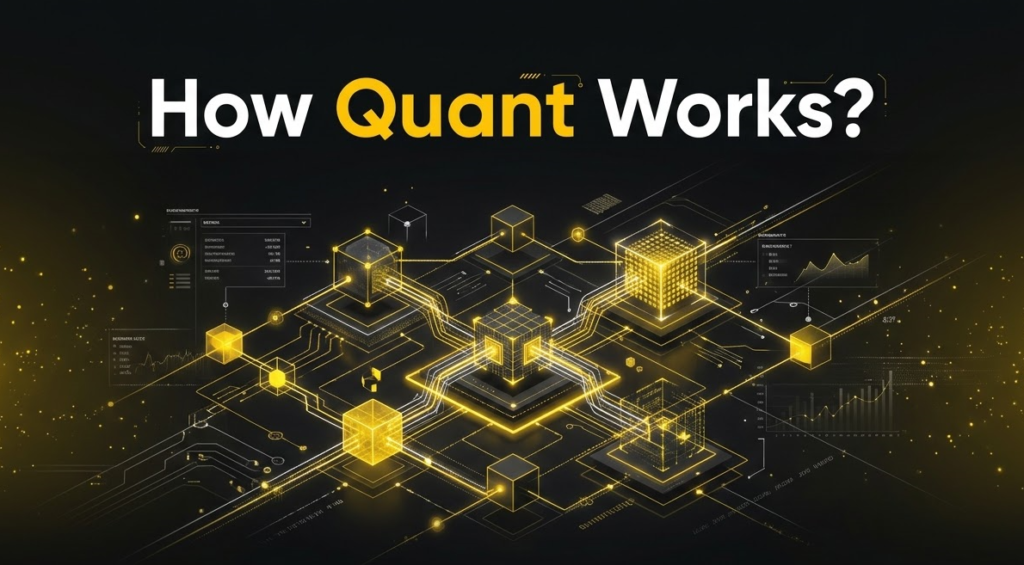
Overledger is the foundation of Quant’s original interoperability model.
It provides a unified way for applications to communicate with multiple distributed ledger technologies. Rather than requiring developers to build a separate integration for every network, Overledger offers common access mechanisms and components that abstract away some of the differences between individual ledgers.
The latest developer documentation describes several core components:
- Gateway: Authenticates users, routes requests, and coordinates higher-level workflows.
- Connectors: Communicate with individual DLT networks and translate their different technical interfaces into a more consistent format.
- Orchestration: Coordinates multi-step workflows and application operations.
- Overledger Firewall: Applies access policies and security controls.
- Fusion Rollup: Provides a shared execution environment connected to multiple external ledgers.
This is more than a simple API wrapper. It is a collection of infrastructure components intended to make cross-ledger applications easier to build and operate.
Why Quant Is Not a Traditional Layer-1 Blockchain
One of the most common questions about Quant is whether it is a blockchain in the same sense as Ethereum, Solana, or Avalanche.
The short answer is that Quant’s original Overledger platform is not a conventional Layer-1 blockchain.
A typical Layer-1 network maintains its own ledger and uses a consensus mechanism to agree on the ordering and validity of transactions. It has its own network participants, transaction execution rules, and underlying security model.
Overledger serves a different purpose. It connects existing ledgers rather than requiring every application to move onto a new base chain.
For example, consider three systems:
- Ethereum, a public blockchain with its own validators and smart-contract execution.
- Bitcoin, a public network with its own transaction and consensus model.
- Hyperledger Fabric, an enterprise-oriented permissioned DLT framework.
Overledger can provide a common software layer through which applications interact with these different environments.
That does not mean the underlying networks become one blockchain. Ethereum remains Ethereum, Bitcoin remains Bitcoin, and the permissioned network retains its own governance and access rules.
The interoperability layer handles the communication and coordination between them.
However, the statement that Quant has no blockchain execution environment is no longer fully accurate. The Fusion Rollup adds a distinct execution layer to the broader Quant stack. It is therefore more precise to say that Quant is not simply a traditional Layer-1 blockchain competing with Ethereum or Solana, while recognizing that its newer infrastructure includes a rollup-based execution environment.
Overledger Gateway: The Connection Point
The Gateway is one of the most important parts of the Overledger architecture.
Think of it as the entry point through which an application accesses the platform.
A developer or enterprise application can submit a request through the Gateway rather than managing every network-specific connection independently.
The Gateway is responsible for tasks such as:
- Authenticating clients and managing access credentials.
- Routing requests to the appropriate network connector or execution environment.
- Applying rate limits and access policies.
- Coordinating higher-level workflows.
- Providing a consistent interface for different operations.
- Supporting monitoring and observability.
For example, a company might need to query information from Ethereum, submit an operation to a private enterprise ledger, and then coordinate a response through another network.
The Gateway helps organize those interactions.
The advantage is not that every blockchain becomes technically identical. That would be unrealistic. The advantage is that developers can work through a more consistent interface while the underlying infrastructure differences are handled by the platform.
Connectors: Communicating With Different Blockchains
A Connector is the component that understands how to interact with a particular family of distributed ledger technologies.
Different networks expose different RPC methods, transaction formats, authentication requirements, and node interfaces. A developer working directly with each network must understand those differences.
Overledger Connectors abstract some of that complexity.
For instance, an EVM-compatible network and a Hyperledger Fabric deployment do not expose identical interfaces. A connector can handle the network-specific communication and return information in a consistent structure for the application.
The official Overledger architecture documentation describes how connectors communicate with network nodes, validate node health, route requests, and translate responses.
This design is particularly relevant to enterprises because they often operate systems that were never designed to communicate with public blockchains.
A bank may have internal databases, payment networks, private DLT infrastructure, and external digital asset services. Replacing all of that with a single blockchain is rarely practical.
Middleware offers a way to connect the systems without requiring a complete technology overhaul.
Multi-Chain Applications and Cross-Ledger Workflows
One of Overledger’s main objectives is to support multi-chain applications, sometimes described as mApps.
A conventional decentralized application usually operates primarily within one blockchain environment. A multi-chain application needs to interact with more than one network.
For example, a financial application could:
- Read the ownership status of a tokenized asset on one network.
- Verify an external transaction on another network.
- Trigger a smart-contract operation on a third network.
- Send a notification to an enterprise system.
- Record the resulting information in a private ledger.
The challenge is coordinating all those actions without creating unnecessary security or operational complexity.
Overledger provides the interoperability infrastructure for such workflows.
However, developers should not assume that every cross-chain operation is automatically atomic or that every external transaction can be reversed if another network fails. Those guarantees depend on the actual workflow design, connected networks, and the execution mechanism being used.
That is one reason the introduction of Fusion is significant: it aims to provide a more unified execution environment for operations that span multiple ledgers.
Quant Fusion: The Layer 2.5 Multi-Ledger Rollup
Quant’s Fusion Rollup represents an important evolution of the project.
Overledger originally focused on connecting separate DLT systems through middleware and APIs. Fusion extends that concept by introducing a shared execution environment that can interact with multiple connected ledgers.
Quant describes Fusion as a Layer 2.5 multi-ledger rollup.
The term is unusual, so it is worth unpacking.
A conventional Layer-2 rollup is generally associated with one underlying Layer-1 network. It executes transactions in a separate environment and relies on its base chain for certain settlement or security functions.
Fusion takes a different approach. Rather than being tied to one base chain, it is designed to connect multiple public and permissioned ledgers through a common execution environment.
According to Quant’s Fusion mainnet announcement, the platform launched with connectivity to 74 networks, with additional networks available through its Trusted Node Program.
That figure reflects the company’s launch announcement and should not be treated as a permanent network count. Connectivity can change as integrations are added, modified, or removed.
How Does Fusion Work?
Fusion is designed to provide an EVM-compatible execution environment that interacts with multiple connected ledgers.
Instead of forcing an institution to manage several disconnected asset representations, Fusion aims to create a shared environment where assets from different networks can be referenced and used through one execution layer.
Consider a simplified example.
A tokenized fund exists on Ethereum, while another representation of the same fund exists on Polygon. A financial institution wants to manage both positions as part of one application.
Traditionally, the institution may need to maintain separate balances, monitor different smart contracts, and coordinate transactions between networks.
Fusion aims to represent those assets within one shared environment, allowing an application to interact with a unified representation while retaining the connection to the original network.
Quant’s documentation uses examples such as unified representations of assets across multiple networks, including stablecoins and tokenized funds.
The idea is not simply to create another wrapped token. It is to provide a common execution environment that coordinates the underlying assets and their movements.
Why Call It a Layer 2.5 Rollup?
Quant uses the Layer 2.5 label because Fusion does not fit neatly into the conventional Layer-1 or Layer-2 categories.
It does not ask institutions to abandon their existing blockchains and migrate everything to a new base network.
It also differs from a conventional single-chain Layer-2 rollup because its architecture is designed around multiple connected ledgers.
The distinction can be summarized as follows:
| Architecture | Main purpose | Relationship with underlying networks |
|---|---|---|
| Layer-1 blockchain | Provides its own ledger and consensus | Operates as an independent base network |
| Conventional Layer-2 rollup | Scales or extends one Layer-1 | Typically settles or anchors to one base chain |
| Overledger | Connects different DLT systems through software interfaces | Provides interoperability across existing networks |
| Fusion Rollup | Provides shared execution across multiple ledgers | Connects to multiple public and permissioned networks |
Quant’s technical explanation of Fusion discusses how the rollup differs from conventional single-chain designs.
Fusion’s Execution and Security Components
The Fusion architecture includes several services responsible for executing transactions and coordinating activity across connected networks.
The Fusion Rollup developer documentation describes its major components, including:
Execution Service
This component provides the EVM-compatible execution environment. It handles transactions, smart contracts, balances, and the rollup’s internal state.
Consensus Service
The service orders transactions and produces rollup blocks. It also reads relevant transactions from connected DLT networks so that deposits and withdrawals can be incorporated into the rollup’s state.
Dispute Resolution Services
These services calculate rollup state roots, monitor the roots submitted to connected networks, and respond to invalid proposals through the dispute process.
Fusion Firewall
The firewall applies access and policy controls to relevant operations. This is particularly important for institutions that need to restrict which users, systems, or counterparties can access certain assets and workflows.
These components are intended to provide a more controlled execution environment than a collection of loosely connected bridges.
Still, no architecture should be described as completely risk-free. The system depends on its smart contracts, connected networks, node infrastructure, configuration, and operational controls. Institutions should assess those dependencies rather than assuming that a multi-ledger design automatically removes every bridge or settlement risk.
Why Fusion Matters for Financial Institutions
For financial institutions, the problem is often not a lack of blockchains. It is the difficulty of operating across too many disconnected systems.
A bank may have access to tokenized deposits on one network, securities on another, and stablecoins on a third. Each environment has different access policies, settlement procedures, and technical requirements.
Fusion is designed to reduce the complexity of coordinating these systems.
Potential applications include:
- Cross-ledger delivery-versus-payment transactions.
- Tokenized securities settlement.
- Unified liquidity management.
- Cross-network stablecoin operations.
- Multi-party financial workflows.
- Interoperability between public and permissioned ledgers.
For example, imagine a bank purchasing a tokenized security using a tokenized deposit held on a separate permissioned network. The transaction requires both sides to settle correctly.
If the payment completes but the security transfer fails, the parties face an operational problem.
A unified execution environment aims to coordinate both sides as one transaction, so the operation succeeds together or fails together under the applicable execution rules.
This is one of the more interesting use cases for Fusion because atomic settlement across different financial networks has been a difficult problem for institutions working with tokenized assets.
Institutional Interoperability
Quant’s focus on financial institutions makes standards and regulatory requirements especially important.
Banks do not simply need a way to transfer tokens between blockchains. They need systems that can communicate with existing payment infrastructure, interpret financial data consistently, maintain audit trails, and operate within applicable compliance requirements.
This is where ISO 20022 enters the discussion.
However, it is important to distinguish between supporting an international financial messaging standard and receiving formal approval or certification from every organization that uses that standard.
What Is ISO 20022?
ISO 20022 is an international standard for financial messaging.
It provides a common framework for defining structured financial messages across different business areas, including payments, securities, foreign exchange, and other financial activities.
Before standards such as ISO 20022, financial institutions often relied on different message formats and proprietary data structures. That fragmentation could make it difficult to exchange information consistently across institutions and systems.
ISO 20022 helps address the problem by defining standardized message models and business concepts.
The standard is relevant to organizations involved in:
- Bank-to-bank payments.
- Cross-border transfers.
- Securities transactions.
- Cash management.
- Financial reporting.
- Payment processing.
- Digital financial infrastructure.
The official ISO 20022 website provides access to the standard’s message definitions and documentation.
Does Quant Have ISO 20022 Compliance?
Quant’s technology is designed for interoperability with financial systems and the structured data environments used by institutions.
Gilbert Verdian has also been involved in the ISO technical work associated with blockchain and distributed ledger technologies, including the interoperability working group within ISO/TC 307.
But the phrase “ISO 20022 compliant” needs careful handling.
ISO 20022 is not a universal certification that automatically applies to every product, blockchain, or company that interacts with financial messaging systems.
The ISO organization explains that there is no single official certification authority for ISO 20022. Implementation depends on the requirements of the relevant user community and the message definitions being applied.
You can verify this distinction in the official ISO 20022 FAQ.
For Quant, the more defensible description is that its enterprise interoperability technology is designed to support integration with financial messaging and institutional systems, including environments using ISO 20022.
That is not the same as claiming that every Quant component, every connected blockchain, or every transaction is automatically ISO 20022 certified.
Quant and SWIFT: Why Interoperability Matters
SWIFT is a global financial messaging network used by banks and financial institutions to exchange standardized financial information.
It is not itself a blockchain, nor does ISO 20022 turn SWIFT into one.
The broader opportunity is that traditional financial messaging infrastructure and distributed ledger systems may increasingly need to work together.
For example, a bank could use traditional payment messaging to communicate transaction information while a separate blockchain-based system handles the issuance or settlement of a tokenized asset.
The challenge is ensuring that the information, authorization, and transaction state remain consistent across those environments.
Interoperability software can help connect the different components.
Quant’s Overledger architecture is designed for this type of integration, although the exact capabilities depend on the connected systems and the commercial implementation.
It is more accurate to discuss Quant in the context of financial infrastructure interoperability than to claim that it has replaced SWIFT or become an official global settlement network.
Project Rosalind: Quant’s Work With the BIS and Bank of England
One of the most notable institutional projects involving Quant is Project Rosalind.
The project was led by the Bank for International Settlements Innovation Hub’s London Centre in collaboration with the Bank of England. It explored how APIs could support retail central bank digital currency systems.
The objective was to investigate how a central bank ledger could interact with private-sector service providers through a common API layer.
This was an important architectural question.
A central bank might provide the underlying infrastructure for a CBDC, while private-sector organizations build consumer-facing applications and additional payment services. Those systems need a way to communicate securely and consistently.
Project Rosalind explored how APIs could support that relationship.
Quant participated as part of the technology vendor team, working alongside UST. The company’s contribution involved infrastructure and interoperability-related components, while UST developed the frontend API layer.
The BIS Project Rosalind page confirms that the project was an experiment and that it has been completed. The final report published on June 16, 2023 describes the API architecture and the results of the experimentation.
The report explored 33 API endpoints across six functional categories and more than 30 use cases.
Those figures are useful because they show that the project was not merely a general discussion about CBDCs. It involved practical API prototypes and use-case testing.
However, there is an important limitation: Project Rosalind was experimental. The BIS explicitly states that it did not represent a decision by the Bank of England to launch a retail CBDC or adopt a particular technology for a future system.
So what does the project tell us about Quant?
It demonstrates that Quant participated in a serious institutional experiment involving central bank infrastructure and API-based interoperability. It does not prove that the Bank of England selected Quant as its permanent CBDC provider.
That distinction matters when evaluating enterprise adoption.
Does Project Rosalind Mean Quant Is Working With Every Central Bank?
No.
Participation in one institutional experiment should not be interpreted as a permanent commercial partnership with every organization involved.
The BIS and Bank of England provided the institutional context for Project Rosalind, while participating vendors and collaborators contributed to the experiment.
For investors, the project is a useful credibility signal because it demonstrates experience in a real financial infrastructure research environment. But it should be considered alongside other evidence, such as commercial deployments, customer contracts, production usage, and recurring revenue.
A successful experiment can open doors. It does not automatically guarantee long-term commercial adoption.
QNT Tokenomics
Now we get to the part that many investors care about most: the token itself.
QNT is an ERC-20 token deployed on Ethereum. Its utility is connected to Quant’s software products, particularly Overledger and the newer Fusion infrastructure.
Unlike a typical proof-of-stake Layer-1 token, QNT was not originally designed around a conventional inflationary block-reward model.
Its economic role is linked to platform access, licensing, fees, and the infrastructure’s evolving participation mechanisms.
What Is the QNT Token Used For?
QNT has several documented uses across the Quant ecosystem.
Overledger licensing
QNT is used in the licensing model for accessing Overledger services. Quant introduced a licensing arrangement in which customers could pay a recurring fee associated with platform access.
The company announced an annual Overledger licensing fee of £100 in December 2021. The number of QNT required to represent a fixed fiat-denominated fee can change as the market price changes.
It is important to distinguish the underlying software price from the number of tokens used to settle the fee. A fixed annual price in pounds does not imply a fixed QNT amount.
Platform and transaction-related fees
QNT can be used for fees associated with Quant’s platform services and related operations. However, not every customer arrangement necessarily requires every payment to be made directly in QNT. Quant’s commercial documentation and service terms should be checked for the applicable payment method.
Fusion Rollup gas and execution
QNT has an additional role in the Fusion ecosystem as the token associated with network fees and execution-related activity, according to the platform’s documented economic model.
This expands its potential utility beyond the original Overledger licensing model.
Trusted Node participation
Quant’s Fusion architecture includes a Trusted Node Program. Qualified operators can participate in the network infrastructure, subject to the applicable onboarding and staking arrangements.
QNT is intended to be used as an economic asset in this framework.
There is an important practical caveat: the existence of a staking design does not mean every retail QNT holder can currently stake tokens through an open public interface. The Overledger staking documentation has described the staking chapter as under development while the new testnet experience is being prepared.
Therefore, it would be misleading to advertise public Fusion staking as an immediately available, universally accessible feature without checking the latest official onboarding conditions.
Does Holding QNT Give You Governance Rights?
Not in the conventional DAO-token sense described by many other crypto projects.
QNT is primarily a utility token associated with Quant’s software and network services. It should not be presented as a governance token that gives holders general voting control over Quant Network Ltd.
There is a difference between participating in a network’s technical or operational framework and owning a voting share in the company.
If you hold QNT, you do not automatically gain:
- Shares in Quant Network Ltd.
- Voting rights over the company’s board.
- A guaranteed claim on company profits.
- A contractual right to dividends.
- Automatic access to every enterprise product.
The company’s commercial decisions remain distinct from token ownership.
This is particularly important when comparing QNT with governance tokens issued by decentralized protocols.
The 14.6 Million QNT Supply: What Is the Real Number?
Quant’s supply figures have created confusion because different platforms can display different values.
The widely reported post-burn issued supply is approximately 14,612,493 QNT.
The reason this number matters goes back to the token generation event in 2018.
After the original token sale, Quant announced that it had permanently burned approximately 9.55 million unsold tokens. Following that burn, the company reported a total supply of 14,612,493.080826178 QNT.
The original token burn announcement explains the amount destroyed, the updated supply, and why Etherscan’s theoretical contract maximum did not match the actual issued amount.
The important distinction is between:
- Theoretical maximum encoded or displayed by the original contract: A larger figure associated with the original token contract’s configuration.
- Actual post-burn issued supply: Approximately 14.61 million QNT.
- Circulating supply: The portion currently classified as circulating by market-data providers.
Etherscan has historically displayed a theoretical maximum of 45,467,000 QNT for the contract. That figure should not automatically be interpreted as the number of tokens actually issued and available to enter the market.
The discrepancy exists because the original token contract’s theoretical supply display was not updated to reflect the actual issuance and burn history.
The Etherscan QNT token page is useful for examining the contract and token balances, but its maximum-supply display needs to be read alongside the original burn explanation.
Was the Entire QNT Supply Circulating From the Beginning?
No. This is another point where the supplied outline needs correction.
The post-burn supply was approximately 14.61 million QNT, but the original distribution included company-held tokens and other allocations that were not necessarily circulating in the market immediately.
The initial distribution is commonly summarized as follows:
| Allocation category | Approximate share |
|---|---|
| Community | 35% |
| Token sale | 35% |
| Team | 10% |
| Advisors | 10% |
| Quant Treasury | 10% |
These percentages describe the broad original allocation structure, not a guarantee that every token was freely tradable at launch.
The company-held portion was subject to its own treasury and distribution arrangements.
For this reason, I would avoid saying that QNT was 100% circulating from inception. The more accurate statement is that Quant reported a fixed post-burn issued supply and has not reported ongoing new token issuance since the original token generation period.
Circulating supply can still change as previously held tokens move into the market or are reclassified by data providers.
Does QNT Have Inflation?
QNT does not operate like an inflationary proof-of-stake network that continuously mints new tokens as block rewards.
There is no conventional QNT mining reward schedule in which validators receive newly created QNT for producing blocks on a Quant Layer-1 chain.
That does not mean the token is free from all supply-related market pressure.
Existing tokens can still move between holders, company-controlled wallets, exchanges, and network participants. If previously held tokens become available for sale, market supply can increase even though no new tokens are minted.
It is therefore useful to separate two concepts:
Protocol inflation
This refers to the creation of additional tokens beyond the existing issued supply. Quant’s reported QNT model has no ongoing issuance of new tokens after the original token generation and burn.
Circulating supply changes
This refers to existing tokens becoming more accessible or being reclassified as circulating. It can occur without creating new tokens.
For investors, the second category still matters.
A fixed supply can support scarcity, but scarcity alone does not create demand. The market value of QNT ultimately depends on the relationship between available tokens and actual demand for the asset.
How Enterprise Licensing Can Create QNT Demand
The relationship between enterprise software adoption and QNT demand is one of the most important parts of the token’s investment thesis.
Imagine a financial institution that wants to use Overledger to connect its internal systems to multiple DLT networks.
It may need a software license, API access, transaction processing, and additional services.
If the applicable licensing arrangement requires QNT, the customer or service provider needs to obtain the token to satisfy that payment requirement.
In principle, increased enterprise adoption could therefore create additional demand for QNT.
But there are several details worth examining.
First, the amount of QNT required for a license can change with the token’s market price if the underlying fee is denominated in fiat currency.
Second, the platform’s commercial terms may permit alternative payment arrangements. A business paying for a service in fiat does not necessarily create the same immediate market demand as a customer purchasing QNT directly.
Third, a license payment does not automatically mean that the tokens remain locked forever. The actual economic effect depends on how the payment is processed and how Quant’s treasury handles the tokens.
Fourth, enterprise customers can use software without necessarily holding QNT as a long-term investment.
So, while licensing utility is relevant, it should not be simplified into a claim that every new enterprise customer permanently removes a fixed amount of QNT from circulation.
QNT and Fusion’s Trusted Node Economy
Fusion introduces another potential demand source through its Trusted Node Program.
A network that coordinates operations across multiple ledgers needs reliable infrastructure participants. Trusted Nodes can provide network services within the platform’s operational and governance framework.
QNT is intended to play an economic role in this model through staking and related participation requirements.
The long-term significance is that QNT could become relevant not only to customers paying for software but also to operators supporting the network.
However, the details of node eligibility, staking amounts, rewards, slashing, and public access need to be verified against the latest official documentation.
Do not assume that every QNT holder can simply deposit tokens into a public staking pool and receive a guaranteed annual percentage yield.
The distinction between a proposed economic design, a testnet feature, and a fully open mainnet service matters.
Common Pitfalls and Misconceptions About Quant (QNT)
Quant is a relatively unusual project because it combines enterprise software, blockchain interoperability, token utility, and a newer multi-ledger rollup. That makes it easy to oversimplify.
Here are the misconceptions I would avoid when researching QNT.
Misconception: Quant Is a Layer-1 Blockchain Like Ethereum
Quant’s original Overledger platform is middleware, not a conventional Layer-1 blockchain.
It is designed to connect existing networks rather than replace them with one new base ledger.
However, the newer Fusion Rollup does provide a shared execution environment with rollup components. So it is also inaccurate to say that Quant has no execution layer or blockchain-related infrastructure at all.
The best description is that Quant is an enterprise interoperability platform whose architecture now includes a multi-ledger rollup.
Misconception: QNT Has Unlimited Supply or Continuous Inflation
QNT has a reported post-burn issued supply of approximately 14.61 million tokens.
Quant has not reported ongoing new token issuance since the original token generation and burn.
However, market-data platforms may display different supply figures because of the distinction between theoretical contract maximum, actual issued supply, and circulating supply.
A fixed supply does not eliminate market volatility or the possibility that existing tokens become available for trading.
Misconception: QNT Automatically Pays Staking Rewards
QNT should not be treated as a conventional inflationary staking token.
Its newer Fusion architecture includes Trusted Node participation and staking-related mechanisms, but availability and conditions depend on the current network implementation.
If you see a platform advertising a guaranteed QNT staking yield, check whether it is an official Quant service, an independent DeFi product, or simply a third-party lending arrangement.
Those are very different risk profiles.
Misconception: Overledger Is Just Another Token Bridge
A conventional token bridge often involves locking, burning, minting, or representing assets across different networks.
Overledger’s broader role is to provide an interoperability layer that connects applications to different distributed ledgers through a common interface.
Fusion adds a more integrated execution environment for multi-ledger operations.
That does not mean Quant has eliminated every possible bridge-related risk. Any system that coordinates transactions across external networks still depends on the security and availability of those networks, its own contracts, and its operational components.
The more accurate distinction is that Quant is not merely a wrapped-token bridge service. It is a broader enterprise interoperability stack.
Misconception: ISO 20022 Means Quant Is Officially Approved by SWIFT
ISO 20022 is a financial messaging standard, not a blanket approval program for blockchain projects.
A platform can support integration with systems that use ISO 20022 without being officially certified by SWIFT or every bank that implements the standard.
Quant’s financial interoperability focus is relevant, but claims about official approvals should be supported by specific institutional announcements.
Misconception: Project Rosalind Proves the Bank of England Will Use Quant
Project Rosalind was a collaborative experiment involving the BIS Innovation Hub and Bank of England.
Quant participated as part of the vendor team, working with UST.
The project explored APIs for retail CBDC infrastructure. It did not establish that the Bank of England selected Quant for a production CBDC or committed to launching a retail digital pound using its technology.
It is a meaningful research credential, but not proof of a permanent commercial deployment.
Quant System Architecture
The following simplified map shows the relationship between Quant’s company, products, token, and institutional use cases.
                         QUANT NETWORK LTD.
                                |
                         Founded by
                         Gilbert Verdian
                                |
                +---------------+---------------+
                |                               |
            OVERLEDGER                       QNT TOKEN
                |                               |
       Enterprise middleware            Ethereum ERC-20
                |                               |
       +--------+--------+             +--------+---------+
       |        |        |             |        |         |
    Gateway Connectors Firewall     Licensing  Fees   Fusion
       |        |        |                      |      participation
       |        |        |                      |
       +--------+--------+                      |
                |                               |
       Multi-DLT connectivity <-----------------+
                |
       +--------+-------------------+
       |                            |
  Public blockchains          Private/permissioned
  and DLT networks            enterprise networks
       |                            |
       +-------------+--------------+
                     |
               FUSION ROLLUP
                     |
          Shared multi-ledger execution
                     |
       +-------------+----------------+
       |             |                |
   Asset flows   Cross-ledger     Institutional
                 settlement       applications
                     |
          Financial interoperability
                     |
       ISO 20022-related integration
       and CBDC experimentation
                     |
              PROJECT ROSALIND
The diagram is simplified. ISO 20022 is a messaging standard rather than a separate Quant product, and Project Rosalind was a research experiment rather than a production Quant network deployment.
Step-by-Step Guide: How to Acquire QNT and Explore Quant’s Developer Tools
If you are interested in QNT, it helps to separate two activities: purchasing the token and using Quant’s enterprise software.
Buying QNT does not automatically provide an Overledger license. Likewise, signing up for a developer account does not necessarily mean you need to hold a large QNT balance in a personal wallet.
Phase 1: Acquiring QNT
Choose a supported cryptocurrency exchange
Start by checking whether QNT is listed on an exchange available in your jurisdiction.
Look for a platform with a transparent fee schedule, strong account security, and clear withdrawal procedures.
Complete account verification
Many centralized exchanges require identity verification before allowing deposits, trading, or withdrawals.
Follow the platform’s official verification process and avoid third-party agents who offer to complete verification on your behalf.
Check the QNT contract address
Before transferring tokens, verify that you are dealing with the genuine Ethereum ERC-20 asset.
The commonly referenced contract address is:
0x4a220e6096b25eadb88358cb44068a3248254675
You can confirm it through the QNT contract page on Etherscan.
Purchase QNT
Choose the trading pair available on your exchange and review the price, spread, and transaction fees before placing an order.
If you are making a first purchase, consider using a small amount while learning how the exchange and withdrawal process work.
Transfer QNT to a secure wallet
If you want self-custody, withdraw QNT to an Ethereum-compatible wallet that supports ERC-20 tokens.
Always verify the destination address and network before confirming the withdrawal. Sending tokens through the wrong network or to an unsupported address can result in permanent loss.
Phase 2: Accessing Overledger Developer Tools
Visit the official developer portal
Use Quant’s official Overledger documentation and Quant Connect portal.
Avoid unofficial websites that imitate the developer dashboard or request wallet signatures without a clear reason.
Review the available platform services
Explore the available Gateway, Connectors, Flow Applications, and Fusion functionality.
The right service depends on whether you are building a multi-chain application, connecting a private ledger, or testing cross-ledger execution.
Create and configure your developer account
Follow the onboarding process and configure the credentials and permissions required for your intended use case.
Enterprise deployments may require additional coordination with Quant, particularly when private or consortium networks are involved.
Review licensing and payment terms
Check the current commercial terms before assuming that a specific service requires a fixed amount of QNT.
Licensing prices, supported payment methods, and execution fees can differ depending on the product and customer arrangement.
Build and test a multi-ledger application
Use the developer documentation to connect to supported test environments and explore the available workflows.
Start with a simple read operation or low-risk transaction before attempting complex cross-ledger settlement.
Review security and access controls
Before deploying anything involving real assets, evaluate the permissions, connected nodes, smart contracts, firewall policies, and transaction failure conditions.
For institutional applications, security review should be part of the design process rather than something added at the end.
Risks and Investment Considerations for QNT
Quant has an interesting enterprise-focused proposition, but that does not make QNT a risk-free investment.
There are several areas I would examine before forming a long-term view.
Enterprise Adoption Risk
Quant’s commercial opportunity depends on organizations actually using its software.
A technology can be impressive in a demonstration and still struggle to achieve broad commercial adoption.
Enterprise customers often have long procurement cycles, strict security requirements, complex integration processes, and existing technology providers.
A successful pilot does not necessarily become a recurring commercial contract.
For QNT holders, the important question is whether adoption translates into meaningful usage of the token rather than simply increased visibility for the company.
Token Utility and Value Capture
QNT’s utility is connected to software licensing, platform fees, and the evolving Fusion economy.
However, the relationship between enterprise revenue and token demand depends on the payment mechanics.
If customers can pay in fiat or use arrangements that do not require them to hold QNT directly, the effect on open-market demand may be different from what tokenholders expect.
Investors should monitor actual usage and token-related payment requirements rather than assuming that every new customer creates permanent buying pressure.
Centralization and Trust Assumptions
Quant’s enterprise model is designed to serve organizations that often prefer controlled access, defined responsibilities, and identifiable infrastructure operators.
That can be attractive to banks and regulated businesses.
But it also means the architecture should not automatically be evaluated using the same decentralization assumptions as permissionless public blockchains.
You should examine who operates the infrastructure, who controls access, how upgrades are managed, and what happens if a service provider becomes unavailable.
Fusion Rollup Execution Risk
Fusion introduces new technical components, including rollup execution, transaction ordering, dispute resolution, connected-node infrastructure, and firewall enforcement.
These features create additional capabilities, but they also introduce new areas that need testing and security review.
A multi-ledger system can inherit dependencies from several connected networks. A failure in one network may affect workflows that depend on it.
Smart-Contract and Infrastructure Risk
QNT is an ERC-20 token, so holders face the usual risks associated with Ethereum wallets, exchanges, smart contracts, and private-key security.
Quant’s software also interacts with external ledgers and enterprise infrastructure.
An error in a contract, connector, configuration, or access policy can create operational problems even if the underlying blockchain itself continues working normally.
Competition
Quant is not the only project working on interoperability.
The broader market includes cross-chain messaging systems, blockchain infrastructure providers, enterprise middleware companies, and specialized settlement networks.
Banks may also develop their own interoperability solutions or work with existing technology providers.
Quant needs to demonstrate that its architecture offers a practical advantage in security, cost, performance, governance, and integration complexity.
Market Volatility
QNT trades in the crypto market and can experience substantial price movements.
Even if Quant wins enterprise customers, the token price can decline during broader market downturns.
A fixed supply does not protect an asset from changing investor sentiment or falling demand.
For this reason, I would separate the long-term technology thesis from short-term trading expectations.
FAQ
What Is Quant (QNT) and How Does It Work?
Quant is an enterprise software company focused on blockchain interoperability. Its Overledger platform connects different public and private distributed ledgers through a unified interface, while its Fusion Rollup provides a shared execution environment across multiple connected networks.
QNT is the Ethereum ERC-20 utility token associated with licensing, platform fees, and participation in the evolving Quant infrastructure.
Is Quant a Blockchain?
Quant’s original Overledger platform is not a conventional Layer-1 blockchain. It is middleware designed to connect existing distributed ledgers.
However, Quant has expanded its architecture with the Fusion Rollup, a multi-ledger execution environment. Therefore, describing the entire Quant ecosystem as having no blockchain-related execution layer would be inaccurate.
What Is the QNT Token Used For?
QNT is a utility token associated with Overledger software licensing and platform-related fees. It also has a role in the Fusion ecosystem’s fee and Trusted Node participation model.
It is not a company share and does not automatically give holders voting rights over Quant Network Ltd. or a guaranteed claim on company revenue.
What Is the Total Supply of QNT?
The widely reported post-burn issued supply is approximately 14,612,493 QNT.
Quant burned approximately 9.55 million unsold tokens in September 2018. Etherscan may display a larger theoretical maximum because the original contract’s maximum-supply field does not directly represent the post-burn issued supply.
Does QNT Have Inflation?
Quant has not reported ongoing new QNT issuance since the original token generation and burn.
It does not operate a conventional inflationary block-reward system in which new QNT is continuously minted to pay validators.
However, existing tokens can still move into circulation, so investors should distinguish new token creation from changes in circulating supply.
Can You Stake QNT?
QNT has a role in the Fusion Trusted Node staking framework, but public availability and participation conditions depend on the current implementation.
The official staking documentation should be checked before assuming that ordinary holders can access a public staking pool or earn a fixed reward.
What Is Quant Overledger?
Overledger is Quant’s interoperability platform. It provides a unified interface for applications that need to communicate with multiple distributed ledger technologies.
Its components include a Gateway, network Connectors, orchestration tools, and security controls.
What Is Quant Fusion?
Fusion is Quant’s multi-ledger rollup. It provides an EVM-compatible execution environment designed to connect multiple public and permissioned ledgers.
Quant announced its mainnet launch in June 2026 with 74 connected networks.
Is Quant ISO 20022 Compliant?
Quant’s technology is designed for interoperability with financial systems and messaging environments that use standards such as ISO 20022.
However, ISO 20022 is a messaging standard, not a universal certification for blockchain platforms. Its implementation depends on the relevant financial community and use case.
What Was Project Rosalind?
Project Rosalind was an experiment led by the BIS Innovation Hub’s London Centre in collaboration with the Bank of England.
It explored how APIs could connect central bank infrastructure with private-sector service providers for potential retail CBDC applications.
Quant participated as part of the vendor team alongside UST. The project was experimental and did not represent a decision by the Bank of England to launch a CBDC using Quant technology.
Who Founded Quant Network?
Quant was founded by Gilbert Verdian. He has a background in cybersecurity, technology leadership, and financial infrastructure, and is the company’s Founder and CEO.
Final Thoughts
Quant is interesting because it approaches blockchain adoption from the perspective of the institutions that need to use the technology, rather than assuming every organization will eventually move to one public blockchain.
That is a meaningful difference.
Banks, payment providers, asset managers, and other enterprises already operate complex systems. They cannot simply replace those systems overnight, and they may not want to put every financial process on a single public network.
Overledger addresses the integration problem by providing a common software layer across different DLT environments. Fusion takes that idea further with a shared multi-ledger execution environment, creating new possibilities for cross-network asset management and settlement.
QNT is the token connecting users and operators to parts of this ecosystem through licensing, fees, and infrastructure participation.
But the investment case still depends on several questions:
- Will enterprises adopt Quant’s products at meaningful scale?
- Will Fusion become a practical option for cross-ledger financial activity?
- How much real usage will require QNT?
- Will the token’s utility translate into sustainable market demand?
- Can Quant compete with other interoperability providers and internal bank solutions?
The technology story is promising, but the token story needs to be evaluated separately. A successful enterprise software company does not automatically guarantee strong token performance, especially when licensing payments, commercial contracts, and token demand can follow different economic paths.
If I were researching QNT for the long term, I would pay particular attention to actual production deployments, Fusion’s technical development, commercial licensing arrangements, and the amount of QNT required for real network activity.
Those indicators will tell you much more about Quant’s progress than a headline about another blockchain partnership or a short-term movement in the QNT price.
Editorial accuracy note: I corrected several potentially misleading claims in the supplied outline: Quant’s Overledger is middleware, but the newer Fusion Rollup is an execution environment; ISO 20022 support is not equivalent to universal certification; Project Rosalind was an experiment, not a CBDC adoption commitment; and the 14.6 million figure refers to the reported post-burn issued supply, not a simple hard-coded contract maximum or proof that every token was circulating from day one. I also avoided claiming that public QNT staking is universally available, because the official staking documentation still describes parts of that experience as under development.