The best crypto wallets in the UK, in one page
If you only read one page of this guide, make it this one, because the honest answer to “what is the best best crypto wallete UK?” is that it depends entirely on what you are actually doing with your crypto. I have used most of the wallets on this list with my own money, and the one I reach for when I am swapping tokens on a Tuesday night is not the one I trust with the coins I plan to hold for five years. Anyone who gives you a single winner without asking how you invest is selling you something.
So here is my shortlist in plain English. If you are brand new and want something free, simple and hard to mess up, start with Coinbase Wallet, which now lives inside the Base app, or Best Wallet if you want everything in one mobile app. If you live in DeFi and hop between chains, MetaMask and Trust Wallet are the two I would put on your phone first. And if the amount you hold has reached the point where losing it would genuinely hurt, stop debating software and buy a hardware wallet, a Ledger or a Trezor, and sleep properly at night.
There is also a UK-specific layer that most American guides ignore, and I think it matters more than most feature lists. Since October 2023 the FCA has run a strict financial promotions regime for crypto, which changes how exchanges can market to you and what risk warnings you see. Then there is HMRC, who treat your crypto as property and will want capital gains tax when you dispose of it above your annual allowance. A good wallet makes living with those rules far less painful, because it keeps clean records and keeps your coins under your control when a platform wobbles.
My personal setup is boring and split in two. The bulk of what I own sits on a hardware wallet that stays offline in a drawer, and I keep a small, almost pocket-money amount in a mobile wallet for swaps, testing new apps and the occasional impulse buy I later pretend was research. That split is the structure I recommend to friends before I recommend any brand name at all.
What “best” means in the UK
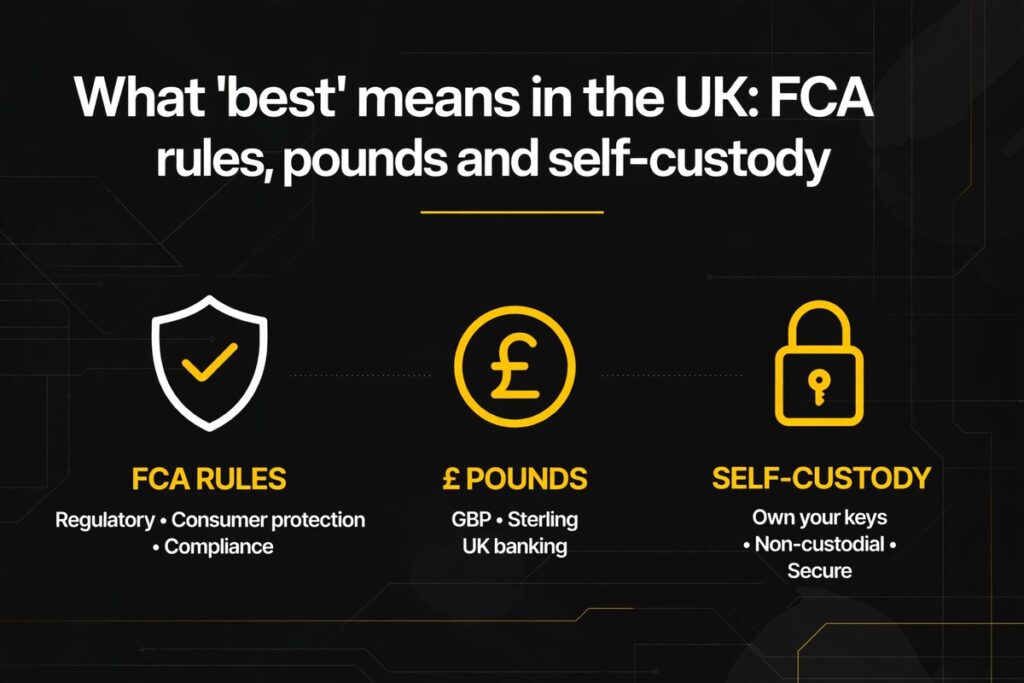
Before we rank anything, we need to talk about what “best” even means for a British user, because the UK is not just America with different weather. First, the regulatory backdrop. Under the FCA’s financial promotions regime for cryptoassets, which has applied to firms marketing to UK consumers since 8 October 2023, companies promoting crypto to you must carry clear risk warnings, drop misleading bonus offers and give first-time investors a 24-hour cooling-off period. That is why signing up to an exchange from London now feels slower and more lecture-heavy than it did a few years ago.
Here is the part people constantly get wrong, and I got it wrong myself at first: that regime regulates firms and exchanges marketing to you, not self-custody wallet software. When you download MetaMask or buy a Ledger, no FCA rule is approving or banning the wallet itself, because you are not being sold an investment by the wallet maker in the same way. A wallet is a tool for holding your own keys. That distinction is exactly why self-custody is so powerful in the UK right now, because your coins in your own wallet are not sitting on a platform whose promotions, solvency or sudden policy changes you have to worry about.
The second UK factor is tax, and I wish someone had drilled this into me in my first year. HMRC treat cryptoassets as property, not currency, so when you dispose of them, which includes selling for pounds, swapping one token for another and even spending them, you may owe capital gains tax on the profit. As Koinly’s guide to how HMRC taxes cryptocurrency in the UK explains, you get a £3,000 annual exempt amount, and above that the CGT rates are 18% or 24% depending on your income tax band. The one piece of mercy in the system is that moving crypto between your own wallets is not a disposal, so transferring from an exchange to your Ledger does not trigger a tax bill, as long as you keep the records to prove the coins were yours throughout.
Those records matter more than beginners realise. HMRC use Section 104 pooling, which means your coins of the same type are treated as one big pool with an average cost, and “the app deleted my history” is not an answer they accept. It is an unglamorous reason to choose a wallet with clean transaction exports, but the first time you file a return with a tidy CSV in hand, you will understand why I bang on about it.
Finally, “best” has to be measured in pounds and in daily friction. A free software wallet costs nothing but carries more risk for large sums, while a hardware wallet at around £69 buys a completely different level of protection. I judge every wallet on five things: who controls the keys, how painful the backup is, which chains it genuinely supports, what it costs in pounds and swap fees, and how likely a tired version of me is to make a mistake using it at midnight.
Best crypto wallets in the UK compared
I pulled this shortlist together from hands-on use and from cross-checking the big UK comparison pages, because prices and fee claims drift over time. If you want a second opinion, CoinLedger’s roundup of the best crypto wallets for UK users is one of the sources I checked prices and headline features against, and you will see the same names circling the top, which is usually a sign the shortlist itself is sane even if everyone orders it slightly differently.
| Wallet | Type | Approx. UK price | Best for | Key strength | Watch out for |
|---|---|---|---|---|---|
| Ledger Nano S Plus | Hardware | ~£69 | Long-term holding | Offline keys, huge coin support | No Bluetooth, small screen |
| Ledger Nano X | Hardware | Higher than S Plus | Holding plus mobile use | Bluetooth, bigger storage for apps | Costs more for convenience |
| Trezor Safe 3 | Hardware | ~£69 | Bitcoin-focused security | Open-source approach, simple backup | Fewer niche altcoins |
| Trezor Safe 5 | Hardware | Premium | Security with a better screen | Colour touchscreen, secure element | Price is hard to justify for small sums |
| Tangem | Hardware (card) | From ~£45 | Simple cold storage | Card format, no cables or charging | No seed phrase in the usual sense |
| Coinbase Wallet (Base app) | Software | Free | Beginners | Clean design, links to Coinbase account | Best inside the Coinbase ecosystem |
| MetaMask | Software | Free | DeFi and Ethereum | Connects to almost every dApp | Swap fees and network clutter |
| Trust Wallet | Software | Free | Multi-chain everyday use | 100+ chains in one app | Easy to approve the wrong contract |
| Exodus | Software | Free | Desktop plus mobile | Lovely interface, built-in portfolio view | Closed-source core, swap spreads |
| Zengo | Software | Free | People who fear seed phrases | MPC security, no seed phrase to lose | Recovery depends on their system |
Read the table as a map, not a verdict. The real divide is not brand versus brand, it is hot versus cold: the free wallets are connected to the internet, brilliant for doing things and risky for storing life-changing amounts, while the hardware wallets keep your keys offline, slightly annoying for doing things and exactly right for storing value. Most people who stay in crypto longer than a year end up with one of each. And treat every price as a guide to the tier rather than a promise, because retailers love a sale; what does not change is the shape of the decision, free and convenient or paid and properly secure.
Best for beginners: Best Wallet and Coinbase Wallet
Why your first wallet should be boring
When a friend asks me where to start, I never hand them the most powerful wallet first, because power is exactly what trips beginners up. Your first wallet should be boring in the best possible way: clear balances in pounds, obvious buttons, a backup process that explains itself in plain language, and very few ways to accidentally send money into the void. You can graduate to the complicated stuff later, and most people do, but your first month in crypto is about building confidence without an expensive lesson.
That is the lens I used for this section, and it is also roughly how the friendlier UK roundups frame it; Sterling Savvy’s guide to the best crypto wallet options in the UK puts the beginner-friendly apps near the top of its list for exactly this reason, because for a first wallet, ease of use is a security feature, not a compromise. A wallet you understand is a wallet you are far less likely to misuse at the exact moment it matters.
Best Wallet: everything in one app
Best Wallet is built for the person who wants one app that does a bit of everything: hold coins across multiple chains, swap inside the app and keep an eye on a portfolio without juggling five logins. I like its mobile-first design for beginners because the home screen answers the only question a new user really has, which is “what have I got and what is it worth?”, without burying the answer under developer menus. For someone coming from a normal banking app, that familiarity lowers the heart rate considerably.
Where I would counsel a little caution is the sheer amount going on inside it. An app that surfaces new tokens and launches is exciting, and excitement is a terrible financial adviser. Use it as a wallet first and an entertainment feed never: set up your backup properly, move a small test amount in, and ignore every shiny banner until you can explain what a seed phrase is out loud.
Coinbase Wallet: the gentle on-ramp I recommend most
Coinbase Wallet, which now lives inside the Base app, is the wallet I have personally talked the most beginners through, usually over the phone with a cup of tea going cold beside me. It is free, the design is calm, and the connection to a Coinbase exchange account makes the first transfer feel like moving money between two accounts you already own rather than defusing something. Because Coinbase’s UK platform operates within the FCA registration framework for cryptoasset firms, the overall experience will feel familiar to anyone who has already passed the risk warnings and cooling-off steps on the exchange side.
Its limits show up once you get adventurous. If your world becomes Solana memecoins one week and obscure layer-2s the next, you will bump into the edges of what it wants to do natively, and that is your signal to add a second wallet rather than replace the training wheels too early. I still keep it installed for its clean view of my Base and Ethereum</a assets, and because when a nervous beginner rings me, it is the wallet I can describe from memory.
Whichever of these two you pick, the beginner rules are the same and I will keep repeating them until they bore you: start with an amount you can afford to lose completely, write your recovery phrase on paper and never photograph it, and do one tiny test transaction before you move anything that matters. Boring, yes. Cheaper than the alternative, also yes.
Best for DeFi and multi-chain everyday use: MetaMask and Trust Wallet
MetaMask: the wallet the whole DeFi world assumes you have
MetaMask is less a recommendation and more a fact of life. Spend any time in DeFi and you will meet dApps and networks that simply assume you have that little fox in your browser or on your phone, and in my experience it still connects to more things, more reliably, than anything else I have tested. It is my main doorway into Ethereum and its layer-2s, and the ability to add custom networks means it grows with you instead of boxing you in.
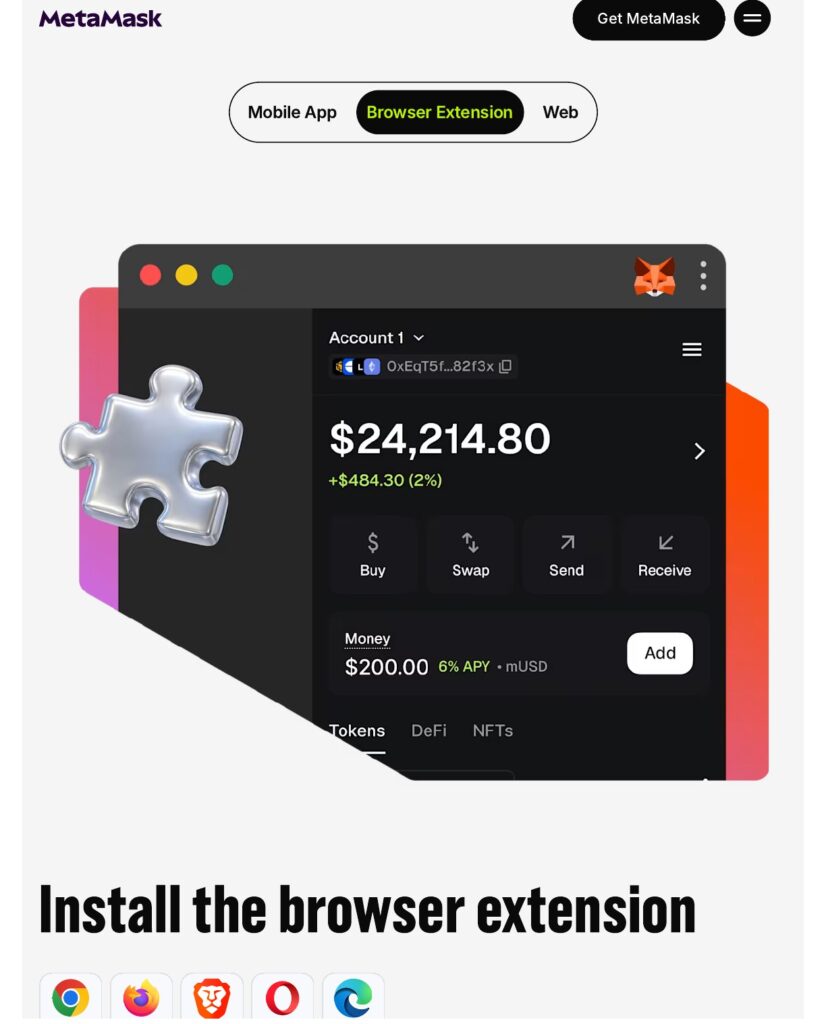
Let us talk about the cost, because MetaMask is free to download but not free to use heavily. Its built-in swap feature charges a 0.875% fee on top of whatever the network itself charges you in gas, and while that fee buys you convenience and decent routing, it adds up quietly if you swap often. My habit is to use MetaMask swaps for small, quick trades and to compare a dedicated exchange or aggregator for anything sizeable. I would also warn you that MetaMask’s openness is its danger: it will happily let you approve a malicious contract if you click without reading, and no wallet can protect you from your own hurry.
Trust Wallet: one app, a hundred chains
Trust Wallet is the one I suggest when someone says “I hold a bit of everything” and means it. It supports over 100 blockchains in a single free app, so your Bitcoin, your Solana, your BNB Chain tokens and your Ethereum bits can all live under one roof instead of across four wallets you forget the passwords to. The built-in dApp browser and staking options make it a proper everyday wallet rather than a vault, and I have found its token detection surprisingly good at surfacing things other wallets make you add by hand.
The flip side of holding everything in one place is concentration risk on a hot wallet: it lives on your phone, connected to the internet, guarded by your own approval habits. That is a reasonable setup for spending money and a poor one for your long-term stack. The moment a hot wallet balance makes you anxious to check your phone at 2 a.m., the excess belongs on hardware.
Which one lives on my phone?
Both, and I do not think that is a cop-out. MetaMask is my specialist tool for Ethereum and DeFi, in a separate browser profile I treat as a workbench; Trust Wallet is my general-purpose carry wallet for balances and smaller cross-chain moves. Splitting them also limits the blast radius if I ever do something stupid in one of them, which, over enough years, everyone eventually does.
Best for long-term security: Ledger and Trezor hardware wallets
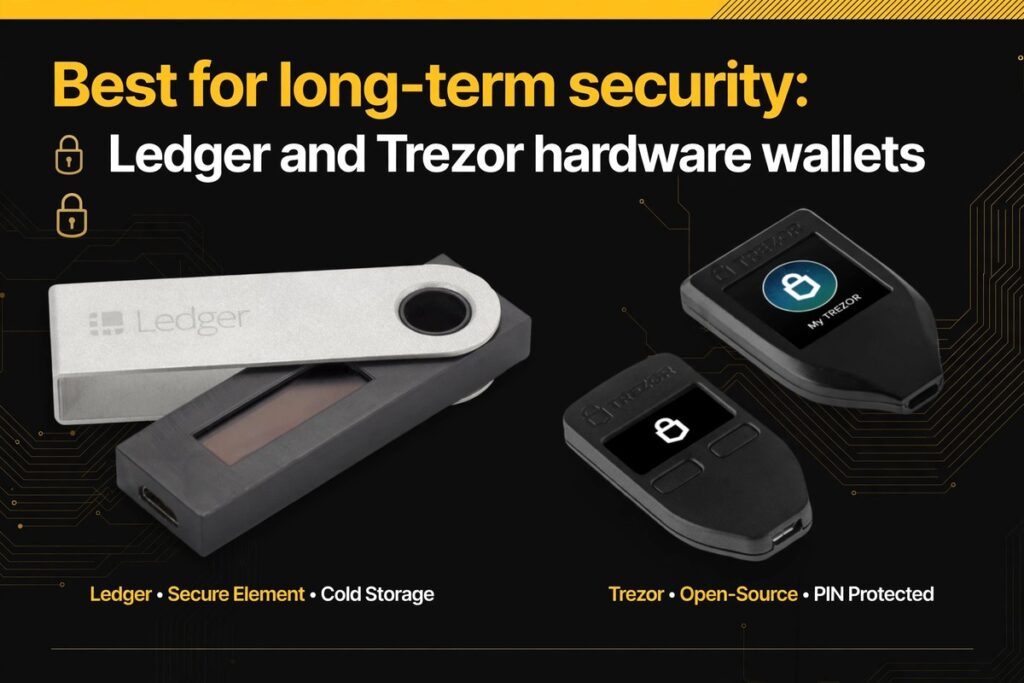
Why hardware changes the conversation
Everything changes when your private keys never touch the internet. A hardware wallet is a small device whose only real job is to hold your keys offline and sign transactions in isolation, so even if your laptop is riddled with malware, the thing an attacker needs is physically in your hand, asking you to press a button. The first time I moved a meaningful sum onto a hardware wallet, I slept noticeably better, and I do not think that was a coincidence or a placebo. It was the first time my crypto felt like it lived somewhere, rather than floating in accounts.
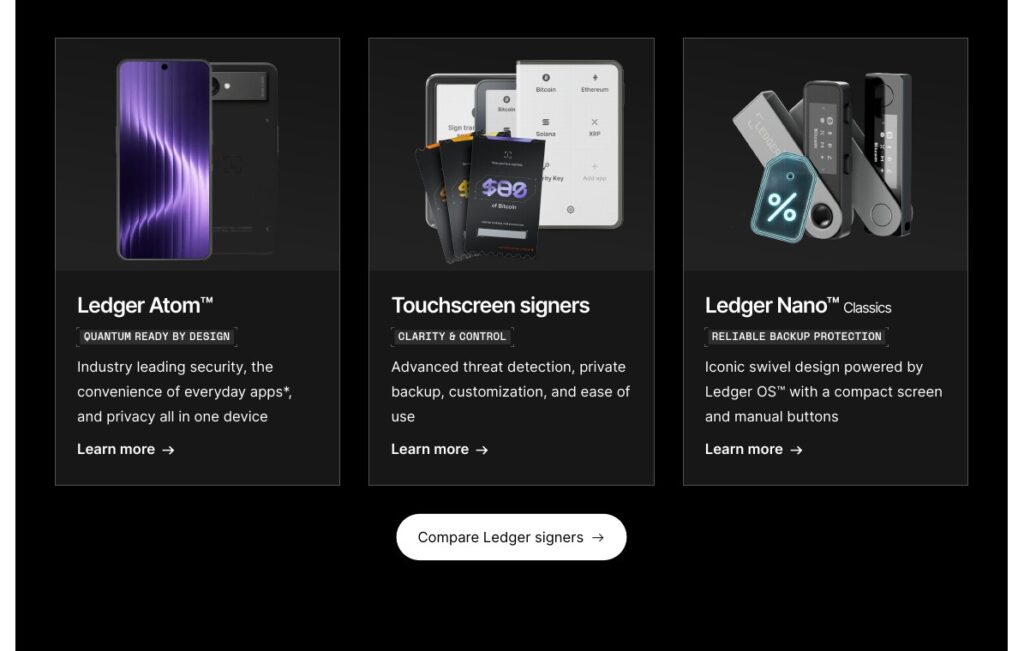
On price, the UK comparison pages put the sensible entry point at roughly the same level: Invezz’s UK guide to the best crypto wallets lists the Ledger Nano S Plus and the Trezor Safe 3 both at around £69, with Tangem’s card-style wallet from about £45. Proper cold storage now costs about the same as a decent meal out; if you hold four figures or more, that is the cheapest insurance in your portfolio.
Ledger: Nano S Plus and Nano X
The Ledger Nano S Plus is the device I recommend most often, because at around £69 it covers the essentials without charging you for frills: a secure element chip, support for thousands of coins and tokens, NFT handling, and enough app storage for most normal humans. It connects by USB-C, has no Bluetooth and no battery, which some people list as drawbacks and I quietly count as simplicity. Fewer radios, fewer moving parts, fewer things to charge before you can check your balance.
The Nano X is the one to pick if you will manage your crypto from your phone a lot, because it adds Bluetooth and more app storage, and the larger screen is kinder when you are verifying addresses, which you should be doing, character by character, every time. I own both; the X travels with me while the S Plus stays home as the vault. Buy either only from Ledger directly or an authorised retailer, never a marketplace seller offering a suspicious discount, because a pre-initialised device is one of the oldest scams in this industry.
Trezor: Safe 3 and Safe 5
Trezor Safe 3, also around £69, is the pick I suggest for the open-source-minded and the Bitcoin-first crowd. Trezor built its reputation on transparent, auditable code, and the Safe 3 added a secure element while keeping that philosophy, plus a backup system designed to be less terrifying for normal people. Its coin support is a touch narrower than Ledger’s at the exotic end, but for Bitcoin, Ethereum and the major networks, it wants for nothing, and its desktop suite is genuinely pleasant to use.
The Safe 5 is the premium sibling, with a colour touchscreen that makes confirming transactions feel less like operating a calculator from 1998. Is the screen worth the extra money? For a beginner who will verify addresses more carefully because the interface invites it, I would argue yes; for a confident Bitcoiner moving funds twice a year, the Safe 3 does the same core job for less.
How to set up your first UK crypto wallet, step by step
Setting up a wallet is a fifteen-minute job that people somehow stretch into a weekend of anxiety, so let me walk you through it the way I walk my friends through it, in order, with no step skipped. It works the same for a free app or a hardware device, because the bones of the process are identical. Pour a drink, close your other tabs, and do not do this on public Wi-Fi.
- Download or buy from the official source only. Get the app from the official app store listing linked from the maker’s own website, or order hardware directly from the manufacturer. Fake wallet apps with near-identical names are a real and profitable scam, and this one check defeats most of them.
- Create a new wallet and choose a strong PIN or password. This protects the app or device in front of you. It is not your recovery phrase, and confusing the two is a classic beginner muddle, so keep them mentally in separate boxes from the start.
- Write down your recovery phrase on paper, by hand. The wallet will show you 12 or 24 words, once. Write them slowly, in order, and check every spelling. Never type them into a website, never photograph them, never store them in cloud notes, email drafts or a password manager note “just for now”, because “just for now” is how phrases leak.
- Store the paper like it is money, because it is. Somewhere dry, private and memorable to you and nobody else. Many of us use a fireproof envelope at home; the truly committed stamp the words into metal.
- Fund it with a tiny test amount first. Send the smallest amount your exchange allows from your UK exchange account to your new wallet address, double-checking you have picked the right network, because sending on the wrong network is the most common way beginners lose money on day one.
- Wait, confirm, then send the rest. Once the test lands and you can see it in the wallet, repeat the transfer with the real amount. Yes, you pay a whisper more in fees. I have paid that whisper gladly ever since a friend of mine sent a four-figure sum to a correctly formatted address on the wrong chain.
- Turn on every protection the wallet offers. Biometric unlock, auto-lock timers, address whitelists where they exist, and transaction previews read properly rather than tapped through. Then note down, somewhere safe, which wallet holds what; future you, mid-tax-return, will be grateful.
If your wallet is a hardware device, there is one extra ritual I insist on: before you load serious money onto it, wipe it and restore it from your written phrase once, with a trivial amount at stake. The day you actually lose the device is the worst possible day to discover you wrote down word fourteen wrong. I did this with my first Ledger on my kitchen table, hands slightly shaking, and the calm it bought me has lasted years.
Common pitfalls and risks UK users run into
The seed phrase scams that never stop working
The most successful scam in crypto is embarrassingly simple: someone claiming to be support or a security team asks you to enter your recovery phrase into a page to “validate” or “secure” your wallet. There is no legitimate version of this, ever, from anyone. The moment those words go into a website or a chat window, your wallet is emptied within minutes, and no bank-style fraud team exists to reverse it. My phrase exists only on paper, and anything asking for it is a thief wearing a lanyard.
Wrong network, wrong address, wrong day
The second pitfall is self-inflicted and I have the scars to prove it. Crypto addresses are unforgiving: send to the wrong network, paste an address your clipboard malware has swapped, or rush a transaction at midnight, and the money is gone in a way that makes a mistyped bank transfer look gentle. This is why I verify the first and last characters of every address on my hardware device’s screen, why I test with small amounts, and why I never move money when I am tired or rushed. Most losses I have personally witnessed were not hacks. They were hurried humans.
Forgetting that HMRC counts swaps as disposals
The UK-specific pitfall that catches almost everyone is tax amnesia. People remember that selling to pounds might be taxable, then swap cheerfully between tokens all year, not realising each swap is also a disposal in HMRC’s eyes. As TaxAssist’s explanation of how cryptoasset investments are taxed in the UK sets out, gains are measured against that £3,000 annual exempt amount and taxed at 18% or 24% once you are over it, with your records doing the heavy lifting under the pooling rules. Export your records a couple of times a year while it is still easy.
Platform risk and promotion-driven decisions
Finally, remember why the FCA regime exists in the first place: the promotions crackdown was a response to real people buying volatile assets on the back of hype and keeping everything on one exchange because an advert made it look like a savings account. Leaving large balances on any platform means trusting its solvency, security and goodwill, all at once, forever. Self-custody does not remove risk, because you become the bank, but it changes the risk into one you can manage with paper, patience and a £69 device, and I will take a risk I control over a risk I merely hope about, every single time.
Knowledge graph: Key entities and relationships

I think in pictures, so here is the whole guide as one map. If any relationship below surprises you, that section is the one to re-read, because most expensive mistakes happen exactly where two of these entities meet.
ENTITIES
UK User --holds--> Cryptoassets (property, per HMRC)
UK User --controls via--> Private Keys --stored in--> Crypto Wallet
Crypto Wallet --type--> Hot Wallet (Coinbase Wallet, MetaMask, Trust Wallet, Exodus, Zengo, Best Wallet)
Crypto Wallet --type--> Cold Wallet (Ledger Nano S Plus, Ledger Nano X, Trezor Safe 3, Trezor Safe 5, Tangem)
Seed Phrase --unlocks--> Private Keys
Seed Phrase --must never be entered into--> Website / "Support" Chat

RELATIONSHIPS
FCA --regulates promotions by--> Exchanges and Firms --marketing to--> UK Consumers
FCA Financial Promotions Regime --in force since--> 8 October 2023
FCA Regime --does NOT directly regulate--> Self-Custody Wallet Software
UK User --buys crypto on--> FCA-Registered Exchange --transfers to--> Own Wallet (not a disposal)
HMRC --taxes--> Disposals (sell, swap, spend) --above--> GBP 3,000 Annual Exempt Amount
CGT Rates --are--> 18% / 24% (by income band)
Section 104 Pooling --governs--> Cost Basis Calculation
Hardware Wallet --keeps--> Private Keys Offline --reduces--> Hacking and Malware Risk
Hot Wallet --optimised for--> DeFi Access, Swaps, Daily Use
MetaMask --swap fee--> 0.875%
Trust Wallet --supports--> 100+ Blockchains
Frequently asked questions about crypto wallets in the UK
Do I actually need a separate wallet if I already have an exchange account?
Strictly speaking, no, and for a tiny amount you are actively trading, leaving it on a large, FCA-registered exchange is a defensible choice plenty of sensible people make. The case for a separate wallet grows with the amount and the time horizon: money held for months or years is exposed, on an exchange, to that platform’s solvency, security and account-freeze decisions, none of which you control. My threshold advice is this: while the sum is small enough that losing it would merely annoy you, convenience wins; the day it would genuinely upset you, move it to a wallet you control, ideally hardware.
Are crypto wallets legal in the UK, and does the FCA approve them?
Yes, holding your crypto in your own wallet is entirely legal in the UK, and no, the FCA does not approve individual self-custody wallets, because that is not how the system is built. The promotions regime, running since 8 October 2023, governs how firms market crypto to UK consumers; your wallet software is a tool you use yourself, not a promotion sold to you. The FCA does warn, usefully, that crypto is high-risk and largely unprotected, so if a wallet or platform goes wrong there is generally no Financial Services Compensation Scheme safety net underneath. Self-custody is legal, powerful and entirely on you, in that order.
How much tax will I pay on crypto in the UK?
It depends on your gains and your income, but the skeleton is simple enough to plan around. HMRC treat crypto as property, so when you dispose of it, by selling, swapping or spending, any gain counts towards your capital gains tax position for the year. You have a £3,000 annual exempt amount, and gains above that are taxed at 18% or 24% depending on your income tax band. Moving coins between your own wallets is not a disposal. Keep records of dates, values in pounds and fees as you go, because reconstructing a year of swaps from screenshots in January is a punishment I would not wish on anyone.
What happens if I lose my seed phrase or my hardware wallet breaks?
These are two very different disasters wearing similar coats. If your hardware wallet breaks or is stolen, nothing is lost as long as you have your recovery phrase, because the phrase is the wallet in every way that matters; you buy a new device, restore from the words, and your coins are exactly where you left them. If you lose the phrase itself, and the device then fails too, there is no recovery, no helpdesk and no appeal, and I cannot soften that sentence because softening it would be a lie. Store the paper like a bearer asset, consider a second copy in a second secure place, and test your restore once while the stakes are trivial.
How much should I spend on a hardware wallet?
Less than you fear, and only once. The sensible UK entry point sits around £69 for a Ledger Nano S Plus or a Trezor Safe 3, with Tangem’s card from roughly £45, and premium models like the Safe 5 or Nano X charging more for screens and Bluetooth rather than fundamentally stronger protection. My framing for friends is a percentage one: if the device costs less than one or two percent of what it protects, it is basic hygiene, not a luxury. If your total holding is £150, a free software wallet and excellent habits will serve you fine while you learn; buy the hardware when the numbers start to matter, and only from the manufacturer, never second-hand.
Final verdict
If you have read this far, you know my answer is a small decision tree rather than a crown, so let me make it as short as I honestly can. New to crypto, holding a little, mostly curious? Install Coinbase Wallet or Best Wallet tonight, move a test amount, and learn the ropes with money you can afford to treat as tuition. Living in DeFi? MetaMask for the Ethereum world, Trust Wallet for everything else, and keep only working balances in either. Holding an amount that would change your year if it vanished? Stop reading comparison pages, spend roughly £69 on a Ledger Nano S Plus or a Trezor Safe 3, and move your stack offline this week.
My own money follows exactly that split: hardware for the holdings, a hot wallet for the doing, and an exchange account used as a doorway rather than a home. It is not the most exciting setup at a dinner party, but excitement is not what I am buying with a wallet; I am buying the ability to ignore crypto for a fortnight without a low hum of anxiety, and to file my taxes without detective work. I buy through firms operating under the FCA’s promotions regime, I custody the serious money myself, and I keep records HMRC would find boringly adequate.
Whatever you choose, choose the backup habits with it, because in ten years of watching people in this space, I have seen far more money lost to lost phrases, rushed transfers and convincing scammers than to any wallet on this list failing. The best crypto wallet in the UK is, in the end, the one whose keys you control, whose phrase you have written down properly, and whose balance you have matched to the right level of security. Pick from the shortlist, set it up slowly, and then go and live your life; that, more than any brand name, is the whole point.